| Author |
Message |
staceyz
Samba Member

Joined: December 05, 2002
Posts: 497
Location: Vancouver, BC

|
 Posted: Sat Jun 12, 2010 10:06 pm Post subject: Vent window strike plate installation... any tips? Posted: Sat Jun 12, 2010 10:06 pm Post subject: Vent window strike plate installation... any tips? |
 |
|
Has anyone tried to install the vent window strike plate with the rivets from Wolfsburg west? I made a little "L" shaped bracket, put it in the vise so I had a surface I could pound the rivets on. (as the head of the rivet is in the door frame) I've pounded till I'm blue, but the strike plate still rattles in the frame and I can't seem to get it tight. Any advice? Thanks in advance...
_________________
Wanted: Old Martin or Gibson Guitars |
|
| Back to top |
|
 |
shano63 
Samba Member

Joined: October 06, 2006
Posts: 3646
Location: Stormville NY
|
|
| Back to top |
|
|
staceyz
Samba Member
Joined: December 05, 2002
Posts: 497
Location: Vancouver, BC
|
| Posted: Sun Jun 13, 2010 9:17 am Post subject: |
|
|
That link would help if I was interested in installing the vent window seal. I'm installing the vent window latch PLATE. The plate get riveted into the window sliding frame.
_________________
Wanted: Old Martin or Gibson Guitars |
|
| Back to top |
|
|
shano63
Samba Member
Joined: October 06, 2006
Posts: 3646
Location: Stormville NY
|
| Posted: Sun Jun 13, 2010 2:00 pm Post subject: |
|
|
If you go to the 3rd page 6th post down (Everett's) it shows a link to replace the latch. Should've said that originally..
_________________
63 T1 Ragtop Gulf Blue
20 Toyota Corolla 6spd
22 Wrangler 6spd
78 F250 4x4 4spd
Chris
Take it as it comes-- Morrison |
|
| Back to top |
|
|
67SingleCabGuy
Samba Member
Joined: August 27, 2003
Posts: 193
|
| Posted: Sun Jun 13, 2010 2:18 pm Post subject: |
|
|
I'm also hoping someone will chime in for later reference. I searched a couple of months ago when I purchased the latch plate from WW and the rivets but when I couldnt find an answer and saw how tight the originals were held on I just cleaned the old ones up and left them on.
I couldnt imagine getting the new rivets as tight as the original ones as the plate needs to be on there solid for the window to latch. There must be some kind of tool out there that someone may be aware of.
Maybe if you capitalize the whole part "VENT WINDOW LATCH PLATE" Chris will finally read your whole post and figure out your not talking about the LATCH.  |
|
| Back to top |
|
|
shano63
Samba Member
Joined: October 06, 2006
Posts: 3646
Location: Stormville NY
|
| Posted: Sun Jun 13, 2010 3:15 pm Post subject: |
|
|
 Did read the whole post, just didn't click... Did read the whole post, just didn't click...
_________________
63 T1 Ragtop Gulf Blue
20 Toyota Corolla 6spd
22 Wrangler 6spd
78 F250 4x4 4spd
Chris
Take it as it comes-- Morrison |
|
| Back to top |
|
|
staceyz
Samba Member
Joined: December 05, 2002
Posts: 497
Location: Vancouver, BC
|
| Posted: Sun Jun 13, 2010 3:29 pm Post subject: |
|
|
Subliminal message..PLATE, PLATE, PLATE...plate..PLATE!!!
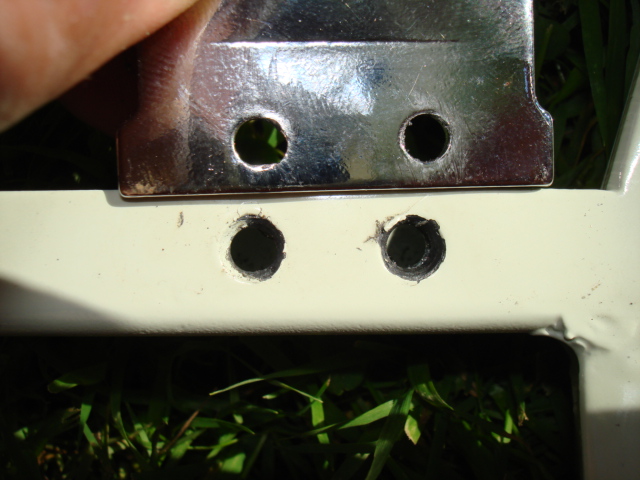
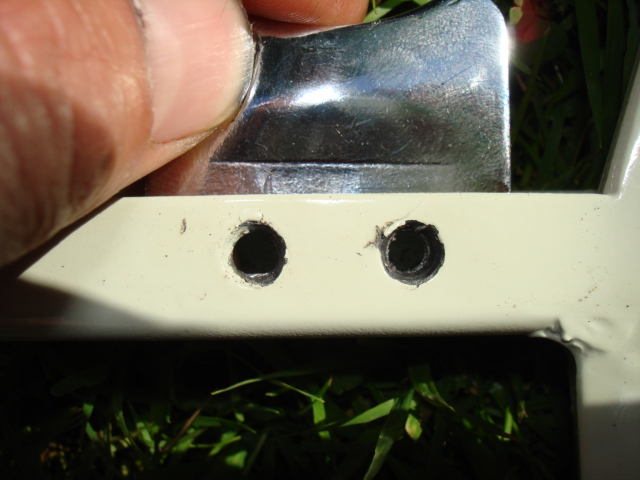
OK, here is some photos of what I thought would be an ideal installation, but it did fail, I can't get the plate tight in the frame. I did a test on a old window and a pop rivet works fine, but I'm trying to do it stock since the parts are available...
So here is the little "L" shaped piece of steel with a couple divets drilled in to hold the rivet, the "L" shape allow a solid piece of steel to get into the channel of the window frame as the head of the rivet needs to be on the inside of the frame.
Here is the frame with rivet resting on the "L" shaped piece.. ready for a pounding...!
Here is the finished, failed product, the rivets, although they seem to be quite long, do flatten out pretty flat, but the striker plate still rattles and isn't locked in tight
Any other ideas?? I wonder what they did at the factory.
A pop rivet from the outside does work, but it will make a fatter head that will poke out from under the vent seal. [/url]
_________________
Wanted: Old Martin or Gibson Guitars |
|
| Back to top |
|
|
rubber hammer
Samba Member
Joined: January 04, 2009
Posts: 77
Location: Edgemont South Dakota
|
| Posted: Sun Jun 13, 2010 4:56 pm Post subject: |
|
|
| The holes look too big for the rivet. |
|
| Back to top |
|
|
Snoop Bob
Samba Member
Joined: May 06, 2003
Posts: 2687
Location: Florida
|
| Posted: Sun Jun 13, 2010 5:47 pm Post subject: |
|
|
| rubber hammer wrote: |
| The holes look too big for the rivet. |
Agreed.
_________________
| BarryL wrote: |
| Put your lips onto the little tit with the hole in it inside and make a good seal. You can suck and blow but with a little resistance. It gets better after it's wet. |
| EverettB wrote: |
| I would be interested in knowing the sizes of the various shafts. |
|
|
| Back to top |
|
|
staceyz
Samba Member
Joined: December 05, 2002
Posts: 497
Location: Vancouver, BC
|
| Posted: Sun Jun 13, 2010 6:23 pm Post subject: |
|
|
The photo might have an optical illusion, the actual holes in the frame match the striker plate exact, the rivet fits in nicely with a tiny bit of wiggle room.
_________________
Wanted: Old Martin or Gibson Guitars |
|
| Back to top |
|
|
Snoop Bob
Samba Member
Joined: May 06, 2003
Posts: 2687
Location: Florida
|
| Posted: Sun Jun 13, 2010 6:31 pm Post subject: |
|
|
No wiggle room would be better. I believe there is a pneumatic tool that you can use for that, or maybe it was something you make with a c-clamp...If I recall it is specifically something used on pinball game repair.
_________________
| BarryL wrote: |
| Put your lips onto the little tit with the hole in it inside and make a good seal. You can suck and blow but with a little resistance. It gets better after it's wet. |
| EverettB wrote: |
| I would be interested in knowing the sizes of the various shafts. |
|
|
| Back to top |
|
|
BeeDubyaBugz
Samba Member

Joined: March 16, 2007
Posts: 129
Location: Colorado
|
| Posted: Sun Jun 13, 2010 9:32 pm Post subject: |
|
|
hi,
when we fixed my strike plates with new ones, we had the same issues so we took an air chisel tool, ground down the sharp edged point to a flat one, dropped the air pressure, and then wedged a piece of metal into the frame to hold the rivet. it worked great. They are nice and tight. It works good to have one person hold the frame and metal wedge as well as a person to run the air chisel. You just have to be careful that it doesn't slip and gouge the frame. Hope this helps. |
|
| Back to top |
|
|
ToolBox
Samba Member

Joined: January 27, 2004
Posts: 3445
Location: Detroit, where they don't jack parts off my ride in the parking lot of the 7-11
|
| Posted: Mon Jun 14, 2010 8:56 am Post subject: |
|
|
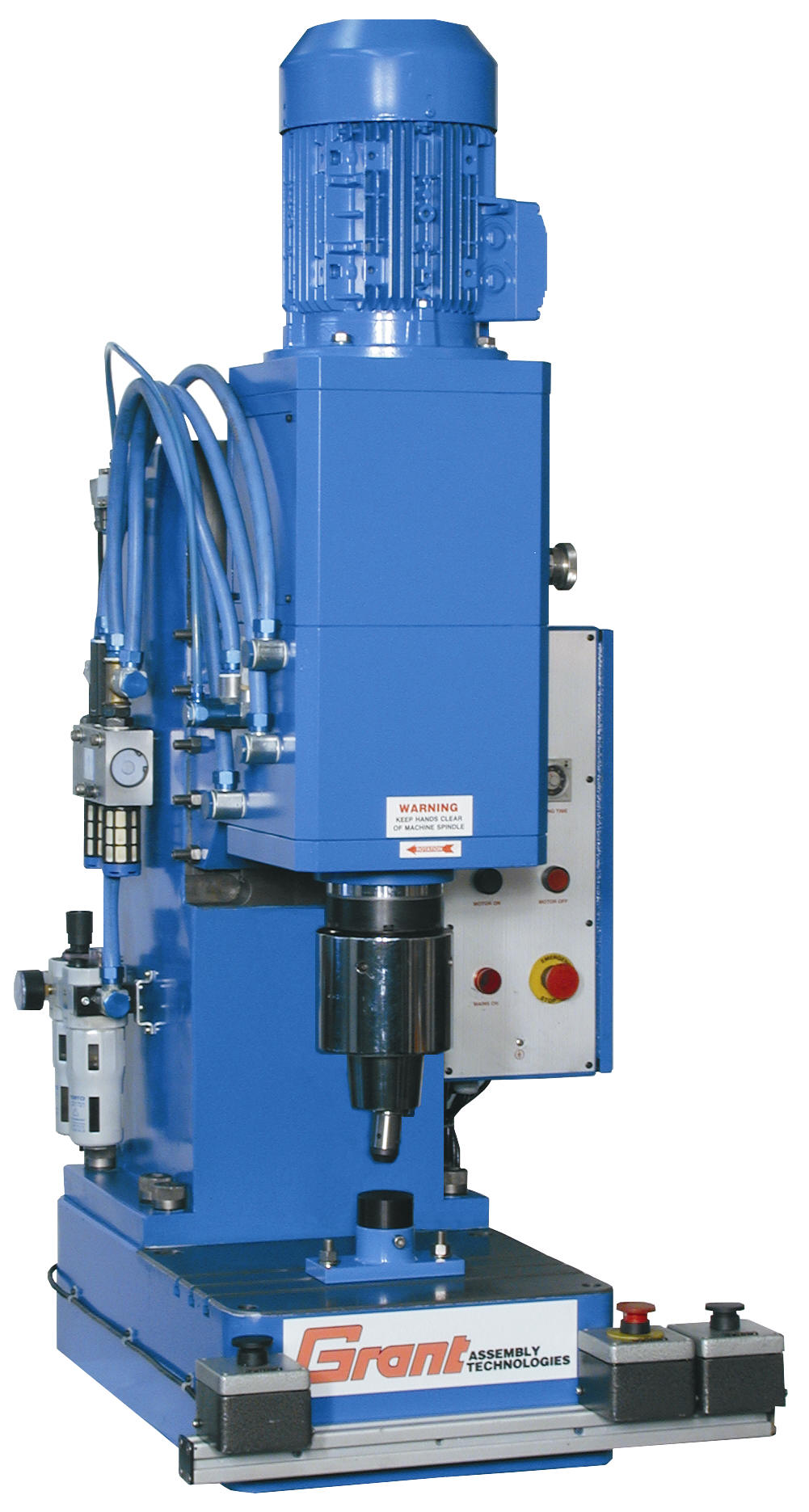
The production way of doing it would use an orbital rivet machine. It would take about 5 seconds to do each of the fasteners.
| Orbitalriveter.com wrote: |
| Orbital Forming is also commonly used in producing heads on rivets, pins, or posts. Orbital tools are composed of a rotating tool holder and a shaped tool insert. The axis of the tool insert has a definite angular relationship to the axis of the tool holder. The forming end of the insert is located at the intersection of these two axes. The insert does not rotate when in contact with the work piece, and as a result, describes a concentric, conical path…. very much like a top beginning to run out. The rivet or pin being worked, is "set" by a combination of pressure, high speed spinning action of the holder, and conical rotary motion. The operation is quiet and produces joints and heads of high quality, at high cycle speeds. Design of tools can be adapted to work in close quarter. Orbital tools can be adjusted to produce a tight or loose assembly, and lubricants may be required for a better finish. Orbital tooling is generally set up to produce extremely tight assemblies where no movement is acceptable. The disadvantage of the orbital forming process is that the initial tool holder is relatively expensive. However, tool inserts - although more expensive than Twin-Spin rolls- have excellent life. The grain structure of orbital formed heads is not of the quality obtained with Twin-Spin rolls and radial forming. The rivet or pin being worked in an orbital form technique, can not be headed without deformation of the shank under the formed head. The cosmetic's are generally very good. |
|
|
| Back to top |
|
|
busdaddy
Samba Member

Joined: February 12, 2004
Posts: 53181
Location: Surrey B.C. Canada, but thinking of Ukraine
|
| Posted: Mon Jun 14, 2010 9:22 am Post subject: |
|
|
Yep, unfortunately you're trying to duplicate a process using the wrong tools. Those holes are far too big to upset a rivet into using hand or pneumatic processes. You could try annealing the rivet first (depends on the alloy) but unless you can find the machine Toolbox posted you'll never get it perfect.
Another option would be to use oversized rivets that fit the holes snugly and turn down the heads to match the size of stock rivets, you'll still have to play with the length to get it to fill the taper on the outer edge and end up flush.
_________________
Rust NEVER sleeps and stock never goes out of style.
Please don't PM technical questions, ask your problem in public so everyone can play along. If you think it's too stupid post it here
Stop dead photo links! Post your photos to The Samba Gallery!
Слава Україні! |
|
| Back to top |
|
|
staceyz
Samba Member
Joined: December 05, 2002
Posts: 497
Location: Vancouver, BC
|
| Posted: Mon Jun 14, 2010 10:22 am Post subject: |
|
|
How would you annealing the rivet, heat it up with a blow torch till it is red (I think the rivet is made of steel)
_________________
Wanted: Old Martin or Gibson Guitars |
|
| Back to top |
|
|
busdaddy
Samba Member
Joined: February 12, 2004
Posts: 53181
Location: Surrey B.C. Canada, but thinking of Ukraine
|
| Posted: Mon Jun 14, 2010 10:37 am Post subject: |
|
|
You'll have to find out what it's made of, is it magnetic? does it make sparks when you grind it?, if it does are the sparks big and fly far or light and feathery?, etc.... Google is likely your friend with that job. Then search online for the method to anneal what you think it is. Some metals and alloys require heating to a fairly exact temperature, holding at that temp for a certain time and cooling in a specific manner and speed.
Or go buy some rivets with a specific alloy, aluminum is the easiest to work with but can corrode fast when paired up against mild steel.
_________________
Rust NEVER sleeps and stock never goes out of style.
Please don't PM technical questions, ask your problem in public so everyone can play along. If you think it's too stupid post it here
Stop dead photo links! Post your photos to The Samba Gallery!
Слава Україні! |
|
| Back to top |
|
|
hugheseum
Samba Member

Joined: February 11, 2004
Posts: 2690
Location: oregon
|
| Posted: Mon Jun 14, 2010 1:48 pm Post subject: |
|
|
ive never taken pics,but i like to shorten the rivets and tig weld them to the frame from the inner channel prior to paint,i know its not factory,but it works very well..............with a tig you can be very tidy in a small area................it absolutely sucks to try and put it together after paint,careful taping of the plate at paint time and presto.......the latch is fitted.......best of luck
_________________
Have a great day! |
|
| Back to top |
|
|
slow36hp
scott wimberley

Joined: August 09, 2004
Posts: 3113
Location: mukilteo washington
|
|
| Back to top |
|
|
staceyz
Samba Member
Joined: December 05, 2002
Posts: 497
Location: Vancouver, BC
|
| Posted: Tue Jun 15, 2010 10:03 am Post subject: |
|
|
So are all the repro rivets too short? or just the ones from Wolfsburg West?
_________________
Wanted: Old Martin or Gibson Guitars |
|
| Back to top |
|
|
monkey knuts
Samba Member

Joined: April 10, 2003
Posts: 60
Location: UK
|
| Posted: Mon Jan 02, 2012 7:58 am Post subject: |
|
|
| ToolBox wrote: |
The production way of doing it would use an orbital rivet machine. It would take about 5 seconds to do each of the fasteners.
| Orbitalriveter.com wrote: |
| Orbital Forming is also commonly used in producing heads on rivets, pins, or posts. Orbital tools are composed of a rotating tool holder and a shaped tool insert. The axis of the tool insert has a definite angular relationship to the axis of the tool holder. The forming end of the insert is located at the intersection of these two axes. The insert does not rotate when in contact with the work piece, and as a result, describes a concentric, conical path…. very much like a top beginning to run out. The rivet or pin being worked, is "set" by a combination of pressure, high speed spinning action of the holder, and conical rotary motion. The operation is quiet and produces joints and heads of high quality, at high cycle speeds. Design of tools can be adapted to work in close quarter. Orbital tools can be adjusted to produce a tight or loose assembly, and lubricants may be required for a better finish. Orbital tooling is generally set up to produce extremely tight assemblies where no movement is acceptable. The disadvantage of the orbital forming process is that the initial tool holder is relatively expensive. However, tool inserts - although more expensive than Twin-Spin rolls- have excellent life. The grain structure of orbital formed heads is not of the quality obtained with Twin-Spin rolls and radial forming. The rivet or pin being worked in an orbital form technique, can not be headed without deformation of the shank under the formed head. The cosmetic's are generally very good. |
|
lol, oh my!
This is one of those processes that surly must be encountered time and time again on a resto yet there seems to be no solution other than welding pre paint 
anyone save me from wrecking my fresh painted frames and another trip to the expensive paint shop??? |
|
| Back to top |
|
|
|