| Author |
Message |
raygreenwood
Samba Member
Joined: November 24, 2008
Posts: 23536
Location: Oklahoma City

|
 Posted: Fri Nov 12, 2010 3:21 pm Post subject: Posted: Fri Nov 12, 2010 3:21 pm Post subject: |
 |
|
| Amazing....it is so rarely the ECU. Excellent! Ray |
|
| Back to top |
|
 |
Tram
Samba Socialist

Joined: May 02, 2003
Posts: 23022
Location: Northwest of Normal
|
| Posted: Fri Nov 12, 2010 3:14 pm Post subject: |
|
|
| emitor81 wrote: |
It must not have been the original pressure sensor. The epoxy on the Allen slot was in tact and just now is messed with.
I was hesitant but I messed with it. I marked the original point and kept track of direction and amount of turns. I first got it to run and keep running by pouring fuel in. It stayed half on then I made my adjustment. It didn't do much at 1/4 then I kept going and at full turn ccw it smoothed out.
Thank you all for any input provided. I've learned heaps about this system. I'm not done with it or with you guys but I think maybe this thread has been answered and done.
So I thought it was the computer but it turned out to be a wire to one of the heat sensors that kept the comp from sending juice to the injectors. (check the comp wiring for continuity). Then I had a lean condition which turned out to be because of the pressure sensor. Still not sure if it's the one my car should have but the adjustment (rich ccw) has it running. |
Excellent.  Your part number suffix on the MAP should match the ECU. If it does, all is good. Your part number suffix on the MAP should match the ECU. If it does, all is good.
_________________
Немає виправдання для війни! Я з Україною.
| Bryan67 wrote: |
| Just my hands. And a little lube. No tools. |
Those who can- do.
Those who can't? Subaru. |
|
| Back to top |
|
|
emitor81
Samba Member
Joined: June 02, 2009
Posts: 31
Location: CA
|
| Posted: Fri Nov 12, 2010 3:06 pm Post subject: |
|
|
It must not have been the original pressure sensor. The epoxy on the Allen slot was in tact and just now is messed with.
I was hesitant but I messed with it. I marked the original point and kept track of direction and amount of turns. I first got it to run and keep running by pouring fuel in. It stayed half on then I made my adjustment. It didn't do much at 1/4 then I kept going and at full turn ccw it smoothed out.
Thank you all for any input provided. I've learned heaps about this system. I'm not done with it or with you guys but I think maybe this thread has been answered and done.
So I thought it was the computer but it turned out to be a wire to one of the heat sensors that kept the comp from sending juice to the injectors. (check the comp wiring for continuity). Then I had a lean condition which turned out to be because of the pressure sensor. Still not sure if it's the one my car should have but the adjustment (rich ccw) has it running. |
|
| Back to top |
|
|
raygreenwood
Samba Member
Joined: November 24, 2008
Posts: 23536
Location: Oklahoma City
|
| Posted: Wed Nov 10, 2010 2:11 pm Post subject: |
|
|
Tram....No one is saying the books are wrong at all.
What is fact...is that the books say exactly what was known in about 1972 for D-jet.....which was that if you keep everything exactly stock and factory spec and bring it right back to"book" settings....and replace the part(s) that are bad with a new one of exact factory spec.....of course it will run.
The problem is this...and in a different thread Jake Raby quoted it quite eloquently about 10 days ago....stock is dead. There is no such thing as stock anymore. I fully agree.
Its been ages since you could exactly get something back to stock. NOS parts are drying up, heads are on their 3rd, 4th and 5th rebuilds. Piston and crank and cam specs are not what they were.
This changes everything.
You want to play with bone, NOSstock and nothing else and you have an endless supply of parts with a factory fresh harness...go for it. I stopped running around gnashing my teeth about 20 years ago.....looking for the dead on bone stock part # of MPS to match each ECU for my 411's and 412's.
It may seem easy to find NOS parts now...simply because we have teh internet. Not having that 20+ years ago.....there were no new parts...and zilch for interchange information.
The only way I even learned of interchanges within MPS's wre this....in order:
(1) A few knowledgable dealer reps at some of the last local VW dealers around me when I was in high school. They were the first to tell me of interchanges and alternate calibrations within part #'s of MPS's. They were the first to describe the "paint marks" on alternate calibrations. They could never produce a list or micro-fiche for me. They simply said....and this was 1978-1980....that when a customer brought in a D-jet injected car that would not claibrate and run properly when all else was well....they would call it in to Germany and an alternate paint code MPS would be shipped (typically 3-weeks).
These were the first people to twig me to the fact that a single adjustment MPS for any year of type 3 were functionally identical. They are just produced (in minor detail only)...slightly differently.
The early slotted screwdriver type one like 311 906 051 B (0 280 100 001)...were prone to leakage around the 0-ring on the adjusting screw. The design variation that fixed that is what you find on the 311 906 051 E (same unit as both 0280 100 106 and 0280 100 116....all the same exact unit). The later allen wrench design...is the same exact unit save for the allen wrench adjsuter and the way the aneroid chamber mounts. It was less prone to vacuum leakage....and much harder to tamper with by owners.
(2) Oddly enough...the second hint of cross-matchability...as I noted...was in Muirs book. Other than that list, John Muirs book is a decoration.
(3) In those days....I had rows of type 3's and type 4's in my local junkyard. No one wanted them. I bought all of my MPS's to experiemnt with...out of a 55 gallon drum of them...for $5 each.
Not knowing they were expensive parts...because they were generally unavailable except by sepcial order....I bought buckets of MPS and dissected many of them.....and drove on most of them....and adjusted all of them. It took me damn near 5 years of playing just to figure out exactly how the late model diaphram MPS actually works inside...because for so long I was afraid of destroying them by taking them too far apart.
After I found quite a few that had gotten wet and were obviously dead.....I was no longer afraid to take them apart.
From this point on...It was easy to figure out why these are recalibrate-able and are easily cross matched..as long as you generally stay within the type...diaphram or non-diaphram....that your car uses.
What I found is that with calibration...you did not have to stay bone stock (except cam timing and valve overlap....because the MPS's can be adjusted. There are limits. The earlier they are...the more limited their adjusting range is.....which is how I found out that you can also use a diaphram type on a non-diaphram model....you just cannot replace the function of the pressure switch with it.
Again...notsaying that teh factory method and staying exactly to it ...does not work. I have never said that. What I am saying...is that you are in know way limited to the factory parts list....once you learn how these parts work. RAy |
|
| Back to top |
|
|
Tram
Samba Socialist
Joined: May 02, 2003
Posts: 23022
Location: Northwest of Normal
|
| Posted: Wed Nov 10, 2010 1:19 pm Post subject: |
|
|
| raygreenwood wrote: |
| Tram wrote: |
| raygreenwood wrote: |
| Tram wrote: |
| raygreenwood wrote: |
| way out west wrote: |
| raygreenwood wrote: |
| One nice thing about the early type MPS that you have (whether its the correct one or not)...is that it only has one adjustment. That allen wrench in the back....if you turn it outward...it gets richer. Inward is leaner. Make adjustments only when fully wramed up...and only about 1/8th to 1/10th turn at a time. kark where it starts. |
Ray, are you sure we're looking at the single-adjustment-type (early) MPS here? Claire's is the "B" model, and it has a slot screw, not a socket screw, and emitor81 states that he has an "E" model:
| emitor81 wrote: |
ok so it seems my MAP sensor is missing the black cap I read about in the FI sticky.
Though, it doesn't seem to have been messed with. the screw doesn't seem to have been moved. #s on the case are 0 280 100 106 & 311 906 051 E
|
|
I am 1000% sure that we are...in this picture...looking at a single adjustment model of MPS (the internal stop does not count...its not adjustable on this model).
Be clear about what we are speaking of here. You have single non-diaphram type MPS's...with an allen wrench adjusting screw and with a SMALL....slotted screw.
By small...I mean about a slot about 8mm wide. The adjusting screw is roughly 8-9mm in diamter.
Whether you have an allen wrench adjustment screw or an 8-9mm slotted screw.....aside from small differences in the mounting of the aneroid barometric chambers, and main armature suspension inside............BOTH OF THEM ARE SINGLE ADJUSTMENT MPS's.
However...if your MPS has a slotted screw in the back that is about 15mm in diameter....it is a "DIAPHRAM" type MPS.....that means it has an extra copper diaphram that the other type of MPS has, an external vent hole/slot (sometimes two) that the other one does not....and two more adjustments.
In fact....on the small adjusting screw, non-diaphram or the allen wrecnch model MPS....the slotted screw and the allen wrench actually adjust a totally different setting than the later diaphram type unit with the 15mm screw does.
On the non-diaphram type.....the adjustment you see directly adjusts main fuel imxture by moving the armature rod in and out of the coil.
On the late model diaphram unit...the 15mm screw ...adjusts the outer stop for teh full load enrichment diaphram. The main fuel mixture armature adjustment is a very small 3.5mm screw underneath that outer 15mm screw.
Regardless at the moment for whether I am right or wrongon which system should be in that car.....I will see if I can post some pictures tonight of the differences in construction in the three main types of MPS...so everyone can see them. Ray |
Ray- 4MM Allen head adjusting screw plus serrations along the edge of the "snout" to hold the black plastic cover = late model "E" MAP.
1000% sure plus 10. Early A/B MAPS never had an Allen or a plastic cover. They also never had an "E" part number as the OP says his has.
Surrender, you dolt! You're surrounded!  |
The letter code does NOT code it to a particular ECU directly....as according to text...E code ECU's also fit with D code MPS. Yes..I know early A/B maps never had an allen screw. They have a screwdriver slot in an 9mm screw...and no copper diaphram inside. And....it makes no difference. They are both SINGLE ADJUSTMENT MPS....that means load on barometric chambers only...no full load stop and no internal stop
What does your answer have to do with the last question.
The last question was....
Ray, are you sure we're looking at the single-adjustment-type (early) MPS here? Claire's is the "B" model, and it has a slot screw, not a socket screw, and emitor81 states that he has an "E" model:
Yes....the MPS in the picture...regardless of the part # and letter code...is a [/b]SINGLE ADJUSTMENT TYPE MPS
We can all get hung up about A's, B's C's and E's......but it makes no difference. Early A's with flate blade screwdriver slots....and late model E's with single adjsutment allen screw...are functionally 100% identical....and with only minor variations to three internal parts...are identical in function and adjustment.
These parts are:
(1) the suspension bearing system for the main armature...whoop-de-doo....makes no difference other than longevity
(2) The main armature load spring length....short or long.....makes no real difference just a change of adjustment
(3) The mounting sytem foe the internal aneroid cans...the allen screw method has the cans mounted to the allen screw itself. the screwdriver slot methods are supsended between armature and screw and can fall out.
Funtionally there are only two types of MPS:
(1) Copper Diaphram type with 3 internal adjustments and 15mm screw adjustment
(2) Single adjustment with EITHER allen screw or flat blade screw...makes no difference whatsoever.
Within both groups...the minor details make no difference whatsoever. All of these in both groups can be made to run on ANY engine within that group with minor adjustments.
The issue here....is what ECU # he has...and what part #'s of MPS are designed to run with it.
According to too many books...E series (and C) ECU uses a 311 906 051D MPS. Ray |
I don't know what books you're getting this info from... nothing in my universe! That includes VW, Mercedes, and Volvo.
As to the type of MPS "not making a difference"... ask Mike Fisher how his '69 runs now that his incorrect "C" MAP has been switched for the proper "B".
Ray, you're a smart guy but you better check yoself before you wreck yoself on this one... Just sayin'... |
Don't have the books in front of me....but doesn't a "B" use an external pressure switch....and doesn't a "C" use a diaphram?
Ah...my bad...."C" was a typo on my part I meant to say "B"
A diaphram type mps will not work with a system that has electrical plumbing for an extrenal pressure switch?
Sorry guys...I have a class full of students in this week from 7:00 am to 7:00 pm...so I get only a few minutes to type.
And...I stand by what I said about the DETAILS of a MAP not making a difference.
I did not say the TYPE...of MAP was not important. If you are going to complain about what I say and quote it back....get it right.
I said....there are two different types of MAP...diaphram...and non-diaphram...period.
Across those two types....100% of all of the coils, barometric chamber pressures and armature rods.....are the same.
I can take the coil section with short spring or long spring from a late model type 4 or type 3 diaphram type MPS....and bolt it right up to an early style non-diphram unit...of any type. With readjustment...it works just fine ....because there is "0" diference in the coil sections of any MPS's ever made.
Yes...there are perhaps 5 different poppet valve designs. You can find all of them within any given part # of MPS over the years. It was a constantly improving piece of the MPS that helped to delay the re-establishment of excessive vacuum after the throttle snaps closed from part throttle.
Yes..there were two different designs of mounting for the aneroid barometric chambers....but the contents (pressure within the chambers) and performance of ALL of them was identical. They swap right out...other than from non-diaphram to diaphram type. Its just an adjustment difference.
There are two different types of suspension for the armature rod....early....non ceramic bearing type and late ceramic bearing type.
If you order a replacement MPS for a B type that may have originally come from the factory with non-ceramic bearings....the late make of an early model MPS will come with all of the improvements inside......late poppet valve type and late armature bearing type.
There were two different armature spring lengths. You can easily find both used within the same part #.....on the same vehicle. It changes repsonse slightly....just another adjustment.
To this point.....everything I just described above.....is ALL part of the Coil section of the MPS (section with the vacuum line and plug on it).....functionally.....they are all identical. They will swap out from ANY model early or late....diaphram type or not. But they will have to be adjusted.
And......because everything in the coil sections are functionally identical.....its why the part # is always on the back section with the diaphram or adjusting screw. The back section...is where all of the major differences are.
But...all of those differences are adjustments.....ONLY.
Any non-dipahram type MPS with the same main spring length (long or short)....can be used within any non-diaphram system. Part # means nothing. They are all functionally identical. They have the same coil, barometric chambers and resistance. There is no programming. There is nothing to program. Its all adjustment.
Same goes for late mode diaphram types. Any of these as long as main armature spring is the same length can easily be adjusted to work within any diaphram type system. There are no dignificant internal differences whatsoever.
Its all calibration....and all response calibration is externally accessible....on all MPS...regardless of type.
The only other internal adjustments...that even I rarely play with....are the factory inner suspension adjustments to the armature coil depth. You will need a pretty good induction meter ...and the coil will have to be desoldered from the MPS to adjust that...and I have no idea why it would need adjusting or get out of adjustment. It is used to set the adsolute coil/armature depth at rest (no vacuum).
In fact....as hopefully the pictures I am working on will illustrate (if I can take them well enough).......there is not a one of you that can tell the difference between any of the internal coil section parts of any of the MPS's of any type....because there are no discernable differences....only manufacturing detail differences that have to do with age...not part #'s.
My point in the last post....is that its dirt simple to run a diaphram type late MPS within a non-diaphram system that does not use a full load sensing switch...because its just an adjsutment. There is no electronic difference....and the ECU has no way of knowing. The diaphram type sensor is much more sensitive...and has better transitions and is more adjustable. Its just an adjustment.
Sorry I made a typo. In the last post....I was trying to note that what Muir said...was actually correct in his cross match list. The 051E and 051 B readily interchange. They are functionally identical. Its just an adjustment. The "B" with the blue paint mark...has this adjustment to be used with the "E" system.
The typo came because I was also trying to make the point that you can also use a diaphram type MPS in this car...and many have...because it does not have a hard wired dedicated pressure switch....but it either has to be calibrated when you get it...or you have to calibrate it.
Primarily what the extra disphram does in this MPS...is change the RATE of enrichment....not the volume of enrichment.
You ask what books I get this out of? None of them.
There is virtually no information in any book ever written by anyone...about tuning and cross matching in the D-jet system. Not even mercedes, volvo or Renault. The system came and went in less than 8 years and all 99% of anyone did was swap parts in out according to the factory manual. No development work or high performance or cross match tuning was ever done.
Get your nose out of the manuals and start working within the system...and doing some adjusting and testing.....you might learn something new. Ray
In fact...I can ta |
Ray: I've been working with these systems since about 1976. Latest one went home last week- With the incorrect MAP replaced with a good used correct one, I might add.
You know what I learn anew every time I work on one of these with a running complaint? I learn that the diagnostic charts and manuals are exactly correct, no thought required. Go thru the system, bring things into specs per the manual, and you're good to go. It's really not that complicated unless you choose to make it so... and it's obvious that you choose to do just that. 
_________________
Немає виправдання для війни! Я з Україною.
| Bryan67 wrote: |
| Just my hands. And a little lube. No tools. |
Those who can- do.
Those who can't? Subaru. |
|
| Back to top |
|
|
raygreenwood
Samba Member
Joined: November 24, 2008
Posts: 23536
Location: Oklahoma City
|
| Posted: Wed Nov 10, 2010 6:37 am Post subject: |
|
|
| Tram wrote: |
| raygreenwood wrote: |
| Tram wrote: |
| raygreenwood wrote: |
| way out west wrote: |
| raygreenwood wrote: |
| One nice thing about the early type MPS that you have (whether its the correct one or not)...is that it only has one adjustment. That allen wrench in the back....if you turn it outward...it gets richer. Inward is leaner. Make adjustments only when fully wramed up...and only about 1/8th to 1/10th turn at a time. kark where it starts. |
Ray, are you sure we're looking at the single-adjustment-type (early) MPS here? Claire's is the "B" model, and it has a slot screw, not a socket screw, and emitor81 states that he has an "E" model:
| emitor81 wrote: |
ok so it seems my MAP sensor is missing the black cap I read about in the FI sticky.
Though, it doesn't seem to have been messed with. the screw doesn't seem to have been moved. #s on the case are 0 280 100 106 & 311 906 051 E
|
|
I am 1000% sure that we are...in this picture...looking at a single adjustment model of MPS (the internal stop does not count...its not adjustable on this model).
Be clear about what we are speaking of here. You have single non-diaphram type MPS's...with an allen wrench adjusting screw and with a SMALL....slotted screw.
By small...I mean about a slot about 8mm wide. The adjusting screw is roughly 8-9mm in diamter.
Whether you have an allen wrench adjustment screw or an 8-9mm slotted screw.....aside from small differences in the mounting of the aneroid barometric chambers, and main armature suspension inside............BOTH OF THEM ARE SINGLE ADJUSTMENT MPS's.
However...if your MPS has a slotted screw in the back that is about 15mm in diameter....it is a "DIAPHRAM" type MPS.....that means it has an extra copper diaphram that the other type of MPS has, an external vent hole/slot (sometimes two) that the other one does not....and two more adjustments.
In fact....on the small adjusting screw, non-diaphram or the allen wrecnch model MPS....the slotted screw and the allen wrench actually adjust a totally different setting than the later diaphram type unit with the 15mm screw does.
On the non-diaphram type.....the adjustment you see directly adjusts main fuel imxture by moving the armature rod in and out of the coil.
On the late model diaphram unit...the 15mm screw ...adjusts the outer stop for teh full load enrichment diaphram. The main fuel mixture armature adjustment is a very small 3.5mm screw underneath that outer 15mm screw.
Regardless at the moment for whether I am right or wrongon which system should be in that car.....I will see if I can post some pictures tonight of the differences in construction in the three main types of MPS...so everyone can see them. Ray |
Ray- 4MM Allen head adjusting screw plus serrations along the edge of the "snout" to hold the black plastic cover = late model "E" MAP.
1000% sure plus 10. Early A/B MAPS never had an Allen or a plastic cover. They also never had an "E" part number as the OP says his has.
Surrender, you dolt! You're surrounded! |
The letter code does NOT code it to a particular ECU directly....as according to text...E code ECU's also fit with D code MPS. Yes..I know early A/B maps never had an allen screw. They have a screwdriver slot in an 9mm screw...and no copper diaphram inside. And....it makes no difference. They are both SINGLE ADJUSTMENT MPS....that means load on barometric chambers only...no full load stop and no internal stop
What does your answer have to do with the last question.
The last question was....
Ray, are you sure we're looking at the single-adjustment-type (early) MPS here? Claire's is the "B" model, and it has a slot screw, not a socket screw, and emitor81 states that he has an "E" model:
Yes....the MPS in the picture...regardless of the part # and letter code...is a [/b]SINGLE ADJUSTMENT TYPE MPS
We can all get hung up about A's, B's C's and E's......but it makes no difference. Early A's with flate blade screwdriver slots....and late model E's with single adjsutment allen screw...are functionally 100% identical....and with only minor variations to three internal parts...are identical in function and adjustment.
These parts are:
(1) the suspension bearing system for the main armature...whoop-de-doo....makes no difference other than longevity
(2) The main armature load spring length....short or long.....makes no real difference just a change of adjustment
(3) The mounting sytem foe the internal aneroid cans...the allen screw method has the cans mounted to the allen screw itself. the screwdriver slot methods are supsended between armature and screw and can fall out.
Funtionally there are only two types of MPS:
(1) Copper Diaphram type with 3 internal adjustments and 15mm screw adjustment
(2) Single adjustment with EITHER allen screw or flat blade screw...makes no difference whatsoever.
Within both groups...the minor details make no difference whatsoever. All of these in both groups can be made to run on ANY engine within that group with minor adjustments.
The issue here....is what ECU # he has...and what part #'s of MPS are designed to run with it.
According to too many books...E series (and C) ECU uses a 311 906 051D MPS. Ray |
I don't know what books you're getting this info from... nothing in my universe! That includes VW, Mercedes, and Volvo.
As to the type of MPS "not making a difference"... ask Mike Fisher how his '69 runs now that his incorrect "C" MAP has been switched for the proper "B".
Ray, you're a smart guy but you better check yoself before you wreck yoself on this one... Just sayin'... |
Don't have the books in front of me....but doesn't a "B" use an external pressure switch....and doesn't a "C" use a diaphram?
Ah...my bad...."C" was a typo on my part I meant to say "B"
A diaphram type mps will not work with a system that has electrical plumbing for an extrenal pressure switch?
Sorry guys...I have a class full of students in this week from 7:00 am to 7:00 pm...so I get only a few minutes to type.
And...I stand by what I said about the DETAILS of a MAP not making a difference.
I did not say the TYPE...of MAP was not important. If you are going to complain about what I say and quote it back....get it right.
I said....there are two different types of MAP...diaphram...and non-diaphram...period.
Across those two types....100% of all of the coils, barometric chamber pressures and armature rods.....are the same.
I can take the coil section with short spring or long spring from a late model type 4 or type 3 diaphram type MPS....and bolt it right up to an early style non-diphram unit...of any type. With readjustment...it works just fine ....because there is "0" diference in the coil sections of any MPS's ever made.
Yes...there are perhaps 5 different poppet valve designs. You can find all of them within any given part # of MPS over the years. It was a constantly improving piece of the MPS that helped to delay the re-establishment of excessive vacuum after the throttle snaps closed from part throttle.
Yes..there were two different designs of mounting for the aneroid barometric chambers....but the contents (pressure within the chambers) and performance of ALL of them was identical. They swap right out...other than from non-diaphram to diaphram type. Its just an adjustment difference.
There are two different types of suspension for the armature rod....early....non ceramic bearing type and late ceramic bearing type.
If you order a replacement MPS for a B type that may have originally come from the factory with non-ceramic bearings....the late make of an early model MPS will come with all of the improvements inside......late poppet valve type and late armature bearing type.
There were two different armature spring lengths. You can easily find both used within the same part #.....on the same vehicle. It changes repsonse slightly....just another adjustment.
To this point.....everything I just described above.....is ALL part of the Coil section of the MPS (section with the vacuum line and plug on it).....functionally.....they are all identical. They will swap out from ANY model early or late....diaphram type or not. But they will have to be adjusted.
And......because everything in the coil sections are functionally identical.....its why the part # is always on the back section with the diaphram or adjusting screw. The back section...is where all of the major differences are.
But...all of those differences are adjustments.....ONLY.
Any non-dipahram type MPS with the same main spring length (long or short)....can be used within any non-diaphram system. Part # means nothing. They are all functionally identical. They have the same coil, barometric chambers and resistance. There is no programming. There is nothing to program. Its all adjustment.
Same goes for late mode diaphram types. Any of these as long as main armature spring is the same length can easily be adjusted to work within any diaphram type system. There are no dignificant internal differences whatsoever.
Its all calibration....and all response calibration is externally accessible....on all MPS...regardless of type.
The only other internal adjustments...that even I rarely play with....are the factory inner suspension adjustments to the armature coil depth. You will need a pretty good induction meter ...and the coil will have to be desoldered from the MPS to adjust that...and I have no idea why it would need adjusting or get out of adjustment. It is used to set the adsolute coil/armature depth at rest (no vacuum).
In fact....as hopefully the pictures I am working on will illustrate (if I can take them well enough).......there is not a one of you that can tell the difference between any of the internal coil section parts of any of the MPS's of any type....because there are no discernable differences....only manufacturing detail differences that have to do with age...not part #'s.
My point in the last post....is that its dirt simple to run a diaphram type late MPS within a non-diaphram system that does not use a full load sensing switch...because its just an adjsutment. There is no electronic difference....and the ECU has no way of knowing. The diaphram type sensor is much more sensitive...and has better transitions and is more adjustable. Its just an adjustment.
Sorry I made a typo. In the last post....I was trying to note that what Muir said...was actually correct in his cross match list. The 051E and 051 B readily interchange. They are functionally identical. Its just an adjustment. The "B" with the blue paint mark...has this adjustment to be used with the "E" system.
The typo came because I was also trying to make the point that you can also use a diaphram type MPS in this car...and many have...because it does not have a hard wired dedicated pressure switch....but it either has to be calibrated when you get it...or you have to calibrate it.
Primarily what the extra disphram does in this MPS...is change the RATE of enrichment....not the volume of enrichment.
You ask what books I get this out of? None of them.
There is virtually no information in any book ever written by anyone...about tuning and cross matching in the D-jet system. Not even mercedes, volvo or Renault. The system came and went in less than 8 years and all 99% of anyone did was swap parts in out according to the factory manual. No development work or high performance or cross match tuning was ever done.
Get your nose out of the manuals and start working within the system...and doing some adjusting and testing.....you might learn something new. Ray
In fact...I can ta |
|
| Back to top |
|
|
way out west
Samba Member
Joined: January 29, 2010
Posts: 111
Location: La Mesa, California
|
| Posted: Tue Nov 09, 2010 2:56 pm Post subject: |
|
|
| Tram wrote: |
| way out west wrote: |
| Tram wrote: |
| way out west wrote: |
I'm looking forward to seeing these details, Ray.
I spent a good long while digging through the FI and D-Jet PhD sticky discussions and the dedicated MAP sensor thread looking for information on adjusting the "B" unit for pre-'70 cars, and found almost nothing useful. Nearly all of the information pertained primarily to the diaphragm-type MPS, and very little to the simpler units.
We had a lean condition causing a ping at low RPM and light engine load. After eliminating all other possible causes*, I took our B unit apart (the epoxy seal had been buggered by a PO), cleaned out the oil inside of it, studied the innards to get a better idea of its function, and reinstalled it. I'm still working on getting it dialed in, and would appreciate any guidance beyond "if you turn it outward...it gets richer. Inward is leaner. Make adjustments only when fully wramed up...and only about 1/8th to 1/10th turn at a time. kark where it starts."
Maybe this part of the discussion belongs over in the D-Jet PhD sticky or the MAP sensor discussion, rather than hijacking this thread. Feel free to quote me and respond in one of these if it seems more appropriate:
D-Jet PhD thread
MAP sensor thread
*All new vacuum and IAD hoses, injector seals, paper manifold gaskets; an excellent (and carefully tested) wiring harness; all contacts and grounds cleaned and tightened; voltage at battery 13.9V running; distributor vacuum can, MPS and full load pressure sensors all hold vacuum; new fuel pump and pressure regulator test steady at 28PSI, new fuel filter; valves at .006", points .016", timing 0°BTDC; trigger points cleaned, lubed & resistance equal; idle speed correct; all compression over 110PSI, etc. etc. |
Are you sure it's actually a lean condition? Could be an ignition distributor issue- weights not returning, etc.
What do the plugs look like?
Where's your timing set WHEN you're getting the pinging? |
OK, I'm moving this over to the PhD discussion. See you there. |
Sorry, but I only have a M.A., not a PhD. They won't let me in. Too much disinformation in that thread, like MAP sensors not making a difference, "C" MPS being used on "E" systems... etc. Can't handle it so I avoid it. |
OK, have it your way then. It's in the FI sticky 
_________________
Jonathan |
|
| Back to top |
|
|
Tram
Samba Socialist
Joined: May 02, 2003
Posts: 23022
Location: Northwest of Normal
|
| Posted: Tue Nov 09, 2010 2:37 pm Post subject: |
|
|
| way out west wrote: |
| Tram wrote: |
| way out west wrote: |
I'm looking forward to seeing these details, Ray.
I spent a good long while digging through the FI and D-Jet PhD sticky discussions and the dedicated MAP sensor thread looking for information on adjusting the "B" unit for pre-'70 cars, and found almost nothing useful. Nearly all of the information pertained primarily to the diaphragm-type MPS, and very little to the simpler units.
We had a lean condition causing a ping at low RPM and light engine load. After eliminating all other possible causes*, I took our B unit apart (the epoxy seal had been buggered by a PO), cleaned out the oil inside of it, studied the innards to get a better idea of its function, and reinstalled it. I'm still working on getting it dialed in, and would appreciate any guidance beyond "if you turn it outward...it gets richer. Inward is leaner. Make adjustments only when fully wramed up...and only about 1/8th to 1/10th turn at a time. kark where it starts."
Maybe this part of the discussion belongs over in the D-Jet PhD sticky or the MAP sensor discussion, rather than hijacking this thread. Feel free to quote me and respond in one of these if it seems more appropriate:
D-Jet PhD thread
MAP sensor thread
*All new vacuum and IAD hoses, injector seals, paper manifold gaskets; an excellent (and carefully tested) wiring harness; all contacts and grounds cleaned and tightened; voltage at battery 13.9V running; distributor vacuum can, MPS and full load pressure sensors all hold vacuum; new fuel pump and pressure regulator test steady at 28PSI, new fuel filter; valves at .006", points .016", timing 0°BTDC; trigger points cleaned, lubed & resistance equal; idle speed correct; all compression over 110PSI, etc. etc. |
Are you sure it's actually a lean condition? Could be an ignition distributor issue- weights not returning, etc.
What do the plugs look like?
Where's your timing set WHEN you're getting the pinging? |
OK, I'm moving this over to the PhD discussion. See you there. |
Sorry, but I only have a M.A., not a PhD. They won't let me in. Too much disinformation in that thread, like MAP sensors not making a difference, "C" MPS being used on "E" systems... etc. Can't handle it so I avoid it.
_________________
Немає виправдання для війни! Я з Україною.
| Bryan67 wrote: |
| Just my hands. And a little lube. No tools. |
Those who can- do.
Those who can't? Subaru. |
|
| Back to top |
|
|
way out west
Samba Member
Joined: January 29, 2010
Posts: 111
Location: La Mesa, California
|
| Posted: Tue Nov 09, 2010 2:30 pm Post subject: |
|
|
| Tram wrote: |
| way out west wrote: |
I'm looking forward to seeing these details, Ray.
I spent a good long while digging through the FI and D-Jet PhD sticky discussions and the dedicated MAP sensor thread looking for information on adjusting the "B" unit for pre-'70 cars, and found almost nothing useful. Nearly all of the information pertained primarily to the diaphragm-type MPS, and very little to the simpler units.
We had a lean condition causing a ping at low RPM and light engine load. After eliminating all other possible causes*, I took our B unit apart (the epoxy seal had been buggered by a PO), cleaned out the oil inside of it, studied the innards to get a better idea of its function, and reinstalled it. I'm still working on getting it dialed in, and would appreciate any guidance beyond "if you turn it outward...it gets richer. Inward is leaner. Make adjustments only when fully wramed up...and only about 1/8th to 1/10th turn at a time. kark where it starts."
Maybe this part of the discussion belongs over in the D-Jet PhD sticky or the MAP sensor discussion, rather than hijacking this thread. Feel free to quote me and respond in one of these if it seems more appropriate:
D-Jet PhD thread
MAP sensor thread
*All new vacuum and IAD hoses, injector seals, paper manifold gaskets; an excellent (and carefully tested) wiring harness; all contacts and grounds cleaned and tightened; voltage at battery 13.9V running; distributor vacuum can, MPS and full load pressure sensors all hold vacuum; new fuel pump and pressure regulator test steady at 28PSI, new fuel filter; valves at .006", points .016", timing 0°BTDC; trigger points cleaned, lubed & resistance equal; idle speed correct; all compression over 110PSI, etc. etc. |
Are you sure it's actually a lean condition? Could be an ignition distributor issue- weights not returning, etc.
What do the plugs look like?
Where's your timing set WHEN you're getting the pinging? |
OK, I'm moving this over to the PhD discussion. See you there.
_________________
Jonathan |
|
| Back to top |
|
|
Tram
Samba Socialist
Joined: May 02, 2003
Posts: 23022
Location: Northwest of Normal
|
| Posted: Tue Nov 09, 2010 1:55 pm Post subject: |
|
|
| raygreenwood wrote: |
| Tram wrote: |
| raygreenwood wrote: |
| way out west wrote: |
| raygreenwood wrote: |
| One nice thing about the early type MPS that you have (whether its the correct one or not)...is that it only has one adjustment. That allen wrench in the back....if you turn it outward...it gets richer. Inward is leaner. Make adjustments only when fully wramed up...and only about 1/8th to 1/10th turn at a time. kark where it starts. |
Ray, are you sure we're looking at the single-adjustment-type (early) MPS here? Claire's is the "B" model, and it has a slot screw, not a socket screw, and emitor81 states that he has an "E" model:
| emitor81 wrote: |
ok so it seems my MAP sensor is missing the black cap I read about in the FI sticky.
Though, it doesn't seem to have been messed with. the screw doesn't seem to have been moved. #s on the case are 0 280 100 106 & 311 906 051 E
|
|
I am 1000% sure that we are...in this picture...looking at a single adjustment model of MPS (the internal stop does not count...its not adjustable on this model).
Be clear about what we are speaking of here. You have single non-diaphram type MPS's...with an allen wrench adjusting screw and with a SMALL....slotted screw.
By small...I mean about a slot about 8mm wide. The adjusting screw is roughly 8-9mm in diamter.
Whether you have an allen wrench adjustment screw or an 8-9mm slotted screw.....aside from small differences in the mounting of the aneroid barometric chambers, and main armature suspension inside............BOTH OF THEM ARE SINGLE ADJUSTMENT MPS's.
However...if your MPS has a slotted screw in the back that is about 15mm in diameter....it is a "DIAPHRAM" type MPS.....that means it has an extra copper diaphram that the other type of MPS has, an external vent hole/slot (sometimes two) that the other one does not....and two more adjustments.
In fact....on the small adjusting screw, non-diaphram or the allen wrecnch model MPS....the slotted screw and the allen wrench actually adjust a totally different setting than the later diaphram type unit with the 15mm screw does.
On the non-diaphram type.....the adjustment you see directly adjusts main fuel imxture by moving the armature rod in and out of the coil.
On the late model diaphram unit...the 15mm screw ...adjusts the outer stop for teh full load enrichment diaphram. The main fuel mixture armature adjustment is a very small 3.5mm screw underneath that outer 15mm screw.
Regardless at the moment for whether I am right or wrongon which system should be in that car.....I will see if I can post some pictures tonight of the differences in construction in the three main types of MPS...so everyone can see them. Ray |
Ray- 4MM Allen head adjusting screw plus serrations along the edge of the "snout" to hold the black plastic cover = late model "E" MAP.
1000% sure plus 10. Early A/B MAPS never had an Allen or a plastic cover. They also never had an "E" part number as the OP says his has.
Surrender, you dolt! You're surrounded! |
The letter code does NOT code it to a particular ECU directly....as according to text...E code ECU's also fit with D code MPS. Yes..I know early A/B maps never had an allen screw. They have a screwdriver slot in an 9mm screw...and no copper diaphram inside. And....it makes no difference. They are both SINGLE ADJUSTMENT MPS....that means load on barometric chambers only...no full load stop and no internal stop
What does your answer have to do with the last question.
The last question was....
Ray, are you sure we're looking at the single-adjustment-type (early) MPS here? Claire's is the "B" model, and it has a slot screw, not a socket screw, and emitor81 states that he has an "E" model:
Yes....the MPS in the picture...regardless of the part # and letter code...is a [/b]SINGLE ADJUSTMENT TYPE MPS
We can all get hung up about A's, B's C's and E's......but it makes no difference. Early A's with flate blade screwdriver slots....and late model E's with single adjsutment allen screw...are functionally 100% identical....and with only minor variations to three internal parts...are identical in function and adjustment.
These parts are:
(1) the suspension bearing system for the main armature...whoop-de-doo....makes no difference other than longevity
(2) The main armature load spring length....short or long.....makes no real difference just a change of adjustment
(3) The mounting sytem foe the internal aneroid cans...the allen screw method has the cans mounted to the allen screw itself. the screwdriver slot methods are supsended between armature and screw and can fall out.
Funtionally there are only two types of MPS:
(1) Copper Diaphram type with 3 internal adjustments and 15mm screw adjustment
(2) Single adjustment with EITHER allen screw or flat blade screw...makes no difference whatsoever.
Within both groups...the minor details make no difference whatsoever. All of these in both groups can be made to run on ANY engine within that group with minor adjustments.
The issue here....is what ECU # he has...and what part #'s of MPS are designed to run with it.
According to too many books...E series (and C) ECU uses a 311 906 051D MPS. Ray |
I don't know what books you're getting this info from... nothing in my universe! That includes VW, Mercedes, and Volvo.
As to the type of MPS "not making a difference"... ask Mike Fisher how his '69 runs now that his incorrect "C" MAP has been switched for the proper "B".
Ray, you're a smart guy but you better check yoself before you wreck yoself on this one... Just sayin'...
_________________
Немає виправдання для війни! Я з Україною.
| Bryan67 wrote: |
| Just my hands. And a little lube. No tools. |
Those who can- do.
Those who can't? Subaru. |
|
| Back to top |
|
|
Tram
Samba Socialist
Joined: May 02, 2003
Posts: 23022
Location: Northwest of Normal
|
| Posted: Tue Nov 09, 2010 1:48 pm Post subject: |
|
|
| way out west wrote: |
I'm looking forward to seeing these details, Ray.
I spent a good long while digging through the FI and D-Jet PhD sticky discussions and the dedicated MAP sensor thread looking for information on adjusting the "B" unit for pre-'70 cars, and found almost nothing useful. Nearly all of the information pertained primarily to the diaphragm-type MPS, and very little to the simpler units.
We had a lean condition causing a ping at low RPM and light engine load. After eliminating all other possible causes*, I took our B unit apart (the epoxy seal had been buggered by a PO), cleaned out the oil inside of it, studied the innards to get a better idea of its function, and reinstalled it. I'm still working on getting it dialed in, and would appreciate any guidance beyond "if you turn it outward...it gets richer. Inward is leaner. Make adjustments only when fully wramed up...and only about 1/8th to 1/10th turn at a time. kark where it starts."
Maybe this part of the discussion belongs over in the D-Jet PhD sticky or the MAP sensor discussion, rather than hijacking this thread. Feel free to quote me and respond in one of these if it seems more appropriate:
D-Jet PhD thread
MAP sensor thread
*All new vacuum and IAD hoses, injector seals, paper manifold gaskets; an excellent (and carefully tested) wiring harness; all contacts and grounds cleaned and tightened; voltage at battery 13.9V running; distributor vacuum can, MPS and full load pressure sensors all hold vacuum; new fuel pump and pressure regulator test steady at 28PSI, new fuel filter; valves at .006", points .016", timing 0°BTDC; trigger points cleaned, lubed & resistance equal; idle speed correct; all compression over 110PSI, etc. etc. |
Are you sure it's actually a lean condition? Could be an ignition distributor issue- weights not returning, etc.
What do the plugs look like?
Where's your timing set WHEN you're getting the pinging?
_________________
Немає виправдання для війни! Я з Україною.
| Bryan67 wrote: |
| Just my hands. And a little lube. No tools. |
Those who can- do.
Those who can't? Subaru. |
|
| Back to top |
|
|
way out west
Samba Member
Joined: January 29, 2010
Posts: 111
Location: La Mesa, California
|
| Posted: Tue Nov 09, 2010 12:21 pm Post subject: |
|
|
| Russ Wolfe wrote: |
I hope you are not using just paper gaskets under the intake runners.
They are supposed to use a phenolic gasket that is about 1/4" thick. Without it, the runner does not set at the right angle to the head surface, and can leak. |
Thanks, Russ.
Yes, there were phenolic blocks in there. We cleaned them up, made four new thin cardboard gaskets using a ball-peen hammer, and sealed them down with aviation sealer to prevent a vacuum leak at the head. Tested there with starter fluid too.
_________________
Jonathan |
|
| Back to top |
|
|
Russ Wolfe
Samba Member

Joined: October 08, 2004
Posts: 25186
Location: Central Iowa
|
| Posted: Tue Nov 09, 2010 12:11 pm Post subject: |
|
|
I hope you are not using just paper gaskets under the intake runners.
They are supposed to use a phenolic gasket that is about 1/4" thick. Without it, the runner does not set at the right angle to the head surface, and can leak.
The one on the left in this picture.
_________________
Society is like stew. If you don't keep it stirred up, you end up with a lot of scum on the top!--Edward Abbey
Gary: OK. Ima poop. |
|
| Back to top |
|
|
way out west
Samba Member
Joined: January 29, 2010
Posts: 111
Location: La Mesa, California
|
| Posted: Tue Nov 09, 2010 11:37 am Post subject: |
|
|
I'm looking forward to seeing these details, Ray.
I spent a good long while digging through the FI and D-Jet PhD sticky discussions and the dedicated MAP sensor thread looking for information on adjusting the "B" unit for pre-'70 cars, and found almost nothing useful. Nearly all of the information pertained primarily to the diaphragm-type MPS, and very little to the simpler units.
We had a lean condition causing a ping at low RPM and light engine load. After eliminating all other possible causes*, I took our B unit apart (the epoxy seal had been buggered by a PO), cleaned out the oil inside of it, studied the innards to get a better idea of its function, and reinstalled it. I'm still working on getting it dialed in, and would appreciate any guidance beyond "if you turn it outward...it gets richer. Inward is leaner. Make adjustments only when fully wramed up...and only about 1/8th to 1/10th turn at a time. kark where it starts."
Maybe this part of the discussion belongs over in the D-Jet PhD sticky or the MAP sensor discussion, rather than hijacking this thread. Feel free to quote me and respond in one of these if it seems more appropriate:
D-Jet PhD thread
MAP sensor thread
*All new vacuum and IAD hoses, injector seals, paper manifold gaskets; an excellent (and carefully tested) wiring harness; all contacts and grounds cleaned and tightened; voltage at battery 13.9V running; distributor vacuum can, MPS and full load pressure sensors all hold vacuum; new fuel pump and pressure regulator test steady at 28PSI, new fuel filter; valves at .006", points .016", timing 0°BTDC; trigger points cleaned, lubed & resistance equal; idle speed correct; all compression over 110PSI, etc. etc.
_________________
Jonathan |
|
| Back to top |
|
|
raygreenwood
Samba Member
Joined: November 24, 2008
Posts: 23536
Location: Oklahoma City
|
| Posted: Tue Nov 09, 2010 10:52 am Post subject: |
|
|
I'll be the first to tell you....that as far as I can find....in the books , notes and texts....you guys are 100% right as far as what type of MPS the late model type 3's had....or were supposed to have.
The problem I have is that:
(a) the books ...virtually all of them...have at least one glitch in information...usually either a part # or a letter code or a photograph.
(b) After dscribing the 1970 and 1971 cars....there is virtually no detailed description of 1972 and 1973 cars.
(c) Although...as you note....the late model 1972 and 1973 are supposed to use the "E" type ECU and MPS....
The "E" type MPS can also be swapped directly with the "B" type....not "D"..because they are functionally identical, adjust the same, and are different only in the detail of how the barometric chamber is installed.
(d) You can also use in 1972 and 1973 model (with five pin TVS and E type ECU)...the late model diaphram type , three adjustment MPS.
Yes...the TVS has a wide open throttle enrichment function.....but it has no transient enrichment system for part throttle which was also part of the function the copper diaphram in the late MPS's.
When they replaced the pressure switch with diaphram type MPS....that diaphram does NOT just funnction at WOT....it functions at any throttle movement position...in a manner proportional to the drop in vacuum.
Its purpose was to allow a faster RATE of expansion (not a farther expansion)...of the barometric chambers.
One of the few things that John Muir got pretty damn right in his book (with regard to fuel injection)...is his cross match parts list.
In this you will find his listing of the use of the "E" series ECU with being able to use "B" series....with blue color paint code. This is because the "B" series and "E" series are 100% identical in function...even though their construction is slightly different and they have a different type of adjustting screw. They can easily be adjusted. The diffference....as I have mentioned many times before...is that late model...or different MPS's...can easily be swapped into different systems as long as they are adjusted for that system.
In this case....the "B" series MPS with blue paint mark is adjusted to "E" mps specification.
Likewise....you can use the late model diaphram type 1972 and 1973 type 3 systems with "E" code ECU....with late model 022 series "E" and "C" type MPS....as long as you adjust them. When they were installed pre-adjusted...they came with yellow paint marks.
Is this what the book says? No. Was it done and did it work? Yes. I have worked on and driven quite a handfull of 1972 and 1973 type 3's with diaphram type MPS's that functioned perfectly. I bought both of mine with those parts installed.
The issue to me is that VW dealers were the absolute worst at working on D-jet. All but a few dealers did no actual work on D-jet. They just swapped parts...but did no adjusting to MPS.
A lot of the issues concerning what should and can be used in parts match comes from people who write books but did no tuning of the systems. They only know what the factory tells them should combine.
I'm in a class right now so I can't drop in the pictures I took at lunch until this evening. But I want to show you why I do not trust the part # listings and diagrams of most of the books. Also...I will show you the differences (or lack therof) in the guts of E and B type non-diaphram MPS' and also the inconsistancy in part #ing on them...as well as the workings of the diaphram type MPS's....and the exact similarities and differences on teh inside of 4 and 5 wire MPS's.
Are you right about what the books say...sure...absolutely. But that does not mean that I am wrong about what actually works and what you can use. Ray |
|
| Back to top |
|
|
Russ Wolfe
Samba Member
Joined: October 08, 2004
Posts: 25186
Location: Central Iowa
|
| Posted: Mon Nov 08, 2010 5:04 pm Post subject: |
|
|
Well, according to the VW Fuel manual, MPS's ARE coded to the ECU.
At least for a Type 3.
"E" ECU takes an"E" mps.
C and D ECU's uses C mps. There is not D mps for Type 3's.
_________________
Society is like stew. If you don't keep it stirred up, you end up with a lot of scum on the top!--Edward Abbey
Gary: OK. Ima poop. |
|
| Back to top |
|
|
raygreenwood
Samba Member
Joined: November 24, 2008
Posts: 23536
Location: Oklahoma City
|
| Posted: Mon Nov 08, 2010 4:54 pm Post subject: |
|
|
| Tram wrote: |
| raygreenwood wrote: |
| way out west wrote: |
| raygreenwood wrote: |
| One nice thing about the early type MPS that you have (whether its the correct one or not)...is that it only has one adjustment. That allen wrench in the back....if you turn it outward...it gets richer. Inward is leaner. Make adjustments only when fully wramed up...and only about 1/8th to 1/10th turn at a time. kark where it starts. |
Ray, are you sure we're looking at the single-adjustment-type (early) MPS here? Claire's is the "B" model, and it has a slot screw, not a socket screw, and emitor81 states that he has an "E" model:
| emitor81 wrote: |
ok so it seems my MAP sensor is missing the black cap I read about in the FI sticky.
Though, it doesn't seem to have been messed with. the screw doesn't seem to have been moved. #s on the case are 0 280 100 106 & 311 906 051 E
|
|
I am 1000% sure that we are...in this picture...looking at a single adjustment model of MPS (the internal stop does not count...its not adjustable on this model).
Be clear about what we are speaking of here. You have single non-diaphram type MPS's...with an allen wrench adjusting screw and with a SMALL....slotted screw.
By small...I mean about a slot about 8mm wide. The adjusting screw is roughly 8-9mm in diamter.
Whether you have an allen wrench adjustment screw or an 8-9mm slotted screw.....aside from small differences in the mounting of the aneroid barometric chambers, and main armature suspension inside............BOTH OF THEM ARE SINGLE ADJUSTMENT MPS's.
However...if your MPS has a slotted screw in the back that is about 15mm in diameter....it is a "DIAPHRAM" type MPS.....that means it has an extra copper diaphram that the other type of MPS has, an external vent hole/slot (sometimes two) that the other one does not....and two more adjustments.
In fact....on the small adjusting screw, non-diaphram or the allen wrecnch model MPS....the slotted screw and the allen wrench actually adjust a totally different setting than the later diaphram type unit with the 15mm screw does.
On the non-diaphram type.....the adjustment you see directly adjusts main fuel imxture by moving the armature rod in and out of the coil.
On the late model diaphram unit...the 15mm screw ...adjusts the outer stop for teh full load enrichment diaphram. The main fuel mixture armature adjustment is a very small 3.5mm screw underneath that outer 15mm screw.
Regardless at the moment for whether I am right or wrongon which system should be in that car.....I will see if I can post some pictures tonight of the differences in construction in the three main types of MPS...so everyone can see them. Ray |
Ray- 4MM Allen head adjusting screw plus serrations along the edge of the "snout" to hold the black plastic cover = late model "E" MAP.
1000% sure plus 10. Early A/B MAPS never had an Allen or a plastic cover. They also never had an "E" part number as the OP says his has.
Surrender, you dolt! You're surrounded! |
The letter code does NOT code it to a particular ECU directly....as according to text...E code ECU's also fit with D code MPS. Yes..I know early A/B maps never had an allen screw. They have a screwdriver slot in an 9mm screw...and no copper diaphram inside. And....it makes no difference. They are both SINGLE ADJUSTMENT MPS....that means load on barometric chambers only...no full load stop and no internal stop
What does your answer have to do with the last question.
The last question was....
Ray, are you sure we're looking at the single-adjustment-type (early) MPS here? Claire's is the "B" model, and it has a slot screw, not a socket screw, and emitor81 states that he has an "E" model:
Yes....the MPS in the picture...regardless of the part # and letter code...is a [/b]SINGLE ADJUSTMENT TYPE MPS
We can all get hung up about A's, B's C's and E's......but it makes no difference. Early A's with flate blade screwdriver slots....and late model E's with single adjsutment allen screw...are functionally 100% identical....and with only minor variations to three internal parts...are identical in function and adjustment.
These parts are:
(1) the suspension bearing system for the main armature...whoop-de-doo....makes no difference other than longevity
(2) The main armature load spring length....short or long.....makes no real difference just a change of adjustment
(3) The mounting sytem foe the internal aneroid cans...the allen screw method has the cans mounted to the allen screw itself. the screwdriver slot methods are supsended between armature and screw and can fall out.
Funtionally there are only two types of MPS:
(1) Copper Diaphram type with 3 internal adjustments and 15mm screw adjustment
(2) Single adjustment with EITHER allen screw or flat blade screw...makes no difference whatsoever.
Within both groups...the minor details make no difference whatsoever. All of these in both groups can be made to run on ANY engine within that group with minor adjustments.
The issue here....is what ECU # he has...and what part #'s of MPS are designed to run with it.
According to too many books...E series (and C) ECU uses a 311 906 051D MPS. Ray |
|
| Back to top |
|
|
emitor81
Samba Member
Joined: June 02, 2009
Posts: 31
Location: CA
|
| Posted: Mon Nov 08, 2010 2:36 pm Post subject: |
|
|
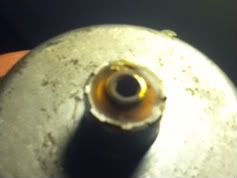
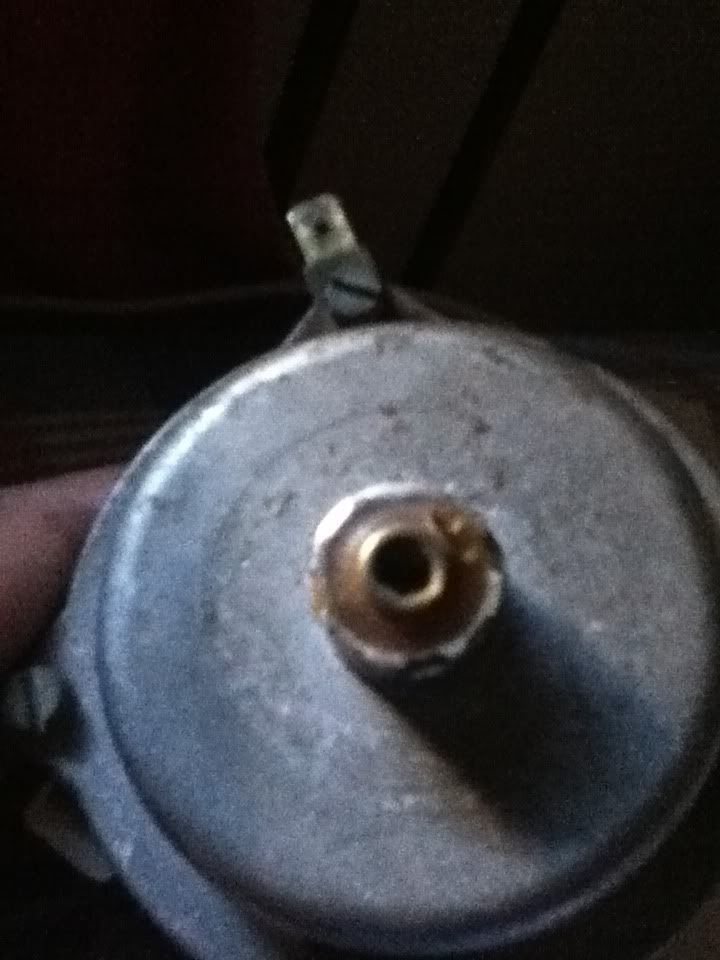
here's another picture. you can see the circumference of the cap kinda etched in.
|
|
| Back to top |
|
|
emitor81
Samba Member
Joined: June 02, 2009
Posts: 31
Location: CA
|
| Posted: Mon Nov 08, 2010 2:30 pm Post subject: |
|
|
I've looked under different light several times and different angles and I do not see what I understand should be a slotted screw inside the allen hole.
also I really do believe there was a black cap on mine as the one shown from another post here:
I can see markings on the case as big a round as the cap would be as in the picture.
you can almost see the markings on it in the picture of my pressure sensor.
Last edited by emitor81 on Mon Nov 08, 2010 3:01 pm; edited 1 time in total |
|
| Back to top |
|
|
emitor81
Samba Member
Joined: June 02, 2009
Posts: 31
Location: CA
|
| Posted: Mon Nov 08, 2010 2:17 pm Post subject: |
|
|
if It were not a single adjustment pressure sensor, how would you make any other adjustments??? how does one know if it's not a single adjustment sensor?
I looked down the allen hole and it has nothing else like another screw in there. its just the allen slot.
raygreenwood wrote: ..how many wires are on that five pin plug? And...where/what #'s do they go to? Ray
9, 20, 30, 17, 14 from top to bottom. 30 is ground both in the book and the car. |
|
| Back to top |
|
|
|