| Author |
Message |
MarkWard
Samba Member

Joined: February 09, 2005
Posts: 19098
Location: Retired South Florida

|
 Posted: Tue Feb 09, 2021 2:30 pm Post subject: Re: Coolant Temp Gauge Rebuild w/parts list & photos Posted: Tue Feb 09, 2021 2:30 pm Post subject: Re: Coolant Temp Gauge Rebuild w/parts list & photos |
 |
|
| Plus, I believe the blue high beam indicator was a bulb not an LED. |
|
| Back to top |
|
 |
RawUmber
Samba Member
Joined: June 23, 2019
Posts: 335
|
| Posted: Tue Feb 09, 2021 4:04 pm Post subject: Re: Coolant Temp Gauge Rebuild w/parts list & photos |
|
|
Here's a schematic for inside a '42' pseudo relay. The chip appears to be an opamp. Props to the author.
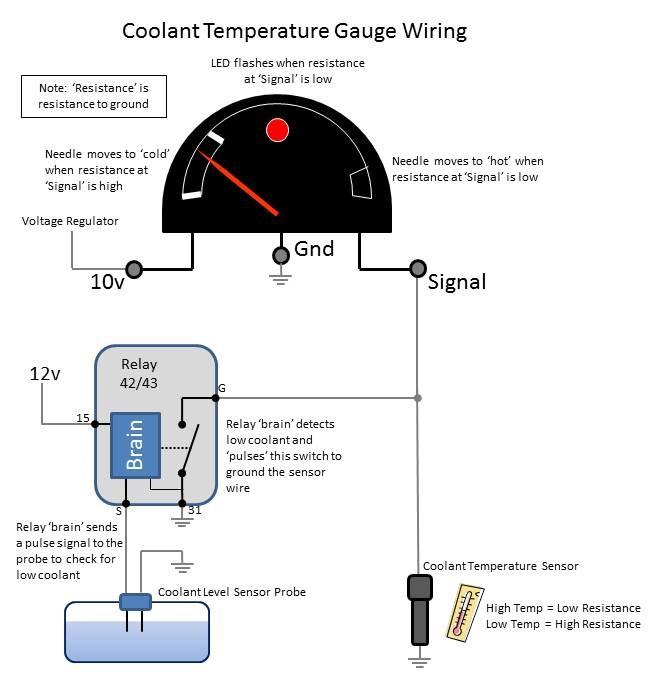
Here's diagram from "Club 80-90":
source: https://wiki.club8090.co.uk/index.php/Coolant_and_Heating_flashing_red_light_on_dash
I have a spare '43' (which was superseded by the '42', if I understand correctly). When I wired it up on a bench, it outputs ~GND its output floats (to the gauge) so long as its input stays grounded (ie, coolant tank full). Once I disconnect ('open') the ground from the input (ie, coolant tank not full), it takes ~7s until its output starts 'blinking' from GND float to ~.6V. I don't have a coolant gauge handy to see it actually blink, but it suggests to me that there is a blink activity coming from this module when the "coolant low-level switch" goes open.
Edit: I wasn't biasing the output, so I incorrectly stated that the '43' output ground when it was instead ~floating.
Last edited by RawUmber on Tue Feb 09, 2021 6:29 pm; edited 1 time in total |
|
| Back to top |
|
|
crazyvwvanman
Samba Member

Joined: January 28, 2008
Posts: 10483
Location: Orbiting San Diego
|
| Posted: Tue Feb 09, 2021 5:23 pm Post subject: Re: Coolant Temp Gauge Rebuild w/parts list & photos |
|
|
There are 3 versions of the coolant level "relay". The later 2 versions connect a pulsing ground to the coolant temp sender line of the gauge. This triggers the circuit inside the gauge to commence the flashing but the ground pulses don't themselves make the led flash.
The original early version of the coolant level relay put a constant ground on the coolant temp sender line and this also triggered the gauge circuit to commence the flashing.
The gauge led flashes upon power up, without the coolant level relay even present. It stops flashing after the capacitor in the circuit is full. There is a current limiting resistor in the circuit that limits how fast the capacitor gets filled. The led continues to flash until the capacitor is full. That is why a leakage failure of this capacitor causes the gauge led to flash for no external reason.
When the coolant level relays pulse a ground or in the case of early version clamp a ground to the temp sender line this also drains the capacitor which causes the led to activate. The current limiting resistor delays the refilling of the capacitor for a period of time but the next ground pulse from the coolant relay drains it again before it has filled and thus the led continues to flash but the temp needle doesn't show much effect. With the early version of the relay the constant ground it puts on the sender line keeps the led blinking but also has the effect of making the temp needle peg hot. VW used the early version for about 2 years before changing to the the pulsed ground version to allow the temp needle reading to remain accurate.
Mark |
|
| Back to top |
|
|
NorthOf50
Samba Member

Joined: October 13, 2020
Posts: 102
Location: Campbell River, BC
|
| Posted: Tue Feb 09, 2021 10:03 pm Post subject: Re: Coolant Temp Gauge Rebuild w/parts list & photos |
|
|
It's a surprise how many people (despite hopefully reading your multiple other posts stating this) still think the LED pulse is triggered by the relay. When troubleshooting my gauge at the beginning of all this even 2 local VW shops thought the same.
What Mark describes is clearly illustrated on Page 3 in Jim's circuit diagram of the gauge. Jim describes how to drop in voltage triggers the LED to flash very succinctly. Hopefully this will settle it for all.
| fxr wrote: |
I think I can see how it works apart from that. With the engine cold, the + i/p of the 741 is held higher than the - i/p (which is a steady 5.2V). If the engine gets so hot the diode pulls the + i/p below 5.2V then the LED turns on, but the o/p is held at 5.5V by the zener. The capacitor charges enough that the + i/p goes higher than 5.2V again, and the LED goes off.
When the coolant level goes low, the control relay sends short -ve pulses to the + i/p, which is enough to trigger the flashing, but hardly affects the high hysteresis of the bimetallic strip.
|
_________________
'84 1.9WBX Camper (Penny)
'88 2.1WBX Camper (Martin) |
|
| Back to top |
|
|
SyncroHead
Samba Member

Joined: May 23, 2005
Posts: 1160
Location: Northern Nevada
|
| Posted: Tue Feb 09, 2021 10:34 pm Post subject: Re: Coolant Temp Gauge Rebuild w/parts list & photos |
|
|
| crazyvwvanman wrote: |
There are 3 versions of the coolant level "relay". The later 2 versions connect a pulsing ground to the coolant temp sender line of the gauge. This triggers the circuit inside the gauge to commence the flashing but the ground pulses don't themselves make the led flash.
The original early version of the coolant level relay put a constant ground on the coolant temp sender line and this also triggered the gauge circuit to commence the flashing.
The gauge led flashes upon power up, without the coolant level relay even present. It stops flashing after the capacitor in the circuit is full. There is a current limiting resistor in the circuit that limits how fast the capacitor gets filled. The led continues to flash until the capacitor is full. That is why a leakage failure of this capacitor causes the gauge led to flash for no external reason.
When the coolant level relays pulse a ground or in the case of early version clamp a ground to the temp sender line this also drains the capacitor which causes the led to activate. The current limiting resistor delays the refilling of the capacitor for a period of time but the next ground pulse from the coolant relay drains it again before it has filled and thus the led continues to flash but the temp needle doesn't show much effect. With the early version of the relay the constant ground it puts on the sender line keeps the led blinking but also has the effect of making the temp needle peg hot. VW used the early version for about 2 years before changing to the the pulsed ground version to allow the temp needle reading to remain accurate.
Mark |
Thank you Mark! Its great to have Vanagon community members like you that put in the effort not only to understand a system like this, but to also share it with the rest of the community.
Can you translate "early", "late", and "about 2 years" into an approximation of model years? There may be uncertainty about exactly when these changes occurred, but an estimation would be very helpful.
Jim Davis
_________________
"A Vanagon? It's not a car or a van. It's a hobby!"
Check out:
www.VANAVATION.com
www.SyncroSafari.org and
www.Vanagons.org
| sphet wrote: |
| I have *no* idea what the previous owner carried in his Westy... angry donkeys? |
|
|
| Back to top |
|
|
crazyvwvanman
Samba Member
Joined: January 28, 2008
Posts: 10483
Location: Orbiting San Diego
|
| Posted: Wed Feb 10, 2021 2:39 am Post subject: Re: Coolant Temp Gauge Rebuild w/parts list & photos |
|
|
Jim, as best I can tell the taller early version was used in 83/84 and the improved version appeared during 85 model year.
The original coolant level control relay #43 for the earlier models is VW # 251-919-376
The #43 control relay for the later models (and replacement for earlier) is VW# 191-919-376
Around 1990 this became a #42 relay VW# 191-919-376A
With the blinking led oddities that occur, attempts to rectify them mean any year can have any version at this point or even no version as someone may have "solved" the problem by simply taking it out.
------------------------------------
These are the 3 versions of the coolant level warning "relay" used in Vanagon 1983-91.
The tall 43 unit is the cursed early first try and should be removed and discarded if encountered.
Either of the short ones is fine.
The tall one pegs the temp gauge hot and makes the temp led blink when coolant is sensed low in the main tank.
The shorter improved later versions only blink the led and let the gauge read what the temps actually are.
Mark |
|
| Back to top |
|
|
kirtfitzpatrick
Samba Member

Joined: July 12, 2014
Posts: 55
Location: San Francisco, CA
|
| Posted: Sat Jun 04, 2022 12:58 pm Post subject: Re: Coolant Temp Gauge Rebuild w/parts list & photos |
|
|
| djkeev wrote: |
I just entered this post into the FAQ section.
I know it is a gauge and I debated where to put it. I figured most people would check out the engine cooling system section if they have gauge issues. So that's where I put it.
https://www.thesamba.com/vw/forum/viewtopic.php?p=6236044#6236044
If you feel it should be with instruments, let me know, I'll move it.
Or..... we don't generally do this, but in both sections?
Dave |
Thanks Dave! What an honor. I was pretty busy back then but now that I've taken a minute to peruse the FAQs, it seems to me that this post would be more at home in the "Coolant Temperature Gauge:" section of "Electrical System".
https://www.thesamba.com/vw/forum/viewtopic.php?p=6288276#6288276
Or both if you want. I don't really know about that sort of thing.
Thanks!
_________________
@tintopcamper
YouTube |
|
| Back to top |
|
|
weekenderraf
Samba Member
Joined: December 16, 2015
Posts: 31
Location: Olen Belgium
|
| Posted: Sat Jul 08, 2023 1:13 am Post subject: Re: Coolant Temp Gauge Rebuild w/parts list & photos |
|
|
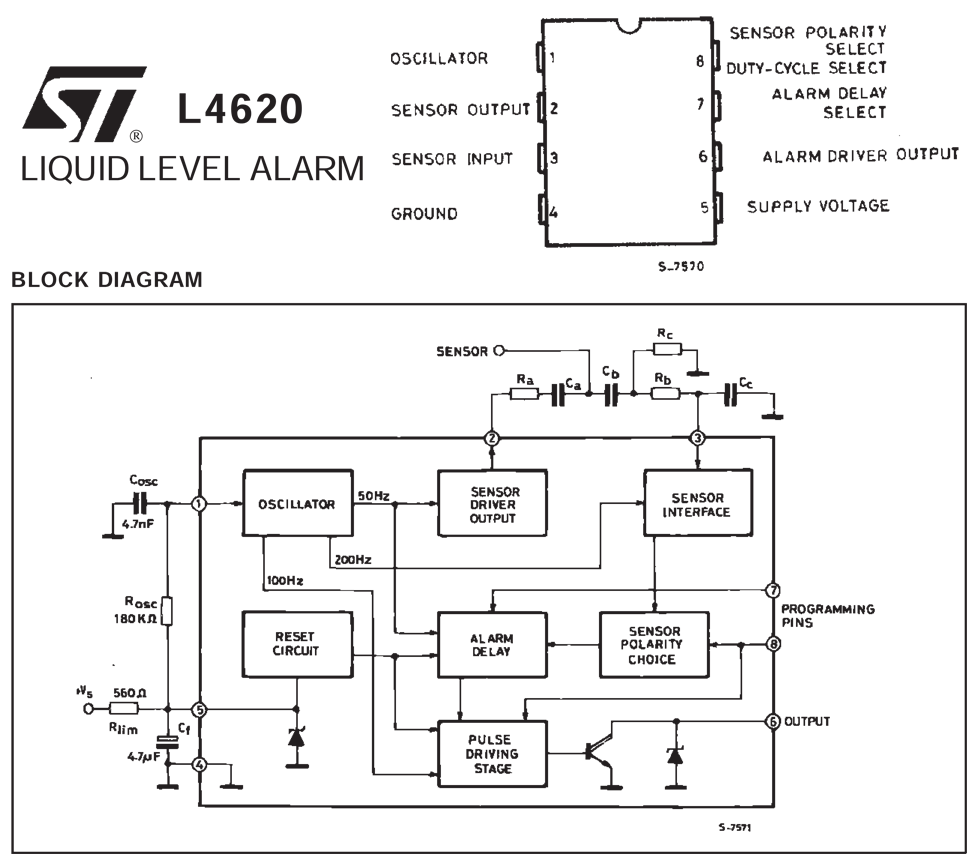
I suspect the IC in the Relay 42 is an L4620 (Liquid Level Alarm). The block Diagram, which you can find at "https://datasheetspdf.com/datasheet/L4620.html " is certainly very similar to the diagram in RawUmber's post of Feb. 10, 2021.
Raf
Last edited by weekenderraf on Sat Jul 08, 2023 11:11 am; edited 1 time in total |
|
| Back to top |
|
|
RawUmber
Samba Member
Joined: June 23, 2019
Posts: 335
|
| Posted: Sat Jul 08, 2023 10:37 am Post subject: Re: Coolant Temp Gauge Rebuild w/parts list & photos |
|
|
| weekenderraf wrote: |
| I suspect the IC in the Relay 42 is an L4620 (Liquid Level Alarm). |
Wow! Good find. It does match up well. So "VW-FSA/0" might be an ST "L4620".
I've duplicated the '42' diagram you were referring to into this post to avoid confusion (you quoted my 'join date' rather than the 'post date'), followed by a couple bits from the L4620 datasheet you linked to, for posterity.
|
|
| Back to top |
|
|
weekenderraf
Samba Member
Joined: December 16, 2015
Posts: 31
Location: Olen Belgium
|
| Posted: Sat Jul 08, 2023 11:28 am Post subject: Re: Coolant Temp Gauge Rebuild w/parts list & photos |
|
|
Nicely done, I found that the IC is an L4620 here: https://www.bulliforum.com/viewtopic.php?p=732540&hilit=L4620#p732540 in a post from 'Feuerwehr01' on 02.08.2017
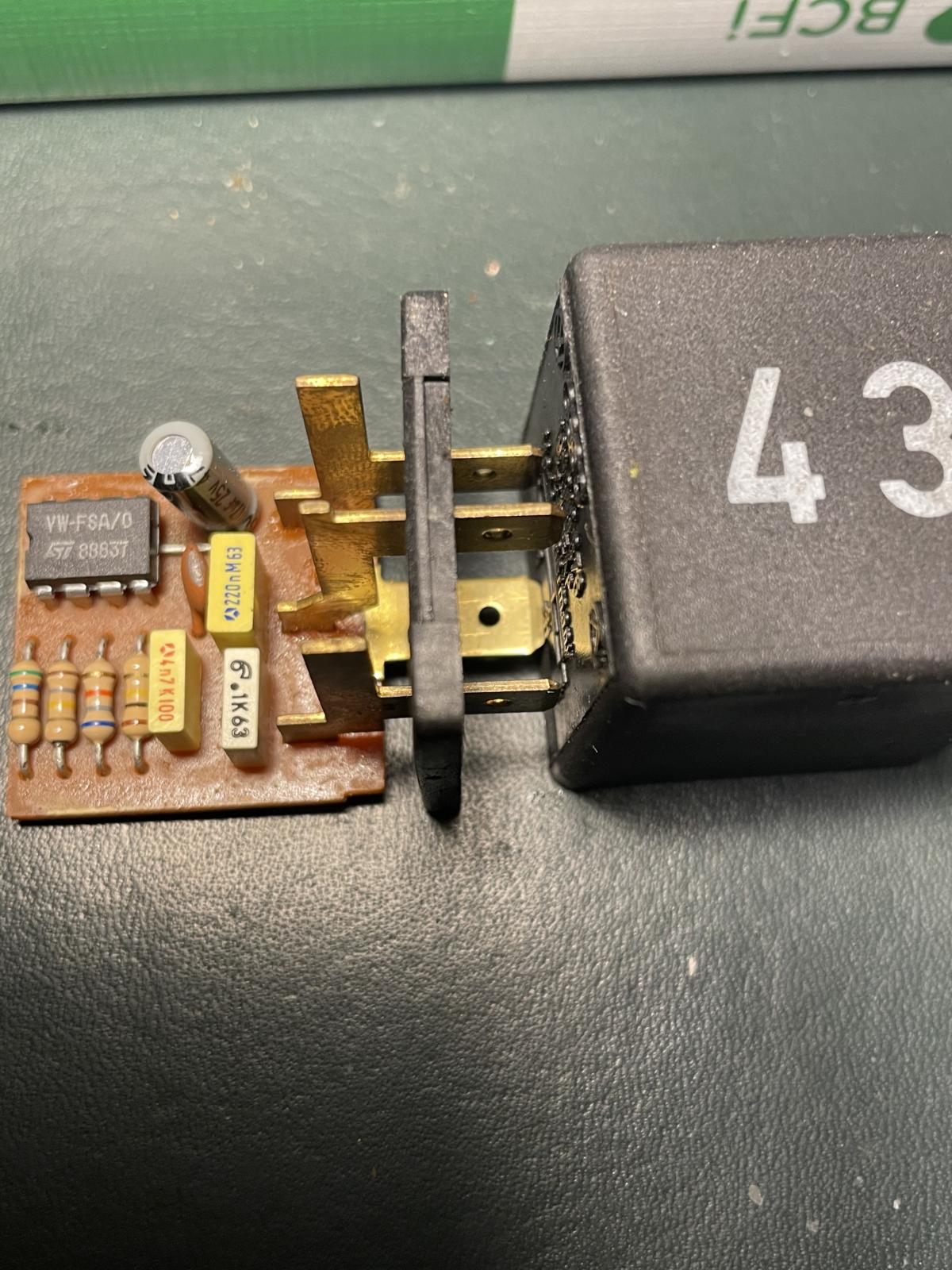
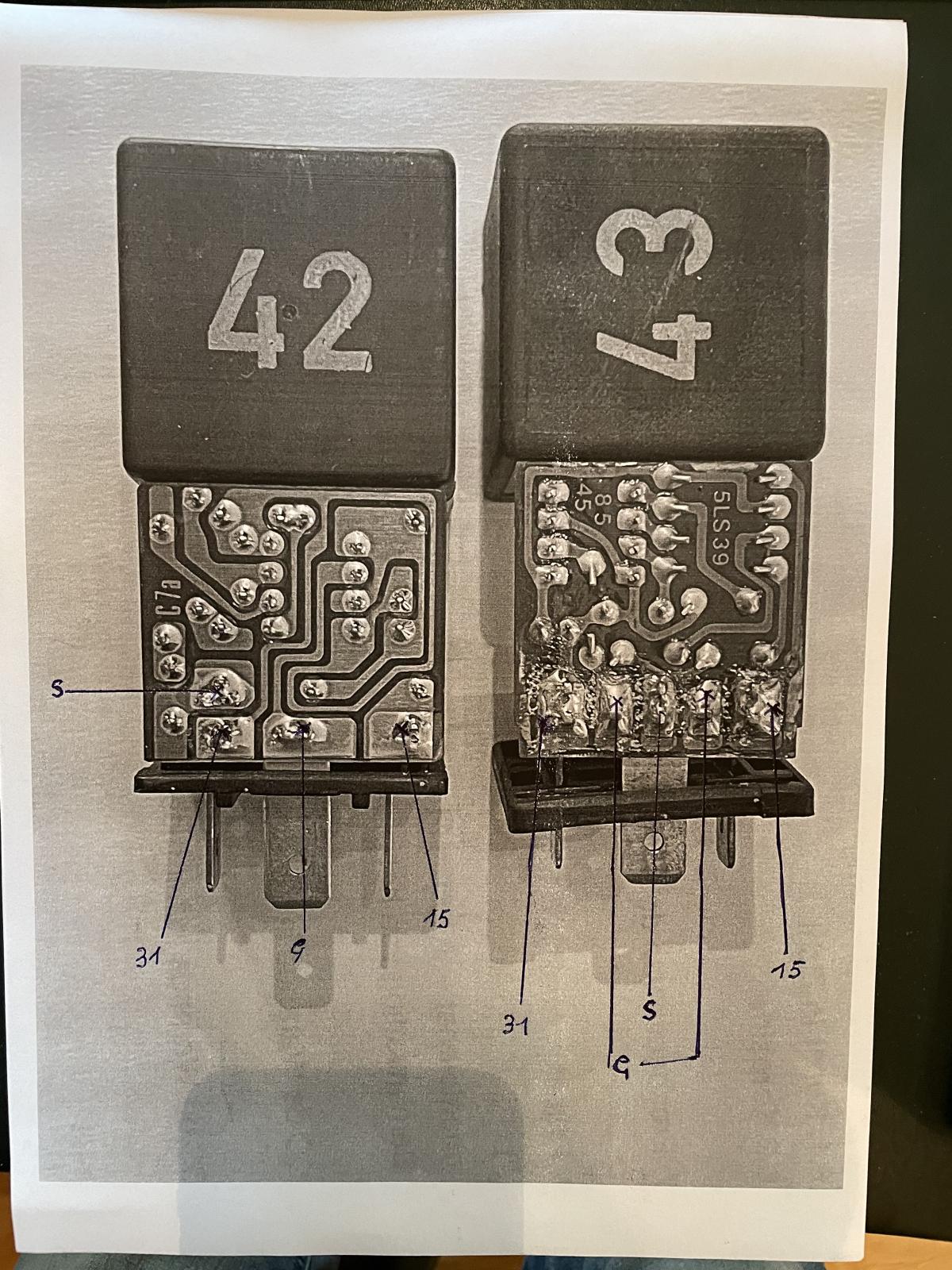
Here is a picture of the printed circuit board with the L4620 (Liquid level alarm by SGS Thomson), the relay is a 43 .
And here an other relay 43 with the the IC labeled "VW-FSA/0 (by ST MICROELECTRONICS)
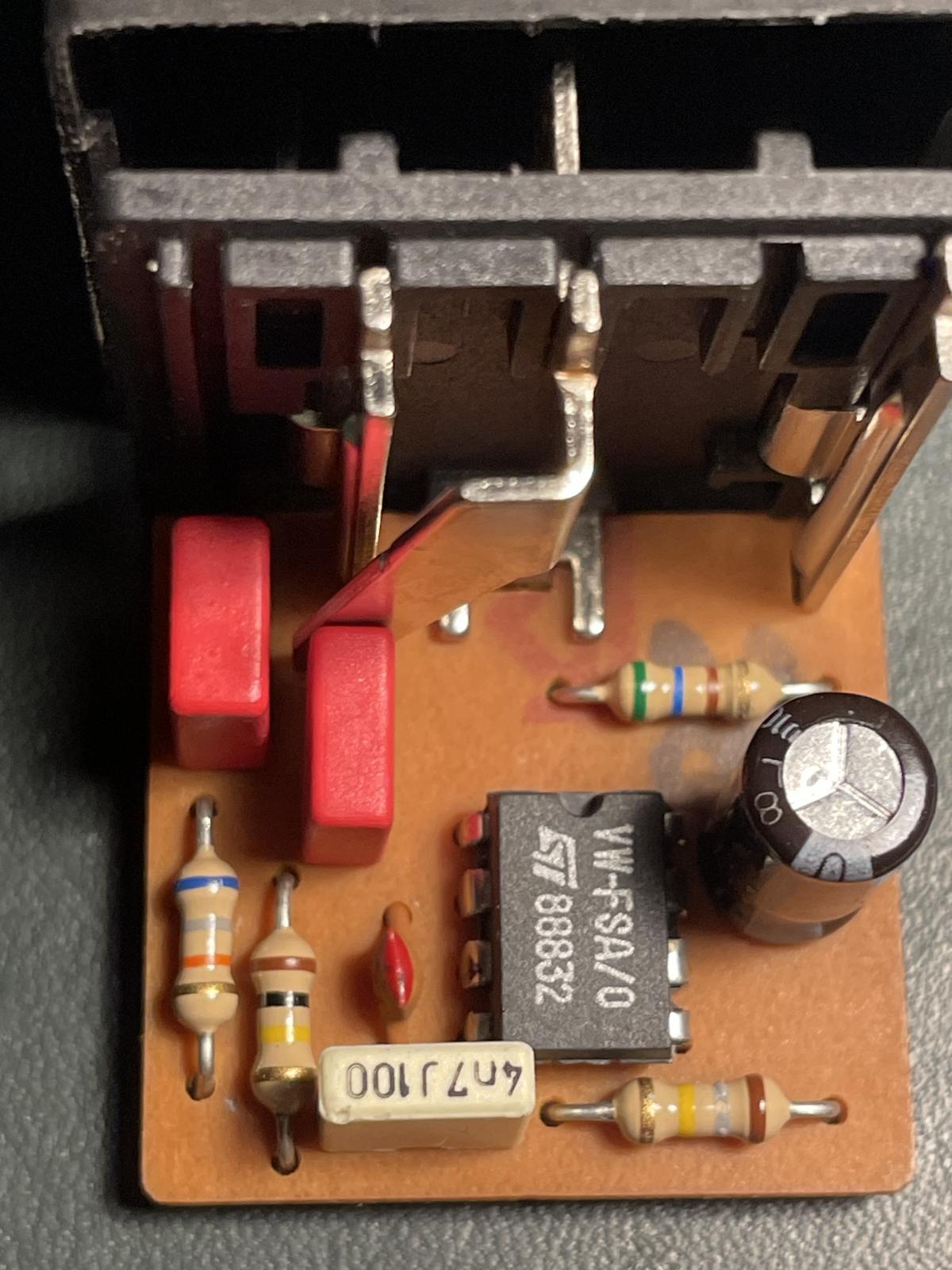
Here a picture of the printed circuit board of a relay 42, (191919376A),
all the components (resistors and capacitors) are the same (560, 180K, 68 K, 100Kohm resistors and 47 mF, 220nF, 4,7nF, 100mF and470 pF capacitors)as with the relay 43 but the layout has been changed.
|
|
| Back to top |
|
|
weekenderraf
Samba Member
Joined: December 16, 2015
Posts: 31
Location: Olen Belgium
|
| Posted: Sun Jul 16, 2023 6:05 am Post subject: Re: Coolant Temp Gauge Rebuild w/parts list & photos |
|
|
| Which component (IC 4620 = VW FSA/0), capacitor, resistor) is most likely the cause of a faulty relay (42 or 43)? |
|
| Back to top |
|
|
DanHoug
Samba Member

Joined: December 05, 2016
Posts: 5936
Location: Bemidji, MN
|
| Posted: Sun Jul 16, 2023 6:59 am Post subject: Re: Coolant Temp Gauge Rebuild w/parts list & photos |
|
|
| weekenderraf wrote: |
| Which component (IC 4620 = VW FSA/0), capacitor, resistor) is most likely the cause of a faulty relay (42 or 43)? |
start by replacing the electrolytic cap. easy, cheap, and have a finite life span.
_________________
-dan
60% of what you find on the internet is wrong, including this post.
'87 Westy & '89 Westy both 2.1 4spd
Past projects can be found at--
www.thefixitworkshop.com |
|
| Back to top |
|
|
RawUmber
Samba Member
Joined: June 23, 2019
Posts: 335
|
| Posted: Sun Jul 16, 2023 7:54 am Post subject: Re: Coolant Temp Gauge Rebuild w/parts list & photos |
|
|
I have no experience with faulty 42/43 'relays'. While I wouldn't recommend 'fixing' a working one, I'd guess the most likely component to fail first would be the electrolytic capacitor, distantly followed by the IC. The remainder rarely fail.
Nice pictures of the 42/43 components! A pic of the bottom sides could be useful too.
Way out on a limb here, was pondering...
L4620 = Liquid Level Alarm
VW-FSA/0 = FlüssigStandAlarm ? |
|
| Back to top |
|
|
weekenderraf
Samba Member
Joined: December 16, 2015
Posts: 31
Location: Olen Belgium
|
| Posted: Sun Jul 16, 2023 8:16 am Post subject: Re: Coolant Temp Gauge Rebuild w/parts list & photos |
|
|
Here a picture of the bottom sides
of the printed circuit boards and to make it easier also
the designation of the connectors (15,31,S and G) on the printed circuit boards |
|
| Back to top |
|
|
RawUmber
Samba Member
Joined: June 23, 2019
Posts: 335
|
| Posted: Sun Jul 16, 2023 8:50 am Post subject: Re: Coolant Temp Gauge Rebuild w/parts list & photos |
|
|
| Nice! Thank you for sharing that. |
|
| Back to top |
|
|
dbeierl
Samba Member
Joined: April 22, 2009
Posts: 165
Location: Providence, Rhode Island, USA
|
| Posted: Mon Oct 09, 2023 11:41 pm Post subject: Re: Coolant Temp Gauge Rebuild w/parts list & photos |
|
|
| kirtfitzpatrick wrote: |
My coolant light has been blinking at me for years and every diagnostic test I tried was inconclusive as to what was causing it. I even unsoldered the capacitor and it tested out okay. Since I was unable to buy a used gauge I was left needing to fix this one. So I unsoldered all the resistors, diodes, chips and cap to test them individually.
Since I had to remove all the components to test them I wasn’t about to solder old and possibly bad components back on so I figured out the specs of each part and ordered new ones. It was a grand total of about $2 from Digikey and $10 from McMaster.
All in all it wasn’t that hard to swap everything out. I never did figure out which part was the bad one but it must have been one of the diodes or the op amp. The resistors and cap all tested perfect but I’m not very familiar with testing diodes and I didn’t test the op-amp.
|
This is a rather drastic solution as the only common trouble with these is the 10 uF 16V capacitor becoming leaky and failing to shut off the LED. The capacitor leak will not be noticed on an ordinary capacitance test. The LED itself is a five volt self-blinker, so it's just as well this wasn't replaced.
Lots of good info in this thread, mixed with lots of bad:
The 741 op amp is used as a timer to keep the LED going for 2-3 seconds any time it lights up, not an oscillator to blink it. The LED self-blinks whenever it sees 5V. That 5V comes from the 10V supply through a 5.1V zener diode, with the ground supplied by the 741.
The 741 goes low and grounds the negative leg of the LED whenever power is turned on (for lamp test) and whenever voltage on the gauge sender line falls to 5V (probably 5.1V actually). This occurs at roughly 45 ohms sender resistance, which gives a reading slightly below the overheat zone on the gauge.
Once the initial condition is no longer met (sender voltage rises) the 10 uF timing capacitor starts charging through a high-value resistor. Two or three seconds later when it reaches a certain level (IIRC 2/3 of the 10V supply but don't quote me) it causes the 741 output to go high, removing the drive from the LED which stops blinking. This 2-3 second timeout is used by the newer type coolant level controller to keep the gauge blinking with a low-duty-cycle pulsed output that doesn't move the needle much.
The trouble comes when the leakage rate of the capacitor approaches the charging rate. Capacitor never reaches the cutoff point and the LED doesn't stop. During the marginal period humidity and temperature changes can affect leakage across the PCB, so behavior varies, becoming better as the gauge element warms up the inside of the gauge and dries it out.
There would be much less trouble with a lower-impedance timing circuit, but that would require a larger timing capacitor (and smaller timing resistor).
Note: It's possible to change the capacitor without removing the gauge face, but a nuisance. Using a surface mount capacitor as replacement can make this easier. Unfortunately I don't remember which size of SMD corresponds to the pad spacing on the PCB. Not one of the microscopic ones.
Note: If you drill out the back of one of the faceplate rivets you can rotate the faceplate out of the way. When remounting, you can degrease and put a drop of epoxy over the back of the rivet stub and and gauge back, or simply let the rivet stub be an index for rotation and let the other rivet carry the mounting load which works fine.
Note: when dismounting the PCB, the heater leads from the gauge must be desoldered from the mounting posts. They are inserted through holes in the posts and then wrapped around the posts; so you must carefully unwrap them while hot before extracting them. Be very careful with them as if you break them they are the very devil to tin so they'll accept solder. When replacing, they are polarity-independent so go for best lead dress.
Note: The gauge needle operation (and calibration) is entirely independent of the blinker circuit. Recalibrating the gauge will not alter the LED activation point which is set by a zener diode on the LED board.
Note: Gauge input voltage out of spec (10V +/- 0.5V) can cause the LED to blink unceasingly just like a leaky timing cap. This could be from bad panel voltage regulator (which will also affect fuel and temp gauge readings) or poor gauge ground (which will only affect the blinker). Poor ground could be at the middle gauge mounting nut or at panel connector or ground stars.
Note: The self-blinking LED can be replaced directly by another 5V blinker, or by any 5V-rated LED with internal resistor. It can also be replaced by a standard LED by substituting a suitable resistor for the 5.1V zener (be sure to replace the right zener, not the one that sets the activation threshold). I'm a bit red-blind, so when I put brighter LEDs in my panel I replaced the gauge blinker with a resistor and clear focused red LED that doesn't blink but will put your eye out.  |
|
| Back to top |
|
|
zoti
Samba Member

Joined: December 26, 2007
Posts: 2173
Location: Plano, TX USA
|
| Posted: Wed Nov 08, 2023 9:33 pm Post subject: Re: Coolant Temp Gauge Rebuild w/parts list & photos |
|
|
Did anyone ever scope the output from the coolant level unit to the sensor?
Can anyone explain why you need a unit that does that instead of just checking they the sensor closes the circuit?
I found that the previous owner put a simple relay instead of the unit in my van so when you turn the key on, it just closes the circuit of the sensor. |
|
| Back to top |
|
|
|