| Author |
Message |
bladerunner80
Samba Member

Joined: February 13, 2011
Posts: 255
Location: Fife, WA

|
 Posted: Wed Apr 11, 2012 10:37 am Post subject: Wiring confusion with headlight dimmer relay and wiring inst Posted: Wed Apr 11, 2012 10:37 am Post subject: Wiring confusion with headlight dimmer relay and wiring inst |
 |
|
I’m just about done with a complete rewire on my 1966 bug, I’m using the Wiring Works kit (for the 1966 bug) and updating the necessary components to 12 volt (the car and all original wiring was gutted, bought new flasher relay from Wolfsburg West and new dimmer relay from CIP1).
Anyhow, the new 12volt headlight dimmer relay from cip1 is this one: (p/n 111-941-583) http://www2.cip1.com/ProductDetails.asp?ProductCode=VWC-111-941-583 . I was going to follow the instructions on The Old Volks Home website (as suggested per posts I found on samba). The only problem is, the instructions provided differ from the instructions included with the Wiring Works kit as far as which wires to hook up to specific terminals on the relay. I went back and forth a couple times, but decided to wire per the kit’s instructions.
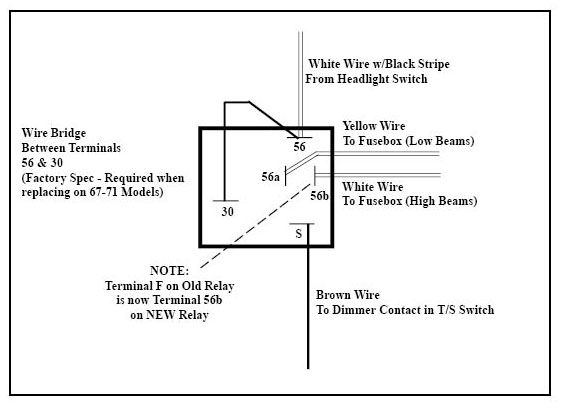
Per The Old Volks Home:
Yellow Wire to Fusebox (Low Beams) – Terminal 56a on relay
White Wire to Fusebox (High Beams) – Terminal 56b on relay
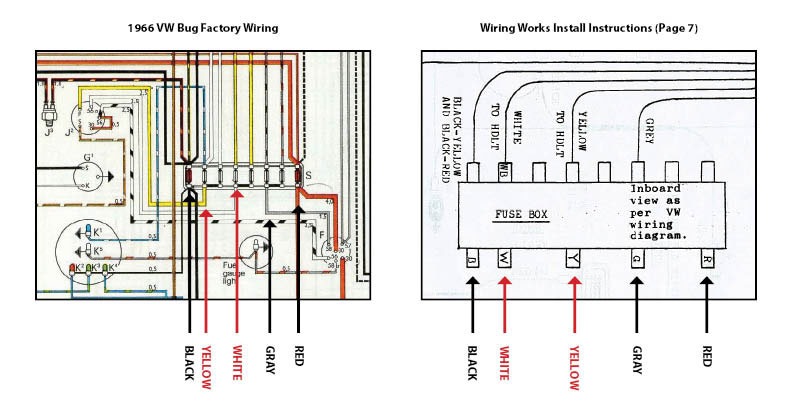
Per Wiring Works instructions (page 4, step #9 “Install misc. wires for Front Lights”):
Yellow wire: Fusebox terminal labeled “Y” on harness diagrams to #f (or #56b) Highbeam relay
White wire: Fusebox terminal labeled “W” on harness diagrams to #56a Highbeam relay
Now, the only thing I can think of as to why the Wiring Works instructions are reversed compared to the instructions by the Old Volks Home, is how the instructions from Wiring Works connect the white, high beam wire and the yellow, low beam wire on the fuse block. They seem to be reversed compared to how the 1966 stock wiring was routed. See my graphic below.
So…..my questions is, did I hook this thing up correctly? I’m assuming that having reversed wiring on the relay and reversed wiring on the fuse block per the Wiring Works instructions kind of auto corrects any problems that would arise compared to the instructions laid out by The Old Volks Home and the factory wiring diagram. I haven’t connected power yet, so nothing has been tested. I figured I would pick the samba brains firth.
Any insight or tips would be greatly appreciated! |
|
| Back to top |
|
 |
glutamodo 
The Android

Joined: July 13, 2004
Posts: 26632
Location: Douglas, WY
|
| Posted: Wed Apr 11, 2012 2:46 pm Post subject: |
|
|
56a should be white. F/56b is yellow.
The relay, when wired with 30 and 56 jumpered, is only used as a toggle, flipping between 56a and F/56b - so it really doesn't matter that much which side you put the white and yellow, so long as one is on 56a and the other on 56b. I think in some international markets the button/relay also served as a daytime passing light flasher, and the wiring was modified on those, the wiring being bass-ackwards on the diagram for the fuse box may be related to that. In the US though I see no reason to not have yellow and whites match. I have a factory 1966 wiring harness that some previous owner transplanted into my 61 Baja, I don't know if they altered anything when they did so, but it is set up so that the yellows and whites match in and out.
Andy |
|
| Back to top |
|
|
bladerunner80
Samba Member
Joined: February 13, 2011
Posts: 255
Location: Fife, WA
|
| Posted: Wed Apr 11, 2012 2:56 pm Post subject: |
|
|
Awesome, thanks Andy. I've spent the last couple week priming for the wiring job and it all went pretty smooth until I hit this point. I guess we'll see how smooth it really was when I connect the battery!
Bill |
|
| Back to top |
|
|
herbie1200
Samba Member
Joined: April 27, 2006
Posts: 836
Location: Rome - Italy
|
| Posted: Wed Apr 11, 2012 11:43 pm Post subject: |
|
|
In some european countries (i.e. Italy) the "flashing" was legal only with low beam, then some schematics have yellow and white wires exchanged.
I prefer flashing with high beam. |
|
| Back to top |
|
|
KTPhil
Samba Member
Joined: April 06, 2006
Posts: 36319
Location: Conejo Valley, CA
|
| Posted: Thu Apr 12, 2012 2:16 pm Post subject: |
|
|
I believe the wiring diagram is an early printing error that has been proliferated by others copying the original mistake.
At the fusebox, white goes to white, yellow to yellow. White is high beam, yellow is low beam.
The jumper from 30 is a bypass of the high-beam flasher that was removed for USA markets. Just run a wire to relay terminal 30 from an always hot wire (a true 30 terminal), and you gain them back. |
|
| Back to top |
|
|
bladerunner80
Samba Member
Joined: February 13, 2011
Posts: 255
Location: Fife, WA
|
| Posted: Sun Apr 15, 2012 12:39 pm Post subject: |
|
|
| Cool, thanks for the replies. After posting this question, I found an earlier topic that referenced this mistake through some serious topic searching, I think it may have actually been written by you! Anyhow, thanks again for the help, I wanted to make sure I had all my ducks in a row before hooking this thing up to a battery and frying everything! |
|
| Back to top |
|
|
KTPhil
Samba Member
Joined: April 06, 2006
Posts: 36319
Location: Conejo Valley, CA
|
| Posted: Tue Apr 17, 2012 7:25 am Post subject: |
|
|
| Just a note about the addition of another terminal 30 wire as I suggest-- make sure it is a thick wire (like the yellow or white from the relay to the fusesbox. That wire will be taking the high beam current of both sides, so it should be heavy enough to not overload. |
|
| Back to top |
|
|
bladerunner80
Samba Member
Joined: February 13, 2011
Posts: 255
Location: Fife, WA
|
| Posted: Wed Apr 18, 2012 1:26 pm Post subject: |
|
|
| Ok. If I wire it this, what exactly does that do for me? Is this the "flasher" that european models had? I'm assuming its a similar effect to a flasher switch you see on motorcycles? |
|
| Back to top |
|
|
glutamodo
The Android
Joined: July 13, 2004
Posts: 26632
Location: Douglas, WY
|
| Posted: Wed Apr 18, 2012 3:33 pm Post subject: |
|
|
Exactly, it was for stuff like flashing someone ahead prior to passing them. As was mentioned before, don't jumper 30 and 56, run a decidated hot-always wire to terminal 30 instead.
And while maybe a little off the topic, but a little history - passing light flashers had been around since 1960, using a dedicated relay. The change for 1966, was they had to redesign things around the new high/low beam relay. Those flashers had long been included on Ghia models, I'm not sure if all markets got it though. But it dates back to the redesign of the turn signal switch for 1960. Those new switches were designed from the beginning to be able to have that extra "clicker" switch added to the arm.
Ghia owner's manuals for 1960 called it the "pass light", later on it was changed to read "headlight flasher" (I have one of those Ghia switches)
http://www.thesamba.com/vw/archives/manuals/8_59_ghia/4.jpg
http://www.thesamba.com/vw/archives/manuals/8_59_ghia/5.jpg
And VW made a kit plus issued a technical bulletin for fitting it on Beetle models as well. (I've also got one of these relays kicking around, a bolt-on-terminal style for 1960.)
http://www.thesamba.com/vw/archives/manuals/techbulletins/e10/12_59_page1.jpg
http://www.thesamba.com/vw/archives/manuals/techbulletins/e10/12_59_page2.jpg
http://www.thesamba.com/vw/archives/manuals/techbulletins/e10/12_59_page3.jpg |
|
| Back to top |
|
|
bladerunner80
Samba Member
Joined: February 13, 2011
Posts: 255
Location: Fife, WA
|
| Posted: Thu Apr 19, 2012 4:03 pm Post subject: |
|
|
| Good info, I'll wire it up that way. |
|
| Back to top |
|
|
bladerunner80
Samba Member
Joined: February 13, 2011
Posts: 255
Location: Fife, WA
|
| Posted: Thu Apr 19, 2012 4:09 pm Post subject: |
|
|
Where is a good place to pull an always hot, thicker wire? Is it ok to tap another wire off the fuse panel?
Thanks! |
|
| Back to top |
|
|
bladerunner80
Samba Member
Joined: February 13, 2011
Posts: 255
Location: Fife, WA
|
| Posted: Thu Apr 19, 2012 4:13 pm Post subject: |
|
|
Wait, I see now. Looks like on the wiring diagram they routed it to the ignition switch (the always hot 30 terminal). Thanks again Andy, good info on the links you provided.
Bill |
|
| Back to top |
|
|
|