| Author |
Message |
DadsOld74
Samba Member

Joined: October 01, 2013
Posts: 138
Location: Cody, Wyoming USA

|
 Posted: Tue Oct 01, 2013 10:30 pm Post subject: Jetting a carb for 5000 feet Posted: Tue Oct 01, 2013 10:30 pm Post subject: Jetting a carb for 5000 feet |
 |
|
Hey Everyone,
I'm in Cody, Wyoming (5000 feet). I want to get my 34 PICT 3 carb jetted right. AirCooled.net had Main, Idle, and Power jets with instructions as to what sizes I should get. But, they didn't have air jets. What size air jet would be in the carb now, and what size should I look for? Thanks so much! |
|
| Back to top |
|
 |
glutamodo 
The Android

Joined: July 13, 2004
Posts: 26637
Location: Douglas, WY
|
| Posted: Wed Oct 02, 2013 12:00 am Post subject: |
|
|
Do you have any idea how many 34PICT-3 carbs there were? And how many different stock combinations of jets? (and the factory matched a specific distributor to each variation of 34PICT-3) So is yours a German carb? Or aftermarket?
German carbs have a modification state number on the base flange on the left side. That tells you what variant it actually is. (aftermarket, well those are almost closest to 1974 SVDA carbs)
Most USA Bug carbs used either a 70z or 75z air correction jet:
But outside the USA there were lots of other sizes. That chart above, is of the most common USA carbs - there were LOTS more outside the USA, and you can find my "master chart" here:
https://www.thesamba.com/vw/archives/info/glutamodo/temp/CarbBaseFlangeNumbersA.doc
Anyhow, as I've lived at 4800+ feet for the last couple of decades, I can say - to compensate for thinner air, you need to either reduce the size of the main jet, or increase the size of the air correction jet. Keep in mind, the gasoline companies already do some of the compensating for you - they drop the octane a couple of points compared to lower elevations. (and still charge you the same, bastards!) I prefer to increase the air correction jet if you can find one larger (I've actually drilled one or two of them out before, slightly)
It's a matter of seeing how well it runs too - and like, looking at your spark plugs. I put a China knockoff 30PICT-1 with an adapter on my 1600DP thinking I'd have to re-jet to get it to run decent, but found it ran just fine out of the box!
-Andy |
|
| Back to top |
|
|
DadsOld74
Samba Member
Joined: October 01, 2013
Posts: 138
Location: Cody, Wyoming USA
|
| Posted: Thu Oct 03, 2013 7:39 am Post subject: |
|
|
Andy -
Thank you so much for your great response. Here's a little more info for you.
My carb has been running great, but rich. It's actually a Chinese EMPI carb that I bought in 2007 - the only thing I could find at the time that would work with my alternator.
A couple weeks ago, my car started sputtering and I barely got it home. I discovered that the problem is probably the coil, but not before doing some research on carburetors where I learned that I really should jet it properly for this altitude. I can't get it properly adjusted as is.
I have an order in my ACN shopping cart that includes a coil, but also a main jet (122.5), an idle jet (55), and a power jet (45). The descriptions on their site were very detailed and helpful, helping me know what size was right. I can only assume that these will fit my EMPI, since the Kadron, Brosol, and Bocar are also Solex copies.
From what I read, though, an air jet is also required, but I couldn't find them on their site. I found something that might have been the right thing, but it didn't have any of the helpful information about sizing the other jets had.
So, I contacted them to ask for what I needed. This was the reply:
"Well, you'd want a larger air jet, 15 larger, but we don't have those."
OK. So, where do I get this? And 15 larger than what? I didn't want to ask them for more help since they don't have the product. So, I finally joined TheSamba - a site that has been very helpful to me in the past.
Thank you so much!
--Brian |
|
| Back to top |
|
|
[email protected]
Samba Member

Joined: August 03, 2002
Posts: 12785
Location: Salt Lake City, Utah
|
| Posted: Thu Oct 03, 2013 7:52 am Post subject: |
|
|
the problem is nobody sells an air jet that fits that carb. So you have to take the stock jet and open it up to "15" larger than it is presently. That's .15mm larger.
_________________
It's just advice, do whatever you want with it!
Please do NOT send me Private Messages through the Samba PM System (I will not see them). Send me an e-mail to john at aircooled dot net
"Like" our Facebook page at
http://www.facebook.com/vwpartsaircoolednet
and get a 5% off code for use on one order for VW Parts ON OUR PARTS STORE WEBSITE, vwparts.aircooled.net |
|
| Back to top |
|
|
glutamodo
The Android
Joined: July 13, 2004
Posts: 26637
Location: Douglas, WY
|
| Posted: Thu Oct 03, 2013 1:21 pm Post subject: |
|
|
You can find different size air correction jets used sometimes. That chart I posted above was for Bugs. Ghias often used larger air correction jets. Many years ago I came across, I think it was an 80z air correction jet at the parts shop I was working at, and put that in my Baja just to try out... I went for a long drive in the mountains and it ran OK there, and my gas milage was great, but I found it made things just too lean. I could have tried a different main jet as well, but I just said screw it and went back to the old air correction jet. That was back when I still ran a 34PICT-3 on there. I now run a 30PICT-1 via an adapter and on that one, I did drill out the air correction jet on the old Bocar 30PICT-1 I ran. Then I got this Euromax Chinese knock-off which was the one that I found to run nice just as it was. So I didn't have to mess with anything (put it on a gas analyzer at one point and it looked pretty decent to me)
On my 62 with a big-bore 40HP, like 20 years ago I found a 145y air correction jet, which was the Ghia jet for the 28PICT carbs, and I've been using that in that carb ever since. For a time I ran a 30PICT-1 and I can't remember what I did there.
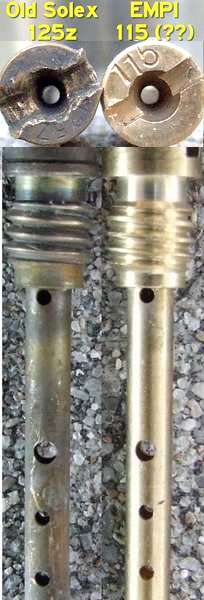
I've done a couple of long photo-heavy threads talking about various carburetors a few years ago. One of them was an EMPI carb, not the one you have but their 30PICT-1. At one point I had the air correction jet out and noticed it really didn't look like that size it said it was - either that or the sizing stamped on there is some other value than DVG stamped on their SOLEX jets. (I've heard various things about those sizes - are they simply a size measurement or are they a flow measurement?) I took this photo - the stock size on the 30PICT-1 was usually 125z, and this EMPI 115 looks to be that size, or perhaps a bit larger. I mention it because you have an EMPI carb as well, but yours would have a smaller a/c jet.
|
|
| Back to top |
|
|
DadsOld74
Samba Member
Joined: October 01, 2013
Posts: 138
Location: Cody, Wyoming USA
|
| Posted: Thu Oct 03, 2013 2:23 pm Post subject: |
|
|
Thank you so much, John.
What would happen if I just changed out those three jets and left the air jet? Wouldn't I be doing better than I am now? It seems I would just be a slight bit rich at RMPs over 3200 or so.
My concern is that I might mess up the air jet - and there will be no turning back. Even if I find a good machine shop to do it, I won't be able to put things back if I move back to the West Coast. I'm holding on to my other jets because of that slight possibility.
Thank you for what you do! I appreciate it.
--Brian |
|
| Back to top |
|
|
DadsOld74
Samba Member
Joined: October 01, 2013
Posts: 138
Location: Cody, Wyoming USA
|
| Posted: Thu Oct 03, 2013 2:30 pm Post subject: |
|
|
-Andy
That's great! It sounds like a lot of trial and error and playing around with it. I may just have to get used to that. I'm sure I'll learn a lot in the process.
The pics are very helpful to let me know what I may be looking for as I search for one. If I could find an "expendable" jet, I may be willing to try my hand at drilling it out.
Enjoy Wyoming! I've been down in Douglas once a year running a camp at the fairgrounds. Nice town.
--Brian |
|
| Back to top |
|
|
gt1953
Samba Member

Joined: May 08, 2002
Posts: 13960
Location: White Mountains Arizona
|
| Posted: Thu Oct 03, 2013 5:47 pm Post subject: |
|
|
A local furnace company may have jet drills. They are very small and precise. I had them fix a jet for me. I soldered it closed then drilled it out. Just my thoughts.
_________________
Volkswagen: We tune what we drive.
Numbers Matching VW's are getting harder to find. Source out the most Stock vehicle and keep that way. You will be glad you did.
72 type 1
72 Squareback
({59 Euro bug, 62, 63, 67, 68, 69, 73 type ones 68 & 69 type two, 68 Ghia all sold}) |
|
| Back to top |
|
|
Juanito84
Samba Member

Joined: March 17, 2012
Posts: 2436
Location: Colorado Mountains
|
| Posted: Sun Nov 17, 2013 7:11 pm Post subject: |
|
|
I have a 1973 manual non-californian and a 1974 manual californian (dual riser). Any suggested jetting for 8000ft operation with and or without ethonal free gasoline?
_________________
If a water cooled engine cools its water with air, isn't it just an overcomplicated air cooled engine? |
|
| Back to top |
|
|
Aussiebug
Samba Member
Joined: June 03, 2002
Posts: 2162
Location: Adelaide Australia
|
| Posted: Mon Nov 18, 2013 3:04 pm Post subject: |
|
|
Dads,
The way these carbs work is as follows.
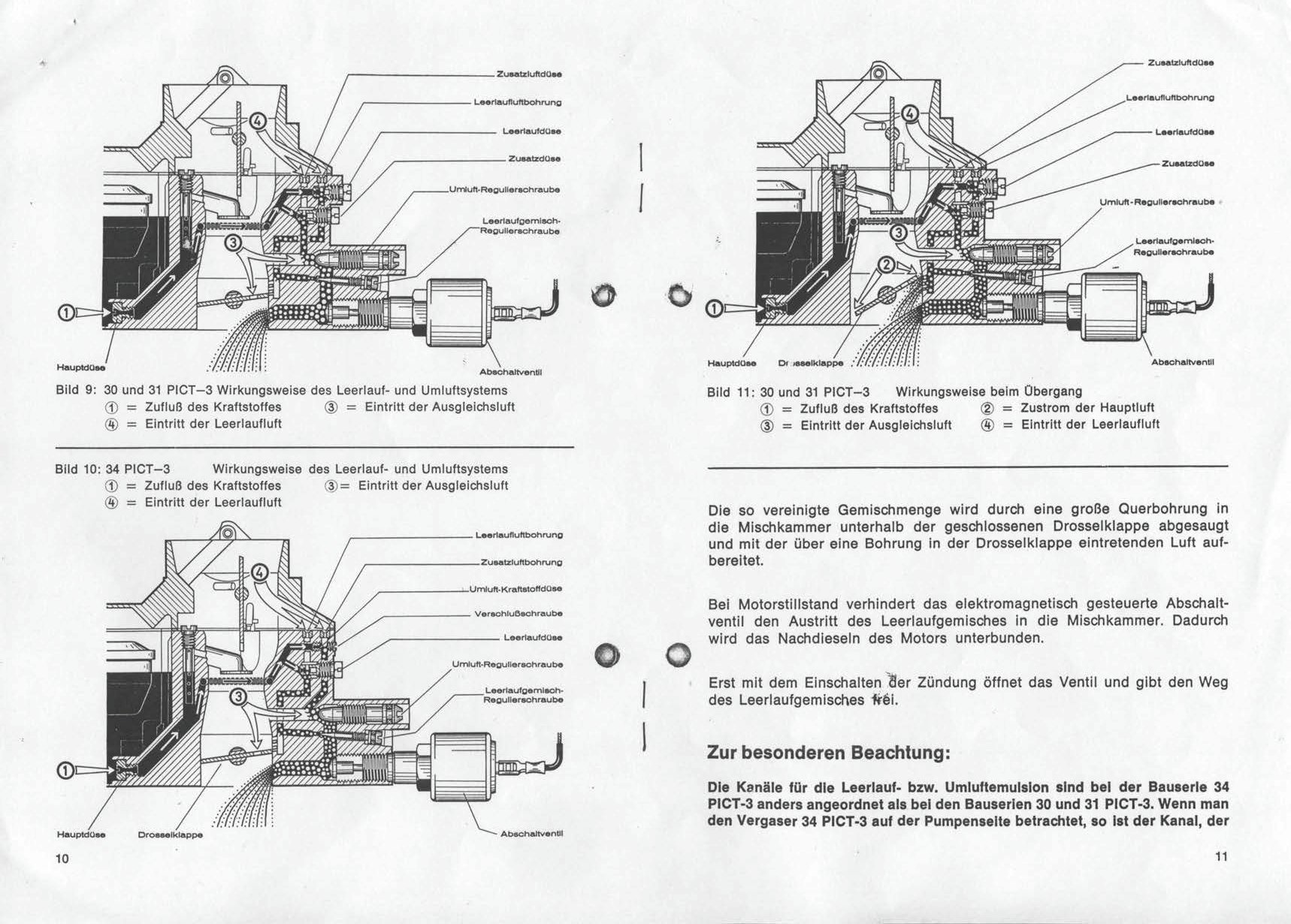
1 the idle jet provides fuel at idle and at lower revs ( via the transfer ports ) up to roughly 2000rpm, gradually handling over the main jet. The idle fuel flows through the main jet to get to the idle jet so the fuel flow of these two are linked - controlled by the size of the main jet. The
idle jet port and transfer ports are in the side of the throat near the closed butterfly so you get a mini Venturi next to the idle port for a good draw of fuel into the throat.
2 the main jet fuel flow depends on the airflow (vacuum) through the main throat, so as those rpms(actually airflow which is a combination of throttle position and rpms) and as the rpms and vacuum rise, the main jet starts flowing too much fuel ( mixture gets richer).
3 so the air correction jet is there to add air to the fuel and bring the mixture back into stiochiometry ( balance), as the rpms rise, working mostly from middle to higher revs
4. But at very high revs the air correction jet does its job too well, leaning the mixture, so the power jet is there to re- richen the mixture at high rpms.
All open- throat carbs have these problems and use a combination of different jet sizes to try to keep the mixture in the ideal range over a wide range of air flows through the throat.
For a 34 pict 3 with a vacuum distributor, the following jets works well...55 idle, 127.5 main, 75 or 80 air correction and 65 power jet.
If you have a centrifugal-only distributor, increase the main jet to a 130 or 132.5 and make sure the accelerator pump is set for max squirt, and that squirt must go straight down the throat, not splashing on anything on the way down...the delivery tube can be twisted a little if needed.
If you have to use alcohol fuels, these have less energy per litre/ gallon, so you need a larger main jet. 10% ethanol ( E10) needs a main jet 2 sizes larger, so go from a 127.5 to a 132.5 for example. E85 (85% ethanol) would need a main jet 8 sizes larger - a 157.5. With THAT level of ethanol you'd also need a larger idle jet, at least a 65 if you can find one.
For information, each change in main jet size changes fuel flow by about 2%.
For altitude operations, you need less fuel because the air is less dense, there is less oxygen in a given volume of air, but carbs work on VOLUME, not oxygen content, so you need to reduce the size of the main jet (calculated above for seal level, distributor you are using, and alcohol content) by one size for each 5000'. Above 10,000', you might also need to reduce the size of the idle jet by one size, for example from 55 to a 50.
These sizes are a ballpark guide only, as engine wear, condition of carb etc will all make a difference in a 40 year old engine, but it should get you close to the ideal.
If you increase the size of the air correction jet to lean it, it will affect the middle and upper rpm mixtures rather than the whole range, so the main jet changes ( and idle jet where needed) are a better option.
_________________
Rob
Rob and Dave's aircooled VW pages
Repairs and maintenance for the home mechanic
http://www.vw-resource.com |
|
| Back to top |
|
|
Juanito84
Samba Member
Joined: March 17, 2012
Posts: 2436
Location: Colorado Mountains
|
| Posted: Mon Nov 18, 2013 7:10 pm Post subject: |
|
|
| Aussiebug wrote: |
Dads,
The way these carbs work is as follows.
1 the idle jet provides fuel at idle and at lower revs ( via the transfer ports ) up to roughly 2000rpm, gradually handling over the main jet. The idle fuel flows through the main jet to get to the idle jet so the fuel flow of these two are linked - controlled by the size of the main jet. The
idle jet port and transfer ports are in the side of the throat near the closed butterfly so you get a mini Venturi next to the idle port for a good draw of fuel into the throat.
2 the main jet fuel flow depends on the airflow (vacuum) through the main throat, so as those rpms(actually airflow which is a combination of throttle position and rpms) and as the rpms and vacuum rise, the main jet starts flowing too much fuel ( mixture gets richer).
3 so the air correction jet is there to add air to the fuel and bring the mixture back into stiochiometry ( balance), as the rpms rise, working mostly from middle to higher revs
4. But at very high revs the air correction jet does its job too well, leaning the mixture, so the power jet is there to re- richen the mixture at high rpms.
All open- throat carbs have these problems and use a combination of different jet sizes to try to keep the mixture in the ideal range over a wide range of air flows through the throat.
For a 34 pict 3 with a vacuum distributor, the following jets works well...55 idle, 127.5 main, 75 or 80 air correction and 65 power jet.
If you have a centrifugal-only distributor, increase the main jet to a 130 or 132.5 and make sure the accelerator pump is set for max squirt, and that squirt must go straight down the throat, not splashing on anything on the way down...the delivery tube can be twisted a little if needed.
If you have to use alcohol fuels, these have less energy per litre/ gallon, so you need a larger main jet. 10% ethanol ( E10) needs a main jet 2 sizes larger, so go from a 127.5 to a 132.5 for example. E85 (85% ethanol) would need a main jet 8 sizes larger - a 157.5. With THAT level of ethanol you'd also need a larger idle jet, at least a 65 if you can find one.
For information, each change in main jet size changes fuel flow by about 2%.
For altitude operations, you need less fuel because the air is less dense, there is less oxygen in a given volume of air, but carbs work on VOLUME, not oxygen content, so you need to reduce the size of the main jet (calculated above for seal level, distributor you are using, and alcohol content) by one size for each 5000'. Above 10,000', you might also need to reduce the size of the idle jet by one size, for example from 55 to a 50.
These sizes are a ballpark guide only, as engine wear, condition of carb etc will all make a difference in a 40 year old engine, but it should get you close to the ideal.
If you increase the size of the air correction jet to lean it, it will affect the middle and upper rpm mixtures rather than the whole range, so the main jet changes ( and idle jet where needed) are a better option. |
Thanks but you're a little misinformed. The aux jet is for idling, not high speed enrichment (power system), that's a different circuit. Also the high speed enrichment system isn't just for bringing back the a/f ratio to stoichiometric from an overworking air correction jet, it's actually designed for enriching the mix to a rich 13:1 to 12:1 ratio. That's because at full throttle the extra evaporating fuel lowers combustion chamber temperatures, which prevents detonation, and also creates more cylinder pressure and therefore more power. Also the small venturi effect off the edge of the throttle plate doesn't really do much of the metering in the idle and off idle areas. It's the much stronger intake manifold vacuum that's being created by the throttle plate that's pulling fuel from the idle and off idle discharge ports.
What I ment was what pilot jet would bring my off idle down to about 15:1 in each one of these carbs at 8000ft? Has anyone experimented with an oxygen sensor at my altitude? The engines are absolute stock with the proper DVDA & SVDA carbs.
_________________
If a water cooled engine cools its water with air, isn't it just an overcomplicated air cooled engine? |
|
| Back to top |
|
|
DadsOld74
Samba Member
Joined: October 01, 2013
Posts: 138
Location: Cody, Wyoming USA
|
| Posted: Thu Nov 21, 2013 5:46 pm Post subject: |
|
|
Wow! Great information ... but, too much for my novice brain. Thanks, Rob, for all your in-depth know-how. Your site is great. It has really helped me several times.
So, in short, maybe I didn't order the right jets. Again, I'm at 5000 feet. Our gasoline typically has about 10% ethanol.
I ordered the following jets -
Idle Jet of 55, Main Jet of 122.5, Power Jet of 45. I'm too chicken to modify the air jet. So, it is stock.
My goal was to try to get the car back together over Thanksgiving weekend. If it doesn't happen, though, because I need to order different jets, that's OK.
How will it run with these jets?
What do you think?
-Brian |
|
| Back to top |
|
|
Juanito84
Samba Member
Joined: March 17, 2012
Posts: 2436
Location: Colorado Mountains
|
| Posted: Sat Nov 23, 2013 5:37 pm Post subject: |
|
|
| DadsOld74 wrote: |
Wow! Great information ... but, too much for my novice brain. Thanks, Rob, for all your in-depth know-how. Your site is great. It has really helped me several times.
So, in short, maybe I didn't order the right jets. Again, I'm at 5000 feet. Our gasoline typically has about 10% ethanol.
I ordered the following jets -
Idle Jet of 55, Main Jet of 122.5, Power Jet of 45. I'm too chicken to modify the air jet. So, it is stock.
My goal was to try to get the car back together over Thanksgiving weekend. If it doesn't happen, though, because I need to order different jets, that's OK.
How will it run with these jets?
What do you think?
-Brian |
That looks like what most accept as 5000ft jets.
But like I said previously, there is no power jet. It's an auxilary jet to the idle circuit and only affects idle and off idle, but of the two, mainly idle. The one you called "idle jet" is the pilot jet. It also affects both idle and off idle, but of the two, mainly off idle.
A nerd's question about auxilary jets
_________________
If a water cooled engine cools its water with air, isn't it just an overcomplicated air cooled engine? |
|
| Back to top |
|
|
Aussiebug
Samba Member
Joined: June 03, 2002
Posts: 2162
Location: Adelaide Australia
|
| Posted: Mon Nov 25, 2013 12:26 am Post subject: |
|
|
| Juanito84 wrote: |
Thanks but you're a little misinformed. The aux jet is for idling, not high speed enrichment (power system), that's a different circuit. |
HUH? I guess it depends on what YOU call the Aux jet.
If you are talking about the two jets in the right side of the carb, then they are the idle jet and the POWER jet (sometimes called the Aux fuel jet). If you remove the power jet you can see a drilling going straight back into the emulsion tube under the air correction jet, which is where the main fuel feed for the throat is (fuel comes through the main jet to the emulsion tube where air is added via the air correction jet and a fizzy mixture of fuel/air is fed to the throat - the power jet ads fuel to that circuit). This jet sits in a protusion (channel) nearer to the top section of the carb.
The idle jet sits in a protrusion (channel) heading to the bottom of the carb where the idle/transfer ports are next to the throttle butterfly.
_________________
Rob
Rob and Dave's aircooled VW pages
Repairs and maintenance for the home mechanic
http://www.vw-resource.com |
|
| Back to top |
|
|
DadsOld74
Samba Member
Joined: October 01, 2013
Posts: 138
Location: Cody, Wyoming USA
|
| Posted: Mon Nov 25, 2013 11:34 am Post subject: |
|
|
Sounds great. Thanks. I'll get it all set up and see how it runs. I'm making so many changes at once, though, (carb, distributor, adding a thermostat, declogging the heat riser) if it doesn't fire right up and run right, I'll have to go through a process of elimination to figure out what is not working.
You've all be extremely helpful. Thank you. |
|
| Back to top |
|
|
Juanito84
Samba Member
Joined: March 17, 2012
Posts: 2436
Location: Colorado Mountains
|
| Posted: Tue Dec 03, 2013 7:07 pm Post subject: |
|
|
| Aussiebug wrote: |
| Juanito84 wrote: |
Thanks but you're a little misinformed. The aux jet is for idling, not high speed enrichment (power system), that's a different circuit. |
HUH? I guess it depends on what YOU call the Aux jet.
If you are talking about the two jets in the right side of the carb, then they are the idle jet and the POWER jet (sometimes called the Aux fuel jet). If you remove the power jet you can see a drilling going straight back into the emulsion tube under the air correction jet, which is where the main fuel feed for the throat is (fuel comes through the main jet to the emulsion tube where air is added via the air correction jet and a fizzy mixture of fuel/air is fed to the throat - the power jet ads fuel to that circuit). This jet sits in a protusion (channel) nearer to the top section of the carb.
The idle jet sits in a protrusion (channel) heading to the bottom of the carb where the idle/transfer ports are next to the throttle butterfly. |
I'm just saying that the auxiliary jet is commonly and INCORRECTLY called a power jet. It does not help with keeping the a/f mix in check at high RPM as the common myth would have it. The auxiliary jet mainly helps at low engine loads, added as an emissions device to keep a more constant a/f ratio at such low loads. Note that both the auxiliar and pilot jets have similar air bleeds and are innertwined in the same circuit. Power jets don't have air bleeds. True, the auxiliary jet will be supplying "all she's got" at high rpm and load but the small size of the jet coupled with the air bleed means that "all she's got" wouldn't amount to a any noticeable change in the a/f ratio at such high rpms and loads.
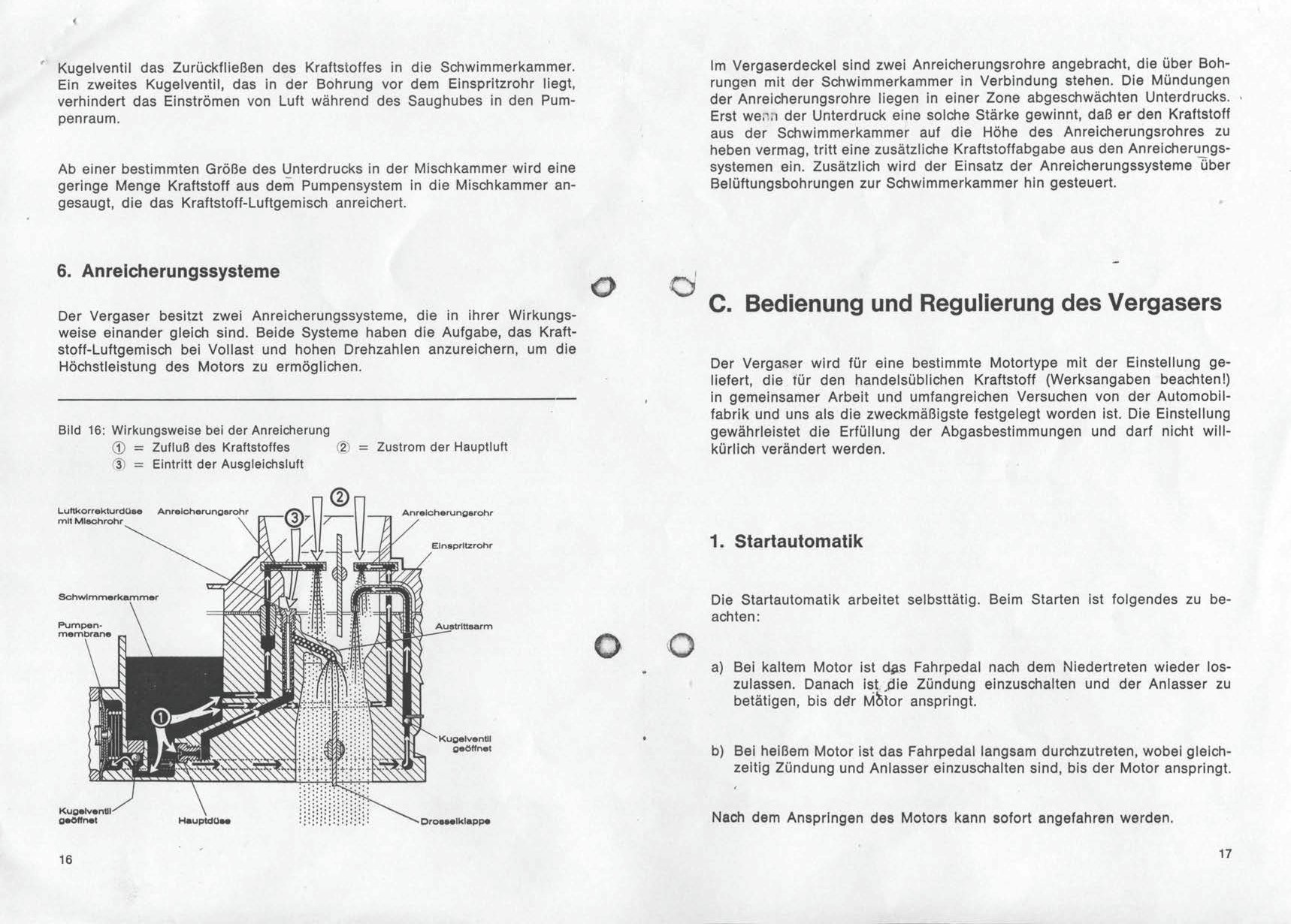
That being said, there is a power jet, and the 34 PICT carbs actually have two. These jets are located in the choke housing and protrude out into the middle kind of like the main fuel circuit. They are #19 in the diagram. These do begin adding fuel at loads and rpms higher than when the main fuel jet began doing it's thing.
_________________
If a water cooled engine cools its water with air, isn't it just an overcomplicated air cooled engine? |
|
| Back to top |
|
|
DadsOld74
Samba Member
Joined: October 01, 2013
Posts: 138
Location: Cody, Wyoming USA
|
| Posted: Sat Jan 18, 2014 8:32 pm Post subject: |
|
|
It's been a while, but I finally had a little time for my project, so I decided to put the jets I ordered into my new Bocar carb.
Main jet and Idle jet were easy. But the power jet (aux fuel jet) is not what I expected. On the ACN description, the idle jet and power jet are said to be interchangeable - physically the same shape, but should be different sizes. So, I ordered one to serve as the power jet and the other to serve as the idle jet.
Now that I've dug into it a little, it appears that the power (aux fuel) jet is a tiny little thing hidden behind a brass plug just to the above left of the idle jet. I do not have a replacement for that jet nor can I find anybody who sells them.
I'm assuming it will work to let that circuit run a little rich - and again, I'm not changing the air aux jet. But, any advice is a good thing. Thanks.
_________________
--Brian ('74 standard bug)
"If one does not fail at times, then one has not challenged himself." - Ferdinand Porsche |
|
| Back to top |
|
|
Juanito84
Samba Member
Joined: March 17, 2012
Posts: 2436
Location: Colorado Mountains
|
| Posted: Sun Jan 19, 2014 8:02 am Post subject: |
|
|
It depends on the carb. On some they use the same style of jet for both the pilot (idle) jet and aux jet, whereas on others the aux jet is that little one like on yours.
But like I said, it's not a power jet as most people say it is. Solex literature shows the aux jet does its job at idle or closed throttle. I do believe it's an emissions jet that helps keep the air fuel ratio closer to stoic when engine braking without having to have an extremely rich idle as in the case of pre PICT-3 carburetors that didn't have the aux jet.
The power jets consist of those two tubes in that protrude in the choke housing along with the accelerator pump nozzle acting as a third power jet. Changing the aux jet will not change their functions.
The power jets are not changeable. On all carburetors I have seen for all kinds of cars the power jets are never changeable. Power jets aren't about an exact a/f ratio like all the other jets. Their job is to just run rich. If the main jet is close to stoichiometric then the power jets will simply enrich the a/f ratio to some 13:1 or richer at full throttle. This protects the engine by preventing engine knock at high loads. Changing the auxiliary fuel jet won't change the power jets' function. It affects low load a/f ratios. You could even plug off the aux jet and it would simply run more like a PICT-1 or-2 carburetor.
_________________
If a water cooled engine cools its water with air, isn't it just an overcomplicated air cooled engine? |
|
| Back to top |
|
|
|