| Author |
Message |
Rifai.Ad
Samba Member

Joined: December 24, 2019
Posts: 58
Location: Trollhattan, Sweden

|
 Posted: Mon Aug 04, 2025 2:17 pm Post subject: Finding the ground terminal on a new alternator Posted: Mon Aug 04, 2025 2:17 pm Post subject: Finding the ground terminal on a new alternator |
 |
|
After my original generator started causing some sort of internal short circuit, I decided I might as well transition to an alternator. I bought an SSP conversion kit and all went well until it was time to connect the ground wire to the new alternator. The instructions mention the existence of such a terminal, but nothing about its whereabouts. Apparently the bolt terminal is for the D+ and the spade one goes to the generator warning light on the dash. I figured i might as well screw the grounding wire under the screw towards the rear of the alternator, but almost rounded the head due to how tight it is.
Any information regarding where to connect the ground to on this new alternator is greatly appreciated.
|
|
| Back to top |
|
 |
ashman40
Samba Member

Joined: February 16, 2007
Posts: 16779
Location: North Florida, USA
|
| Posted: Mon Aug 04, 2025 3:57 pm Post subject: Re: Finding the ground terminal on a new alternator |
|
|
| Rifai.Ad wrote: |
... all went well until it was time to connect the ground wire to the new alternator. The instructions mention the existence of such a terminal, but nothing about its whereabouts.
|
Unlike the earlier generators and externally regulated alternators... the AL-82 style alternator you installed (2-wire alternator) does not normally require a ground wire. One reason for having a ground wire is so the VR can share the same ground potential as the generator/alternator. So it can measure the output voltage and get the same reading. This is why generators and early externally regulated alternators (AL-7 had a D- or ground wire running between the remotely mounted VR and the case of the generator/alternator. had a D- or ground wire running between the remotely mounted VR and the case of the generator/alternator.
The AL-82 style alternators have INTERNAL VRs. The internal VR shares the same ground as the alternator... the case of the alternator. The case grounds to the engine (via the alternator stand) which in turn grounds thru the transmission which is connected to the chassis via a braided cable at the front of the transmission.
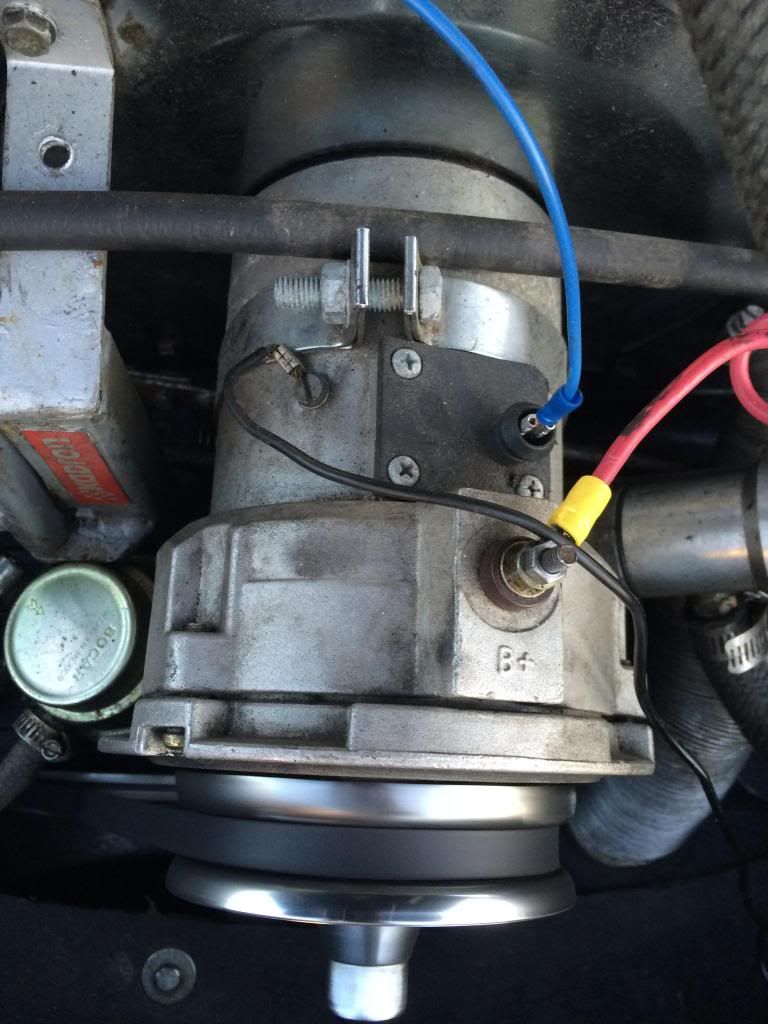
I can think of ONE other reason you would want a dedicated ground wire.... if you painted the alternator case and/or the alternator stand and didn't want to scrape the paint off to ensure a good electrical ground from the alternator case to the engine case. In this case, you would NEED to run a dedicated ground wire between the alternator body and someplace with a good ground (engine, transmission or chassis). I found this pic off the internet of an AL-82 alternator with a spot for a ground screw (black wire).
Note: if your alternator case did not offer a good path to ground for the alternator (eg. painted)... the use of such a dedicated ground wire would be required. But the wire gauge for this ground wire MUST be nearly the same gauge as the B+ wire. The above pic is not a good example of this. Presuming the above pictured alternator case is properly grounded thru the engine stand, the black ground wire is unnecessary.
| Rifai.Ad wrote: |
| Apparently the bolt terminal is for the D+ and the spade one goes to the generator warning light on the dash. |
You have the labels mixed up. The threaded stud should be marked "B+" (see above pic) and the smaller push on terminal should be marked "D+". Admittedly, not all alternators have both markings. B+ is the high amp output with a thick red wire that runs to the junction below the left rear seat. Here it connects to the wire coming from the battery positive terminal and the red #30 wire that runs to the front of the car. Some buggies will run the B+ wire to the starter solenoid threaded stud that the positive battery cable connects to. This is functionally the same as joining with the wires below the rear seat.
The smaller D+ wire runs to the GEN lamp in the speedometer. When you turn the key to ON/RUN before you start the engine, the GEN lamp (powered from the fusebox) turns ON and grounds thru the alternator D+ terminal. As the current coming from the GEN lamp flows thru the alternator it passes thru the field coil. This small current flow thru the field coil creates a magnetic field which will start the alternator charging. Without this current flow from the GEN lamp... the alternator never starts charging. This means if you don't see the GEN lamp turn ON before you start the engine, the alternator will not start charging. Even a blown GEN lamp bulb will prevent the alternator from charging! Always confirm the OIL and GEN lamps turn ON before you crank the engine.
Once the engine is running and the alternator starts outputting a charge, the alternator will sends 12v+ OUT the D+ terminal. Once the engine is running and the alternator starts charging the 12v+ coming out the D+ "runs into" the 12v+ coming from the GEN lamp. The GEN lamp "sees" 12v+ coming from both of its connections. Equal voltage on each connection means no current is flowing thru the GEN lamp... it turns OFF once the engine the charging system is outputting current. The reason for outputting 12v on D+ is actually to maintain the field coil charge so the alternator continues to output a charge.
_________________
AshMan40
---------------------------
'67 Beetle #1 {project car that never made it to the road  } }
'75 Beetle 1200LS (RHD Japan model) {junked due to frame rot}
'67 Beetle #2 {2019 project car - Wish me luck!} |
|
| Back to top |
|
|
Rifai.Ad
Samba Member
Joined: December 24, 2019
Posts: 58
Location: Trollhattan, Sweden
|
| Posted: Mon Aug 04, 2025 8:42 pm Post subject: Re: Finding the ground terminal on a new alternator |
|
|
| ashman40 wrote: |
Unlike the earlier generators and externally regulated alternators... the AL-82 style alternator you installed (2-wire alternator) does not normally require a ground wire. One reason for having a ground wire is so the VR can share the same ground potential as the generator/alternator. So it can measure the output voltage and get the same reading. This is why generators and early externally regulated alternators (AL-7 had a D- or ground wire running between the remotely mounted VR and the case of the generator/alternator.
The AL-82 style alternators have INTERNAL VRs. The internal VR shares the same ground as the alternator... the case of the alternator. The case grounds to the engine (via the alternator stand) which in turn grounds thru the transmission which is connected to the chassis via a braided cable at the front of the transmission.
I can think of ONE other reason you would want a dedicated ground wire.... if you painted the alternator case and/or the alternator stand and didn't want to scrape the paint off to ensure a good electrical ground from the alternator case to the engine case. In this case, you would NEED to run a dedicated ground wire between the alternator body and someplace with a good ground (engine, transmission or chassis). I found this pic off the internet of an AL-82 alternator with a spot for a ground screw (black wire).
Note: if your alternator case did not offer a good path to ground for the alternator (eg. painted)... the use of such a dedicated ground wire would be required. But the wire gauge for this ground wire MUST be nearly the same gauge as the B+ wire. The above pic is not a good example of this. Presuming the above pictured alternator case is properly grounded thru the engine stand, the black ground wire is unnecessary.
| Rifai.Ad wrote: |
| Apparently the bolt terminal is for the D+ and the spade one goes to the generator warning light on the dash. |
You have the labels mixed up. The threaded stud should be marked "B+" (see above pic) and the smaller push on terminal should be marked "D+". Admittedly, not all alternators have both markings. B+ is the high amp output with a thick red wire that runs to the junction below the left rear seat. Here it connects to the wire coming from the battery positive terminal and the red #30 wire that runs to the front of the car. Some buggies will run the B+ wire to the starter solenoid threaded stud that the positive battery cable connects to. This is functionally the same as joining with the wires below the rear seat.
The smaller D+ wire runs to the GEN lamp in the speedometer. When you turn the key to ON/RUN before you start the engine, the GEN lamp (powered from the fusebox) turns ON and grounds thru the alternator D+ terminal. As the current coming from the GEN lamp flows thru the alternator it passes thru the field coil. This small current flow thru the field coil creates a magnetic field which will start the alternator charging. Without this current flow from the GEN lamp... the alternator never starts charging. This means if you don't see the GEN lamp turn ON before you start the engine, the alternator will not start charging. Even a blown GEN lamp bulb will prevent the alternator from charging! Always confirm the OIL and GEN lamps turn ON before you crank the engine.
Once the engine is running and the alternator starts outputting a charge, the alternator will sends 12v+ OUT the D+ terminal. Once the engine is running and the alternator starts charging the 12v+ coming out the D+ "runs into" the 12v+ coming from the GEN lamp. The GEN lamp "sees" 12v+ coming from both of its connections. Equal voltage on each connection means no current is flowing thru the GEN lamp... it turns OFF once the engine the charging system is outputting current. The reason for outputting 12v on D+ is actually to maintain the field coil charge so the alternator continues to output a charge. |
Really really useful info, thank you very much! The alternator indeed does not have any markings, which confused me further. The instructions do say to route a red cable to the solenoid for charging, but people mentioned that the original red cable was enough for 50 amps, so I used the original one. I'll go ahead and connect the warning light as well and take care of the stuff under the back seat, and isolate the ground wire for now. Thanks a lot! |
|
| Back to top |
|
|
|