| Author |
Message |
peasant
Samba Member

Joined: April 25, 2009
Posts: 321

|
 Posted: Mon Aug 13, 2012 6:05 pm Post subject: Posted: Mon Aug 13, 2012 6:05 pm Post subject: |
 |
|
Thanks for the clarification, that link is really good too. That one is bookmarked.
_________________
89 wolfsberg weekender carat
89 Westfalia |
|
| Back to top |
|
 |
67r69s
Samba Member
Joined: August 14, 2012
Posts: 4
Location: Ottawa, Canada
|
| Posted: Tue Aug 14, 2012 6:07 am Post subject: |
|
|
| This is just general advice but don't assume anything as far as measurements go. Measure that crank and ensure that your clearances will be correct with the new bearings. Measure everything, even new parts. It's a pain and it takes time but it can prevent a lot of heartbreak. and yeah, you'll need access to a micrometer. |
|
| Back to top |
|
|
Zero419
Samba Member

Joined: January 11, 2008
Posts: 2160
Location: PA
|
| Posted: Tue Aug 14, 2012 7:32 am Post subject: |
|
|
I love these threads, thanks for the write up.
I did the same thing a couple of years ago. I hope you have better luck then me. Mine lasted 10,000 or so miles.
Bad cam or lifters, not sure which, but they ate each other up.
_________________
1987 Westy Auto Bostig 2.0 Ztec |
|
| Back to top |
|
|
the man with the van
Samba Member
Joined: August 09, 2012
Posts: 31
Location: Albuquerque, NM
|
| Posted: Tue Aug 14, 2012 7:29 pm Post subject: |
|
|
Ok I will take the advice from stevey88 and 67r69s and measure my crank as soon as I can find a micrometer that will fit... harbour freight has finally failed me
The only reason I wasn't being very precise on the measurements before ordering my bearings is that as far as I can tell they only have 3 sizes: Standard, + .25mm, and +.50mm... But it sounds like you should always make sure your crank is to spec. |
|
| Back to top |
|
|
stevey88
Samba Member
Joined: January 16, 2008
Posts: 1317
Location: Fremont, SF Bay Area
|
| Posted: Tue Aug 14, 2012 8:51 pm Post subject: |
|
|
| the man with the van wrote: |
Ok I will take the advice from stevey88 and 67r69s and measure my crank as soon as I can find a micrometer that will fit... harbour freight has finally failed me
The only reason I wasn't being very precise on the measurements before ordering my bearings is that as far as I can tell they only have 3 sizes: Standard, + .25mm, and +.50mm... But it sounds like you should always make sure your crank is to spec. |
You don't know if your crank is standard or regrind to 10 thou ( .25mm ) or 20 thou under size so you have to measure. Harbor Freight no longer sell the micrometer set that can measure to 0.0001 inch so you have to get another one. You can find decent micrometer on ebay with 0.0001 resolution like this one
http://www.ebay.com/itm/Micrometer-Caliper-Set-Wel...19d41823f3
But I am not sure of the quality of this one and the seller did not say anything about the calibration standard. I have the early harbor freight set that have the 0.0001 resolution and also a set of the Blue-point that measure in mm and have digital read out. Both is decent as I check them with a Mitutoyo gauge block set.
_________________
Steve |
|
| Back to top |
|
|
the man with the van
Samba Member
Joined: August 09, 2012
Posts: 31
Location: Albuquerque, NM
|
| Posted: Tue Aug 14, 2012 9:49 pm Post subject: |
|
|
And finally it hits me, the bearings are oversized to fit on a crank that has been ground down. Wow I've definitely had the whole thing backwards. Thanks Stevey for persisting to get this through to me. It makes me wonder though, why doesn't GW just include bearings in their rebuild sets? They should know better than anybody what size they are grinding the crank to. I guess if they made it too easy everybody would be doing it.
At least I have a one in three chance that the right bearings are coming in. I need to try and find a micrometer locally, I'm tired of waiting on shipping. Hopefully somewhere cheaper than Grainger |
|
| Back to top |
|
|
Zero419
Samba Member
Joined: January 11, 2008
Posts: 2160
Location: PA
|
| Posted: Wed Aug 15, 2012 5:32 am Post subject: |
|
|
Because your case could be bored (rare) and that would require a different size bearing.
_________________
1987 Westy Auto Bostig 2.0 Ztec |
|
| Back to top |
|
|
dobryan 
Samba Member

Joined: March 24, 2006
Posts: 17360
Location: Brookeville, MD
|
|
| Back to top |
|
|
veloandy
Samba Member

Joined: December 04, 2010
Posts: 363
Location: Fort Collins, Colorado, USA
|
| Posted: Wed Aug 15, 2012 7:13 am Post subject: |
|
|
| dobryan wrote: |
| Since he's already got the bearings on the way could he install them and the crank and then use plastigauge to see if there is correct clearances? Might be an alternative to getting a micrometer at this stage? |
Unfortunately, plastigauge ( http://www.plastigaugeusa.com/how.html ) only seems to work on the center split bearing and rod bearings (and it only works on the rod bearings if you can keep the rods from wiggling as you torque them down). When I was rebuilding my air cooled, I couldn't figure out how to use plastigauge on the 360-degree-ring-type bearings at the front and rear of the crank.
I ended up measuring the front and rear main bearing clearances with a dial caliper like this one from Harbor freight: http://www.harborfreight.com/6-inch-dial-caliper-66541.html. It has gradations down to .001, which means its measuring accuracy is .0001 (b/c you can estimate between the two most-fine gradations). A micrometer would have been better and less flexy at these tiny measurements...but I felt a steel dial caliper was sufficient to tell me that my bearing clearances were no less than .0005 and no greater than .002.
A couple of other things to consider:
1. Be careful getting the oil pickup tube sealed when you put it back in!
2. As you reassemble the case, take your time torquing down the case bolts, and regularly check that the crank still turns easily. Sometimes the main bearings like to jump off the dowel pin, which will then screw up the bearing if you torque down the case. If this happens, crank will get harder to turn as you torque down the case bolts...if you go slowly, you'll notice this change before any damage is done to the bearing.
Excellent thread! Keep up the good work!
-Andy |
|
| Back to top |
|
|
dobryan
Samba Member
Joined: March 24, 2006
Posts: 17360
Location: Brookeville, MD
|
| Posted: Wed Aug 15, 2012 7:33 am Post subject: |
|
|
| veloandy wrote: |
| dobryan wrote: |
| Since he's already got the bearings on the way could he install them and the crank and then use plastigauge to see if there is correct clearances? Might be an alternative to getting a micrometer at this stage? |
Unfortunately, plastigauge ( http://www.plastigaugeusa.com/how.html ) only seems to work on the center split bearing and rod bearings (and it only works on the rod bearings if you can keep the rods from wiggling as you torque them down). When I was rebuilding my air cooled, I couldn't figure out how to use plastigauge on the 360-degree-ring-type bearings at the front and rear of the crank. |
 Of course! Of course!
_________________
Dave O
'87 Westy w/ 2010 Subaru EJ25 (Vanaru) and Peloquin TBD
"To travel hopefully is a better thing than to arrive." Robert Louis Stevenson
MD>Canada>AK>WA>OR>CA>AZ>UT>WY>SD
https://www.thesamba.com/vw/forum/viewtopic.php?t=620646
Building a bus for travel in Europe (euroBus)
https://www.thesamba.com/vw/forum/viewtopic.php?t=695371
The Western Syncro build
https://www.thesamba.com/vw/forum/viewtopic.php?t=746794 |
|
| Back to top |
|
|
stevey88
Samba Member
Joined: January 16, 2008
Posts: 1317
Location: Fremont, SF Bay Area
|
| Posted: Wed Aug 15, 2012 9:08 am Post subject: |
|
|
| Quote: |
| It has gradations down to .001, which means its measuring accuracy is .0001 (b/c you can estimate between the two most-fine gradations). |
Sorry to disagree. The accuracy of the caliper is plus or minus 0.001 so you may get a reading with the resolution of 0.0001 but it could be 0.001 off either way. If you just want to see if the crank has been grind down, the caliper will do.
_________________
Steve |
|
| Back to top |
|
|
tencentlife
Samba Member

Joined: May 02, 2006
Posts: 10163
Location: Abiquiu, NM, USA
|
| Posted: Wed Aug 15, 2012 10:28 am Post subject: |
|
|
Right. You need only a caliper to find out if a crank has been ground undersize because the undersize increments are 0.010" (0.25mm) per grind, for such a gross measurement any vernier caliper will do.
Same goes for assessing whether the case has been align-bored, then the increments are even larger, 0.020" (0.5mm).
But both those things can be determined more quickly when an existing engine is torn down, though, by simply reading the markings on the back of the bearings. I have detailed in earlier threads how to decipher the markings.
The micrometer comes in when it's time to assess the accuracy of the crank grind, measuring the journals for oval and taper requires higher resolution and repeatability than can be attained with any caliper. That, and to take dimensions in order to transfer them to other instruments.
To assess the accuracy of the main bearing saddle bores for oval and taper, you need either a dial bore gauge to measure directly, or quality snap gauges and a micrometer, but using snap gauges requires very experienced hands.
To use the dial bore gauge, you first dial the mic to the target dimension, then transfer that to the dial bore gauge and zero it there. Then probe the bores to find out how far off that dimension the saddle bores are. You use this same technique to check the rod big end bores. Both these checks are done sans bearings, what you are checking is the accuracy of machining of the bearing housing.
Then to measure bearing oil clearance, the main bearings must be mounted in the case and the case fasteners fully torqued. For rod bearings the bearing shells must be installed in the rods and fully torqued. Then you mic each crank journal, transfer that dimension to the dial bore gauge and zero it there. Probe the ID of the mounted bearings to determine how much each bearing internal dimension differs from the diameter of the journal that will run in it. The measured difference is the oil clearance.
A full-circle main bearing will not be round in hand, it must be clamped in the case saddle and fully torqued to assume its running shape. It should also have an interference fit in the case saddles of about 0.002", which is easiest to assess by feel. Once again, a caliper measurement of a main bearing is too coarse for determining anything except whether it is std. or off size.
Once clamped in the case, a bearing ID is not a circle, the main bearing ID should be about 0.001" larger in the horizontal axis than the vertical in a boxer engine (for engines in general, it should be larger in the direction of force). Same goes for rod bearings when installed in the rods and fully torqued; 0.001" larger ID along the rod axis, or direction of force.
Plastigauge is swell if you don't have proper instruments, but it can only be used on split bearings, there is no method to use it to check oil clearance on full-circle bearings.
_________________
Shop for unique and useful Vanagon accessories at the Vanistan shop:
https://intrepidoverland.com/vanistan/
also available at VanCafe.com!
Please don't PM here, I will not reply.
Last edited by tencentlife on Tue Aug 28, 2012 7:22 am; edited 1 time in total |
|
| Back to top |
|
|
the man with the van
Samba Member
Joined: August 09, 2012
Posts: 31
Location: Albuquerque, NM
|
| Posted: Sun Aug 19, 2012 9:49 am Post subject: |
|
|
Heating up gears in canola oil
I had everything ready incase some force was necessary
They heat up pretty fast and had reached 220f when I first checked on the temperature. They slipped right on with zero effort
|
|
| Back to top |
|
|
Zeitgeist 13
Samba Member

Joined: March 05, 2009
Posts: 12177
Location: Port Manteau
|
| Posted: Sun Aug 19, 2012 9:53 am Post subject: |
|
|
I use an old Krupps coffeemaker hotplate for that same task ^
_________________
Casey--
'89 Bluestar ALH
'01 Weekender --> full camper
NEAT, no ICE. |
|
| Back to top |
|
|
the man with the van
Samba Member
Joined: August 09, 2012
Posts: 31
Location: Albuquerque, NM
|
| Posted: Sun Aug 19, 2012 10:03 am Post subject: |
|
|
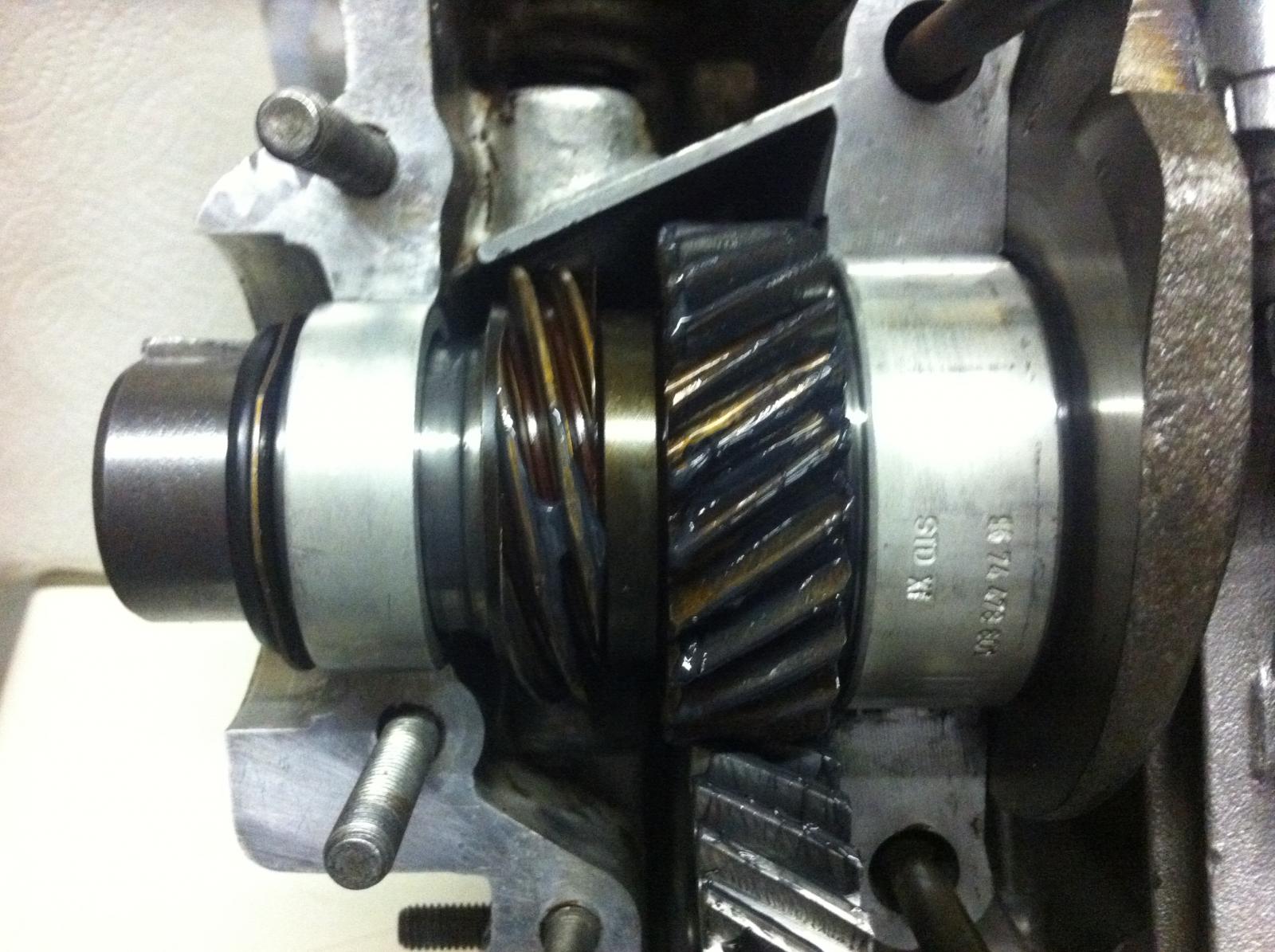
Measuring camshaft endplay
Crank, camshaft and distributer driveshaft in case. Distributer is installed to hold the driveshaft in place. Sorry about the blury pic
Here's a closeup of the pulley end.
Closeup of flywheel end. I put more assembly lube everywhere after taking these pics
Timing dots on the Crank and Camshaft gears lined up
Sealant on the right case half
Enigne sealed. Do not try to do this by yourself... it was hell
|
|
| Back to top |
|
|
the man with the van
Samba Member
Joined: August 09, 2012
Posts: 31
Location: Albuquerque, NM
|
| Posted: Sun Aug 19, 2012 10:07 am Post subject: |
|
|
| Zeitgeist 13 wrote: |
| I use an old Krupps coffeemaker hotplate for that same task ^ |
Just dry!? Or with oil? |
|
| Back to top |
|
|
Zeitgeist 13
Samba Member
Joined: March 05, 2009
Posts: 12177
Location: Port Manteau
|
| Posted: Sun Aug 19, 2012 10:22 am Post subject: |
|
|
Yeah, I just set the gear on there until it gets nice and toasty, and it slides right into place. No fuss no muss.
_________________
Casey--
'89 Bluestar ALH
'01 Weekender --> full camper
NEAT, no ICE. |
|
| Back to top |
|
|
the man with the van
Samba Member
Joined: August 09, 2012
Posts: 31
Location: Albuquerque, NM
|
| Posted: Sun Aug 19, 2012 10:30 am Post subject: |
|
|
| Zeitgeist 13 wrote: |
| Yeah, I just set the gear on there until it gets nice and toasty, and it slides right into place. No fuss no muss. |
Nice! That's easy |
|
| Back to top |
|
|
Robw_z
Samba Member
Joined: April 28, 2007
Posts: 997
|
| Posted: Sun Aug 19, 2012 2:45 pm Post subject: |
|
|
So what size main bearings did you end up going with?
-Rob |
|
| Back to top |
|
|
Mark
Samba Member

Joined: January 20, 2003
Posts: 1523
Location: Victoria, BC Canada
|
| Posted: Sun Aug 19, 2012 4:59 pm Post subject: |
|
|
| Zeitgeist 13 wrote: |
| Yeah, I just set the gear on there until it gets nice and toasty, and it slides right into place. No fuss no muss. |
Excellent, I use a small toaster oven normally used for for smaller powder coating jobs. No oil to interfere or create an extra burning hazard. |
|
| Back to top |
|
|
|