| Author |
Message |
sunkid
Samba Member

Joined: March 31, 2008
Posts: 31
Location: San Diego, CA

|
 Posted: Wed Aug 20, 2014 7:33 am Post subject: YAVAWD - Yet Another Vanagon AUX Wiring Diagram - Fuses? Posted: Wed Aug 20, 2014 7:33 am Post subject: YAVAWD - Yet Another Vanagon AUX Wiring Diagram - Fuses? |
 |
|
Finally putting an AUX battery, a small solar panel, and an inverter into my '86 Westy "Jezebel" (aka. Trusty Rusty).
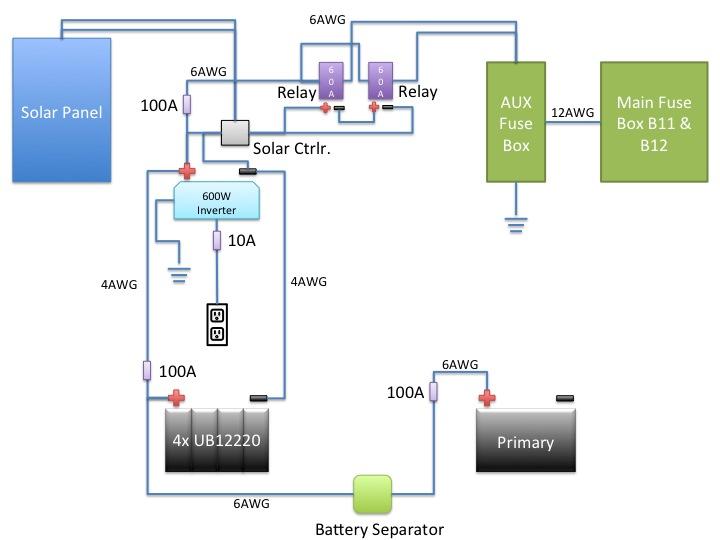
Here is the plan:
My question is, do I need all three of the 100A fuses? Do I have the placement right? Are the sized correctly? The inverter is rated at 600W, 1100W peak.
Thanks for any input and advice. |
|
| Back to top |
|
 |
sunkid
Samba Member
Joined: March 31, 2008
Posts: 31
Location: San Diego, CA
|
| Posted: Thu Aug 21, 2014 8:54 am Post subject: |
|
|
bump goes the weasel  |
|
| Back to top |
|
|
crazyvwvanman
Samba Member
Joined: January 28, 2008
Posts: 10476
Location: Orbiting San Diego
|
| Posted: Thu Aug 21, 2014 8:57 am Post subject: |
|
|
Ok, it won't work as drawn. Also not quite enough detail. Better to make the negative wires a contrasting color from the positive wires. What is the purpose of the two 60 amp relays?
Mark |
|
| Back to top |
|
|
thatvwbusguy
Samba Member

Joined: April 18, 2007
Posts: 1712
Location: Newmarket, New Hampshire
|
| Posted: Thu Aug 21, 2014 9:38 am Post subject: |
|
|
Connect the solar panel directly to the auxiliary battery bank. Not sure what the two 60A relays shown at the top are supposed to be doing, but they won't do anything as shown.
There is absolutely no need for 6AWG wire on the way from the solar panel to the battery bank. 10AWG is the most you would ever need on the charging side.
Larger wire could be used from the battery out to the devices you are powering, but even then the 6AWG is likely overkill. What are you planning to power with your auxiliary battery? The 4 x UB12220 only has 88Ah, which isn't a lot of capacity to be planning on powering anything that will require the use of 6AWG wires.
Lots of people have run into troubles with the 4 x UB12220 setup within a couple years of installation. Of the ten or more people I know who went with the UB12220's, only one of them is still using them and his van is always connected to a Noco Genius charger when it is parked for more than a day.
Fuses should be located as close to the positive posts of both batteries as possible to protect the wiring.
Let us know what size solar panel and what type of charge controller you are planning to use as well as what you will be using to separate the batteries and it will be much easier to give useful information.
_________________
Jay Brown
'85 Zetec Westfalia
Newmarket, NH
If you want others to be happy, practice compassion.
If you want to be happy, practice compassion. |
|
| Back to top |
|
|
crazyvwvanman
Samba Member
Joined: January 28, 2008
Posts: 10476
Location: Orbiting San Diego
|
| Posted: Thu Aug 21, 2014 9:54 am Post subject: |
|
|
Many solar controllers have an extra set of output wires meant for lights and other small loads. These draw on the battery. Sometimes this function is programmable and other times it is fixed. A usual default is to use these for loads that you want to shut off if the battery becomes too low, as protection for the battery from total discharge. As for the relays I assume the intent is to use this "lighting-load" output of the solar controller to control the relays to shut off power to the whole fuse panel when the battery is nearly drained. That way even though this output can only drive smaller loads you can use it to control large loads via a relay. But why 2 relays and why the series wiring of the relay control coils instead of parallel? And of course the relays themselves will be active and using up some battery power at all times until such a low voltage shutdown occurs.
Mark |
|
| Back to top |
|
|
sunkid
Samba Member
Joined: March 31, 2008
Posts: 31
Location: San Diego, CA
|
| Posted: Thu Aug 21, 2014 12:10 pm Post subject: |
|
|
Thanks for the replies! Much appreciated!
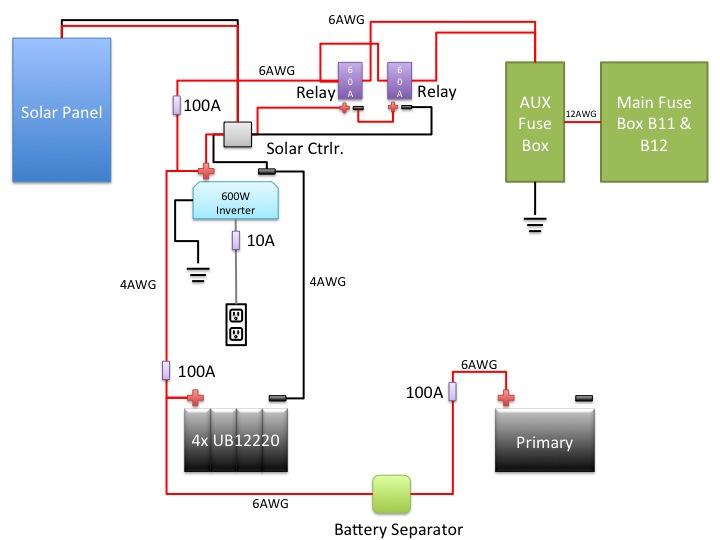
I cleaned up the drawing somewhat and below are details on the components and my thinking on their connection.
The solar panel is rated at 30W and comes with a very dinky controller. That controller has input terminals for the solar panel (drawn on top) and output terminals for connection to the battery (drawn left) and a low-voltage disconnecting, 10A rated load (drawn right).
I am planning on running lights and other 12V accessories off the AUX fuse box, possibly including the radio, which will add up to more than 10A, methinks. Hence the 60A relays. Their input terminals are connected in series to the controller (serial or parallel shouldn't matter here, should it?) and the switched load is connected in parallel.
The relays and the 6AWG wiring are clearly oversized. Are there disadvantages to that?
The 100A fuse drawn next to the primary battery is now mounted in the battery compartment behind the passenger seat. I opted for the Blue Sea Systems charging relay, which I velcro'd under the driver seat. I liked that it comes with a remote LED capability and a starter interrupt, although I have not yet researched how to hook up the latter.
The 100A fuse drawn next to the AUX battery is not yet installed. I am thinking it is probably undersized given the max load of the inverter and the planned max load of the AUX fuse box (none of which I am likely to take full advantage off): about 90A for the inverter (1100W peak) plus 120A max capacity of the relays. In any case, I was planning to mount it under the sink where I am routing the cables from the AUX battery.
The 100A fuse in front of the relays is probably not in the correct location. I did quite a bit of searching and researching before posting this topic and I am aware that the fuses should be located as close to the positive terminals of the battery. However, I am running the 4AWG wires behind the fridge to the little hidden compartment next to the water tank, where I am planning to mount the inverter, relays, and the AUX fuse box. I was thinking to connect the 6AWG for very short runs between the positive input terminal of the inverter, the relays, and the input terminal of the AUX fuse box. Not sure if those short runs need protecting but I wouldn't mind having a max load protection from that fuse.
When I researched the AUX battery install, I did see that some people had the UB12220 go kaput on them after a short couple of years. I was thinking (?) that with the constant trickle charge of the solar panel and the LVD of the solar controller, I might be better off. Please correct me if I am wrong! |
|
| Back to top |
|
|
m_brown_
Samba Member
Joined: August 21, 2002
Posts: 85
Location: Juneau, AK
|
| Posted: Thu Aug 21, 2014 1:53 pm Post subject: |
|
|
Your setup is overly complicated. Connect the controller directly to your aux battery. The relays are not needed. The load of the aux fuse bank will not go through the controller. It sounds like that is why you are installing the relays.
Check out this thread. The solar setup is a little more fancy, but it looks like your trying to do the same thing.
http://www.thesamba.com/vw/forum/viewtopic.php?t=595535&highlight=battery+solar
Also nothing wrong with 6ga, just way overkill. |
|
| Back to top |
|
|
sunkid
Samba Member
Joined: March 31, 2008
Posts: 31
Location: San Diego, CA
|
| Posted: Thu Aug 21, 2014 2:29 pm Post subject: |
|
|
| m_brown_ wrote: |
| Your setup is overly complicated. Connect the controller directly to your aux battery. The relays are not needed. The load of the aux fuse bank will not go through the controller. It sounds like that is why you are installing the relays. |
Again, the controller has two main functions: 1) battery charging and 2) low-voltage disconnect (LVD) for any load directly connected to it (10A max). The charging outputs are directly connected to the battery. The relays are connected to the second output to be able to run loads greater than 10A off the AUX battery that will be disconnected by the LVD if the battery is drained too low.
This post was my inspiration for the relay setup. |
|
| Back to top |
|
|
kourt
Samba Member

Joined: August 13, 2013
Posts: 2391
Location: Austin, TX
|
| Posted: Thu Aug 21, 2014 2:34 pm Post subject: |
|
|
I agree with m_brown_...
Organize items in the schematic by loading or charging behaviors.
A solar panel and charge controller is simply a charging device. It should connect directly to the battery independently. The charge controller should not be interfaced with the aux fuse bank or the inverter. The wire gauge of the solar charging array probably need not be very robust. I see you have ambitions to put loads on the charge controller itself (because it has that feature) but this may make troubleshooting complicated later in life---I would not recommend doing that (and the wire gauge for loading becomes an issue).
The inverter is a loading device, and a potentially big one. Another independent connection to the battery array, with a properly rated fuse on positive side for that circuit near the battery.
Same for aux fuse bank--independent connection to battery array, separate master fuse near battery on positive side for that circuit.
Do you have any other method of charging other than solar? 30 watts will not get you very far. A separate battery charger (or inverter/charter) would be ideal--you can plug the van into the wall outlet at home (or an RV park) and charge the batteries that way.
Do you plan to mod your house wiring to run radio/interior lights/etc from the aux battery? Just curious.
kourt |
|
| Back to top |
|
|
m_brown_
Samba Member
Joined: August 21, 2002
Posts: 85
Location: Juneau, AK
|
| Posted: Thu Aug 21, 2014 2:44 pm Post subject: |
|
|
Sorry missed that on the LVD. Are the coils on the relays 24v since they are wired in series? I would simplify the relays with a single relay. I personally would eliminate the LVD function because your 30W panel is not going to do too much more than trickle charge and may be a pain when camping. I would also look into upgrading your inverter to a inverter/charge combo unit. How much will you be using your inverter? That can suck down your 88aH pretty quick.
Last edited by m_brown_ on Thu Aug 21, 2014 2:55 pm; edited 1 time in total |
|
| Back to top |
|
|
sunkid
Samba Member
Joined: March 31, 2008
Posts: 31
Location: San Diego, CA
|
| Posted: Thu Aug 21, 2014 2:53 pm Post subject: |
|
|
| kourt wrote: |
| A solar panel and charge controller is simply a charging device. It should connect directly to the battery independently. The charge controller should not be interfaced with the aux fuse bank or the inverter. The wire gauge of the solar charging array probably need not be very robust. I see you have ambitions to put loads on the charge controller itself (because it has that feature) but this may make troubleshooting complicated later in life---I would not recommend doing that (and the wire gauge for loading becomes an issue). |
You may not have seen my reply to m_brown before posting this, but just to clarify: this charge controller also works as a low-voltage disconnect (LVD) for small loads. Yes, it's more complicated to have the relays in the circuit, but I think it will be worth it in the long run by extending battery life.
| kourt wrote: |
The inverter is a loading device, and a potentially big one. Another independent connection to the battery array, with a properly rated fuse on positive side for that circuit near the battery.
Same for aux fuse bank--independent connection to battery array, separate master fuse near battery on positive side for that circuit. |
Yeah, that part I was wondering about... I'll run the separate connection from the AUX fuse panel to the battery with the fuse I have drawn at the inverter connection.
| kourt wrote: |
| Do you have any other method of charging other than solar? 30 watts will not get you very far. A separate battery charger (or inverter/charter) would be ideal--you can plug the van into the wall outlet at home (or an RV park) and charge the batteries that way. |
I have considered adding a charger but have not researched this thoroughly yet. I am thinking I might upgrade the solar panel first (the little one was a gift).
| kourt wrote: |
| Do you plan to mod your house wiring to run radio/interior lights/etc from the aux battery? Just curious. |
Yes, part of that is already drawn in above (12AWG to stock fuse panel connectors B11 & B12). The radio seems to have its own fuse not on the stock fuse panel (which I just recently discovered the hard way) and I am considering running another connection to the AUX fuse panel just for it (and its soon to come successor).
Should all these wires be run in a conduit under the fridge and sink? |
|
| Back to top |
|
|
sunkid
Samba Member
Joined: March 31, 2008
Posts: 31
Location: San Diego, CA
|
| Posted: Thu Aug 21, 2014 3:05 pm Post subject: |
|
|
| m_brown_ wrote: |
| Sorry missed that on the LVD. Are the coils on the relays 24v since they are wired in series? I would simplify the relays with a single relay. I personally would eliminate the LVD function because your 30W panel is not going to do too much more than trickle charge and may be a pain when camping. I would also look into upgrading your inverter to a inverter/charge combo unit. How much will you be using your inverter? That can suck down your 88aH pretty quick. |
The relays are solid state and rated 3-32V on the input. Not sure what the voltage drop is over the inputs, but I really don't see the issue wiring them in series.
I have yet to camp somewhere where I have shore power available, but an inverter/charge combo was a consideration. However, I somehow got convinced I needed the pure sine inverter (intended to hook up a Mac laptop), and those combos are $$$$$. This inverter's internal LVD will cut off at 10V, which may be a tad low... |
|
| Back to top |
|
|
thatvwbusguy
Samba Member
Joined: April 18, 2007
Posts: 1712
Location: Newmarket, New Hampshire
|
| Posted: Thu Aug 21, 2014 3:17 pm Post subject: |
|
|
There are several disadvantages to using over-sized wiring that immediately come to mind:
1) The wire is expensive.
2) Good quality tools to correctly install large gauge terminals are very expensive.
3) It is harder to make a clean installation with large diameter wires.
4) You won't actually gain anything for the extra cost and frustration.
Here are some general thoughts based on the dozens of solar installations I have done and helped design for use in Vanagon's:
A 30W solar panel is only capable of producing 2.5A @ 12VDC (assuming 100% efficiency, which is never going to happen). That is not very much charging power.
I would consider a good quality 70W panel and an MPPT charge controller the entry level for usable auxiliary charging unless you only plan on very minimal use (which the 600W inverter pretty much immediately cancels out). It has been my experience that most people who start with a small output panel will go back to upgrade it within a year or two of actual use. To put it another way, nobody ever complains about having too much solar power, but lots of people complain about not having enough.
Few will argue that the simpler you can make your installation, the less headaches you will have with it in the future. Using the low voltage disconnect feature on a cheap controller is adding complexity that is only marginally useful. Since you are not depending on these batteries to start the van, it will only serve to guard against killing the auxiliary battery after leaving accessories on by mistake. A simple low voltage alarm would probably be more useful in the long run.
Since you already have the 30W panel, it would be an ideal candidate to be used as a "sun tracker" that you can move around to place in direct sunlight, while depending on a larger roof mounted panel to do the majority of your charging.
Running power from the auxiliary fuse block to power the radio, interior lights and 12V socket on the dash is easy in an 86-91 van using the fuse 3 modification https://sites.google.com/site/vanagonheadlightrela...iary-power
_________________
Jay Brown
'85 Zetec Westfalia
Newmarket, NH
If you want others to be happy, practice compassion.
If you want to be happy, practice compassion. |
|
| Back to top |
|
|
WLD*WSTY
Samba Member

Joined: November 04, 2009
Posts: 438
Location: Arizona
|
| Posted: Thu Aug 21, 2014 6:41 pm Post subject: Re: YAVAWD - Yet Another Vanagon AUX Wiring Diagram - Fuses? |
|
|
| sunkid wrote: |
Finally putting an AUX battery, a small solar panel, and an inverter into my '86 Westy "Jezebel" (aka. Trusty Rusty).
My question is, do I need all three of the 100A fuses? Do I have the placement right? Are the sized correctly? The inverter is rated at 600W, 1100W peak.
|
The relays will need to be connected in parallel, since wiring them in series will allow only half of the voltage to each relay.
_________________
'82 SyncroWesty, the first ever conversion.'06 Subaru 2.5L |
|
| Back to top |
|
|
Phishman068
Samba Member

Joined: February 19, 2007
Posts: 2024
Location: Pittsburgh PA (ish)
|
|
| Back to top |
|
|
crazyvwvanman
Samba Member
Joined: January 28, 2008
Posts: 10476
Location: Orbiting San Diego
|
| Posted: Fri Aug 22, 2014 8:54 am Post subject: |
|
|
You don't need 2 of the 60 amp relays. A single one would more than do. Carry the extra as a spare. If you do wire both up you need to wire the control pins in parallel, not in series.
Besides the relays, the way other things are shown wired it will not work.
Mark
| sunkid wrote: |
The relays are solid state and rated 3-32V on the input. Not sure what the voltage drop is over the inputs, but I really don't see the issue wiring them in series...... |
|
|
| Back to top |
|
|
sunkid
Samba Member
Joined: March 31, 2008
Posts: 31
Location: San Diego, CA
|
| Posted: Sun Aug 24, 2014 7:46 am Post subject: |
|
|
| crazyvwvanman wrote: |
You don't need 2 of the 60 amp relays. A single one would more than do. Carry the extra as a spare. If you do wire both up you need to wire the control pins in parallel, not in series.
Besides the relays, the way other things are shown wired it will not work. |
Just a quick update to show that the relays wired in series work just fine. The input is rated 3-32V, so 6V is plenty to trip them. The measured current is just 13mA, which I am not worried about at all. That said, I might put in a cut-off switch into the control panel I am planning to set up next.
I would be curious to know what exactly won't work as I have drawn it and why?
|
|
| Back to top |
|
|
crazyvwvanman
Samba Member
Joined: January 28, 2008
Posts: 10476
Location: Orbiting San Diego
|
| Posted: Sun Aug 24, 2014 8:14 am Post subject: |
|
|
If you wire the relay controls in series like that then if one should fail the other could stop working too. Why 2 relays? Why wired so a single failure could disable both?
Mark |
|
| Back to top |
|
|
sunkid
Samba Member
Joined: March 31, 2008
Posts: 31
Location: San Diego, CA
|
| Posted: Sun Aug 24, 2014 9:35 am Post subject: |
|
|
| crazyvwvanman wrote: |
If you wire the relay controls in series like that then if one should fail the other could stop working too. Why 2 relays? Why wired so a single failure could disable both?
Mark |
Ahh... progress! We are now discussing reasons rather than simply stating stuff won't work! 
Anyways, as you have probably noticed, I have sized the entire system for overkill future expansion. Given the resulting fuse sizes, I don't want any of the components to have less capacity and blow before the fuse does. Hence, I want two relays with the load connected in parallel. I am also hoping that the relays won't heat up as much with the load spread evenly between them.
There is actually one minor advantage to wiring the input of the relays in series. You are correct that if one of the input channels somehow blocks, the other relay would shut down too. But that means that I would actually find out about the relay failure (however unlikely) rather than just running off a single relay unbeknownst. |
|
| Back to top |
|
|
whynotvw
Samba Member
Joined: May 04, 2004
Posts: 1322
|
| Posted: Sun Aug 24, 2014 9:51 am Post subject: |
|
|
couple of things,
30 watt isn't much for solar. I would go minimum 80 watts.
the ub series batteries are prone to problems, are you sure you want to go that route? |
|
| Back to top |
|
|
|