| Author |
Message |
polkat
Samba Member
Joined: February 10, 2011
Posts: 11
Location: Chico, CA

|
 Posted: Thu Feb 10, 2011 5:13 pm Post subject: Air cooled compression question? Posted: Thu Feb 10, 2011 5:13 pm Post subject: Air cooled compression question? |
 |
|
Hi guys, new here, and while I built Mopar performance engines for years, I'm relatively new to VW's.
I understand that higher compression in air cooled VW's is touchy because of heat considerations. I'm presently doing a somewhat mild performance build on a 1600 for (mostly) street use, and I am wondering just how high I can go with the static compression ratio? And how to acheive it? I have read that some builders leave the rings out between the cylinders and case to get a bit more compression.
In the water cooled Mopar arena, we often build what is called a "Quench" engine, which among other things cuts down on detonation. It requires the piston tops to come just .045" below the chamber, but it appears that attempting this on a VW engine is not recommended? Or is it?
What are you performance builders doing about compression on engines that will be mostly street driven?
Much thanks! |
|
| Back to top |
|
 |
66brm
Samba Member

Joined: January 25, 2010
Posts: 3676
Location: Perth Western Australia
|
| Posted: Thu Feb 10, 2011 5:26 pm Post subject: |
|
|
Squish is good, the .045" is about as close as most want to get in a performance acvw engine, with expansion etc. Compression is widely debated on here, as camshaft selection and heads will determine what you can get away with and what you can't, longer duration will allow higher CR's to be bled off during valve overlap. Finding the balance in the whole package is the key.
Are you looking to go up in stroke and bore? What kinda budget did you have in mind? Remembering that speed costs, how fast do you want to go?
_________________
Aust. RHD 66 Type 1
Aust. RHD 57 Type 1 Oval
| modok wrote: |
| I am an expert at fitting things in holes, been doing it a long time |
|
|
| Back to top |
|
|
polkat
Samba Member
Joined: February 10, 2011
Posts: 11
Location: Chico, CA
|
| Posted: Thu Feb 10, 2011 8:31 pm Post subject: |
|
|
I was thinking about keeping the stock bore and stroke, basic head porting, headers, single 2 bbl, and not sure about the cam (I understand that the factory cams were all the same). But I'm quite new to these engines and not firmly sure about any of this. I'm not looking to build a high HP strip engine, but more like something for a street sleeper. Yes, quench is a strong thought, but I'm unsure how to acheive it with these engines (parts?).
Any websites around describing builds like this? Or detailed books I should be reading? |
|
| Back to top |
|
|
modok
Samba Member

Joined: October 30, 2009
Posts: 27724
Location: Colorado Springs
|
| Posted: Thu Feb 10, 2011 8:43 pm Post subject: |
|
|
As the factory built them the piston should come up to .060 short of the top of the cylinder with no gasket under the cylinder (nobody uses gaskets there anyway since the invention of silicone sealant!).
If the case has been resurfaced where the cylinders sit you might have no deck height at all, it is common to need shims.
The cylinders do sink into the case over time, so chances are your case ought to be resurfaced unless it is new or it has been done already.
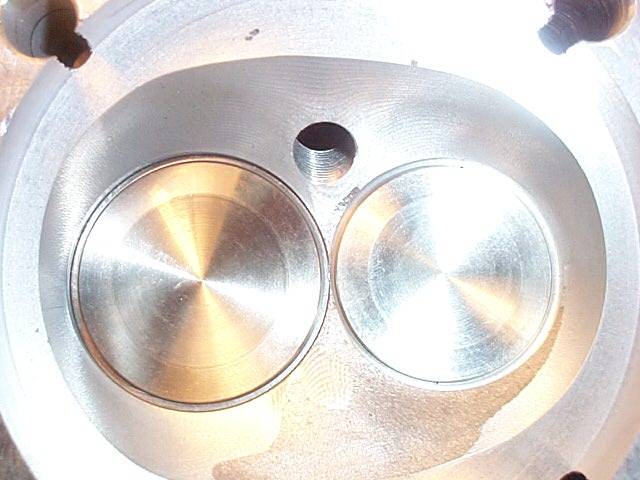
The majority of stock heads have a step cut in them so the actual deck height was .120", you must cut the step out or use heads with no step to get close deck. most engines have been rebuilt many times by now so you'll just have to take it apart to know what you have.
With the stock cam you better stay below 8-1CR
If you put a cam in it like an engle 100 or 110 then you might get away with 8-1, 8.5-1 or even a little higher if you use fancy stuff like dual carbs. |
|
| Back to top |
|
|
polkat
Samba Member
Joined: February 10, 2011
Posts: 11
Location: Chico, CA
|
| Posted: Thu Feb 10, 2011 9:08 pm Post subject: |
|
|
Well, this is good as I was thinking in terms of about 8:1, but I'm still unsure of how to acheive it. So, assuming the cylinders have not sunk into the case, you are saying cutting the head steps out will get me about 8:1, and to use an Eagle cam and higher octane?
Can you name a good book out there that covers these kinds of mods? |
|
| Back to top |
|
|
miniman82
Samba Swamp Donkey

Joined: March 22, 2005
Posts: 9515
Location: Southern Maryland
|
|
| Back to top |
|
|
modok
Samba Member
Joined: October 30, 2009
Posts: 27724
Location: Colorado Springs
|
| Posted: Thu Feb 10, 2011 9:25 pm Post subject: |
|
|
I could tell you exactly what it would all be like on a stock 70's engine.
But 95% chance that somebody has rebuilt it and put diferent heads on it that might be flycut or might not, or might be aftermarket, or might be junk, hell they probably don't even match, I'm not kidding.
Step one: get two good heads that match.
Step two: take them to a machine shop that works on vw stuff and have them flycut to the chamber CC you desire.
I'm just warning you friend, it's not like working on normal engines, if half the parts in the engine match factory specifictions it is a miracle. |
|
| Back to top |
|
|
Bruce
Samba Member
Joined: May 16, 2003
Posts: 17632
Location: Left coast, Canada
|
| Posted: Thu Feb 10, 2011 11:53 pm Post subject: |
|
|
| polkat wrote: |
| , single 2 bbl, and not sure about the cam ...... |
Your thinking about quench in your V8 is exactly what you should do to the VW.
There are 2 major differences in engine building approaches with VWs compared to domestic V8s. Carbs and cams.
Due to the vast distance between the heads, single carbs with plenum intakes don't work well. Two carbs is where it's at. With twin carbs you will make more hp, have better driveability, better cold weather driveability, and get way better mileage.
For your 1600, consider dual 40mm Kadrons. Weber ICTs, or Dellorto FRDs work too. Solex has a twin carb kit too. The ultimate is twin Dellorto 36DRLAs. Don't fear carb synchronizing.
The next is the cam. Compared to your V8, we use cams on the street with durations that could never work on a V8. The reason they work is due to the above dual carburators. When you have individual runners from carb to intake (DRLA), you can run massive duration with good low rpm driveability.
_________________
| overheard at the portland Swap Meet... wrote: |
| ..... a steering wheel made from a mastadon tusk..... |
|
|
| Back to top |
|
|
polkat
Samba Member
Joined: February 10, 2011
Posts: 11
Location: Chico, CA
|
| Posted: Fri Feb 11, 2011 12:26 am Post subject: |
|
|
Thanks guys, all good info here. Bruce, you seem to favor quench in the VW's. Here's my concern with that. A quench engine is basically built for a near miss between the piston top and the flat area of the combustion chamber. As might be expected, this dramatically raises compression, with 10:1 being common in water cooled engines. The advantage is that the resulting very high charge volicity across the chamber actually cools the chambers and piston top, to the point where, if done right, can allow a quench engine to run higher compression then a non-quench engine and actually get less detonation.
But even with quench, 10 to 1 compression seems very high for an air cooled engine as I understand it. And I'm still not sure what 'quench' pistons (which usually result in zero deck) are available for the VW's. Do the books mentioned discuss this? |
|
| Back to top |
|
|
Bruce
Samba Member
Joined: May 16, 2003
Posts: 17632
Location: Left coast, Canada
|
| Posted: Fri Feb 11, 2011 12:45 am Post subject: |
|
|
| polkat wrote: |
, if done right, can allow a quench engine to run higher compression then a non-quench engine and actually get less detonation.
|
Same applies to a VW engine. The incredible turbulence created by the squish promotes better A/F mixing, reducing lean pockets that tend to pre-ignite.
VW pistons are almost always flat top. The thing you need to learn is that we set the deck height. It is not fixed like it is on a V8 block. The quench has almost nothing to do with the piston, it's controlled by the deck height that you must set, and the chamber.
You won't be at 10:1, the VW engine runs much hotter head temps normally, so it can't tolerate V8 type compression ratios. 350ºF is considered cool running.
This is what you will shoot for if you want to use 87 octane:
| modok wrote: |
With the stock cam you better stay below 8-1CR
If you put a cam in it like an engle 100 or 110 then you might get away with 8-1, 8.5-1 or even a little higher if you use fancy stuff like dual carbs. |
_________________
| overheard at the portland Swap Meet... wrote: |
| ..... a steering wheel made from a mastadon tusk..... |
|
|
| Back to top |
|
|
polkat
Samba Member
Joined: February 10, 2011
Posts: 11
Location: Chico, CA
|
| Posted: Fri Feb 11, 2011 1:09 am Post subject: |
|
|
Okay, this is where my VW ignorance comes in. Perhaps the small stroke of these engines is the reason the compression on a quench built engine won't reach 10:1 even though the piston is coming all the way up to just short of the chamber. So deck height is acheived by machining the heads...right?
I am seriously listening here, but I had in mind another approach to this as well, and that is keeping the engine basically stock and running a turbo. How much would a 1600 have to be beefed up for a turbo (I guess depending on boost amount), and are we talking just aftermarket parts here (case, pistons, etc.)? or is this just a bad idea overall? |
|
| Back to top |
|
|
steve34
Samba Member
Joined: April 17, 2004
Posts: 490
|
| Posted: Fri Feb 11, 2011 1:20 am Post subject: turbo |
|
|
You could actually turbo a stock 1600 without any mods. Most would say the minimum is C/m head studs, Hbeam Rods, and forged pistons.
AA pistons would be fine with even stock rods...As long as you tune it appropriately |
|
| Back to top |
|
|
polkat
Samba Member
Joined: February 10, 2011
Posts: 11
Location: Chico, CA
|
| Posted: Fri Feb 11, 2011 1:35 am Post subject: |
|
|
Okay, thanks, lots to sit back and think about.
Last question for a while. Would the stock 1600 tranny hold up to a turbo'd engine?
Thanks for all the advice guys! |
|
| Back to top |
|
|
66brm
Samba Member
Joined: January 25, 2010
Posts: 3676
Location: Perth Western Australia
|
| Posted: Fri Feb 11, 2011 1:59 am Post subject: |
|
|
It all depends on how the engine produces the power, and how you engage it, the stock trans has been known to last on high performance engines but MUST be driven accordingly. Start doing drag race starts and look in your mirror for your diff components. If you intend building up to a stroker engine later then its good insurance to have a quality trans built.
_________________
Aust. RHD 66 Type 1
Aust. RHD 57 Type 1 Oval
| modok wrote: |
| I am an expert at fitting things in holes, been doing it a long time |
|
|
| Back to top |
|
|
modok
Samba Member
Joined: October 30, 2009
Posts: 27724
Location: Colorado Springs
|
| Posted: Fri Feb 11, 2011 3:26 am Post subject: |
|
|
| polkat wrote: |
Okay, this is where my VW ignorance comes in. Perhaps the small stroke of these engines is the reason the compression on a quench built engine won't reach 10:1 even though the piston is coming all the way up to just short of the chamber. So deck height is acheived by machining the heads...right?
|
the type-1 40 horse/1300/1500/1600 as designed and built by the factory in the 60's is a "quench" engine with .050-.060 piston to head clearance and 7.5-1 cr.
Deck height is adjusted by how close the piston comes to the head surface, we adjust it any way we can.
in 71 on, the heads were modified to make for .120 deck height in an effort to reduce HC emissions.
But in the 80's all those heads wore out and were rebuilt or replaced.........with who knows what.
So all you need to do to make it tight deck with 8-1 cr is restore the bottom end to factory specs and put the right heads on it.
It might already be built that way, you never know. |
|
| Back to top |
|
|
polkat
Samba Member
Joined: February 10, 2011
Posts: 11
Location: Chico, CA
|
| Posted: Fri Feb 11, 2011 4:04 am Post subject: |
|
|
| Well, it's well known in the water cooled arena that anything above about .050" looses any 'quench' type benefits. A .060" space is too big for effective quench. That's why I was asking for specifics. |
|
| Back to top |
|
|
leaker
Samba Member

Joined: May 18, 2009
Posts: 348
Location: richmond,va
|
| Posted: Fri Feb 11, 2011 6:33 am Post subject: |
|
|
| Check out some of the older tech articles on Cal-look.com,there's a couple of good reads on there you might like. |
|
| Back to top |
|
|
vgajames
Samba Member

Joined: June 13, 2002
Posts: 805
Location: Texas
|
| Posted: Fri Feb 11, 2011 8:12 am Post subject: |
|
|
Are you aware of the VW Engine calculators?
http://www.cbperformance.com/enginecalc.html
Also moving cylinder up and down with shims under the cylinder to change deck height volumn? As well as using copper shims between head and cylinder...And reshaping head combustion chambers
to increase head CC volumn to lower CR...
[/url] |
|
| Back to top |
|
|
mark tucker
Samba Member

Joined: April 08, 2009
Posts: 23947
Location: SHALIMAR ,FLORIDA
|
| Posted: Fri Feb 11, 2011 9:53 am Post subject: |
|
|
| I like .035 -.040 max.remember the cylinders grow quite a bit on these things.I try to build mine about the same as my mopars but with 10.2-10.5 cr on any thing smaller than 2050cc but I did have 11+cr on my 1874.all were street DD motors.mild cam (fk8) lotsa port work(wedge ports) if you are just getting into vw.s do some research.if you are going to hot rod it you need a counterweighted crank & balancing is a must.so when you are looking at a counterweighted crank look at the price dif between a stk stroke and a stroker crank. get the stroker.&get the 90.5 P&J or 94's. the cam is up to you but a mild cam starts around 244 @.050 witch is a thumpy one on a v8 but stil kinda small.I ran a [email protected] in my 1874, and ran great.top & bottom.better on top. below 2000cc 40mm idf webber or empi hpmix ( china clone), above 2000 44mm. heads need a lot of work & big valves.or you can buy them ready to go hand or cnc ported in just about any configuration.raito rockers,many to choose from, some cheep some not so cheep. have fun and dont get hurt.and you will need to get some vw type tools to do the job.there is more out there for this motor than a small block chevy,but you wont find any parts for it at wallmart, the chevy superstore. |
|
| Back to top |
|
|
AlteWagen
Troll

Joined: February 23, 2007
Posts: 8702
Location: PNW
|
| Posted: Fri Feb 11, 2011 10:37 am Post subject: |
|
|
I like to use the engine calculators on aircooled.net
http://www.aircooled.net/gnrlsite/resource/articles.htm
good articles to get used to the aircooled engine.
You will need several specialty tools as well when calculating compression
A deck height tool. This flat plate holds the cylinder down as the head would under torque so you can measure actual deck height once assembled.
A head cc kit. It consists of several plastic disks for various size head bore sizes, and a 60 cc syringe. You use brake fluid or ATF as the measuring liquid and find the cc of your chambers.
Many late heads have a step that modok mentioned which add to the volume of the chamber. Many builders now use copper head gaskets in the same location to lower compression on large stroke engines. Some love them, some hate them, but its the cheap and easy way to lower compression without using larger shims under the cylinder.
I built a mini stroker engine with a 74mm crank and stock bore and built a zero deck engine. I used one large shim under the cylinder to make the positive deck to "0". I used new VW mexico heads with the step, an engle 110 cam and have been VERY happy with its performance.
Matching compression to cam is VERY important
common grinds with accepted compression as follows
Engle Cam grinds
E100 - 7:1
E110 - 8:1
E120 - 9:1
E130 - 10:1
Again as mentioned earlier more duration allows cylinder pressure to bleed off and becomes acceptable "dynamic compression"
There are several ways of adjusting compression:
Case decking
Shims (between case and bottom of cylinder)
Copper head gaskets (between head and top of cylinder )
Combustion chamber shaping (deshrouding the valves and changing shape of chamber adds ccs)
Aftermarket "long" cylinders. You can have these custom machined so you do not need shims between the cylinder and case. Mainly used on long stroke engines.
Bore and stroke. Changing components will require a total recalculation.
If you really want some hope for building a stock block turbo read this
http://www.thesamba.com/vw/forum/viewtopic.php?t=271444
I would suggest a built trans if you do go turbo just for sanity sake. |
|
| Back to top |
|
|
|