| Author |
Message |
HotStreetVw
Samba Member
Joined: October 03, 2004
Posts: 871
Location: Wild West

|
 Posted: Fri Jun 28, 2019 8:07 pm Post subject: Sequential Injection Posted: Fri Jun 28, 2019 8:07 pm Post subject: Sequential Injection |
 |
|
Being a NA guy at heart, I am always trying to understand how VW guys and others at the highest levels of NA racing (NHRA pro stock) continue to increase performance. Both groups are pretty tight lipped, sometimes you get lucky and they spill some beans.
This post is in reference to sequential injection. For the most part, the argument for sequential is limited to low speed operation. Many non sequential ECUs argue against, or down play the value.
I stumbled across this article
https://www.racepagesdigital.com/unknown-commoditi...injection/
To pharaphrase, traditional injector sizing tell us to estimate HP, bsfc, rule of thumb of 85% duty cycle and now you have injector sizing.
The problem with this approach is that it eliminates the possibility of benefits from injection timing. After all, you have accepted that at peak power you will be spraying the injector for 85% of the time.
Now if you follow NHRA pro stock, you will know they have converted from carbs to injection a few years ago. These engines make approx 1300+hp and run on race gas. They are required to run a spec 160lb/hr injector @ 43 psi, and can operate at max of 90psi (220lb/hr). At the low end of flow, it’s 46% idc, at the high end it’s 33% idc. Definitely a different line of thought compared to the 85% IDC methid.
The article also states that they pick up 25hp with injector timing. That’s pretty significant on a NA engine that is already optimized to the nth degree.
Im currently in the market for a new set of injectors. I have 66lb/hr and they are 90+% on e85. The cost difference between a set of 83lb/hr and 160lb/hr isn’t that significant to have another toy (injector timing) to play with, and the possibility of finding a few more hp.
What roll would injector placement play? My injectors are in the throttle bodies, so the fuel added would be for the next cycle. But at minimum the injection event could be timed with air flow for better distribution.
Just something fun to think about
_________________
4inBhore
50 Split - 2724cc NA. Haltech injected
62 Notchback - 2542cc Turbo WIP |
|
| Back to top |
|
 |
slalombuggy
Samba Member

Joined: July 17, 2010
Posts: 9340
Location: Canada
|
| Posted: Fri Jun 28, 2019 10:06 pm Post subject: Re: Sequential Injection |
|
|
Having the next pulse of fuel waiting at the back of the valve waiting to go in after the initial reversion pulse is perfect timing. If you could time it so that the majority of the fuel is at the valve when the cylinder is creating vacuum WOILD give you the best cylinder filling efficiency. Too soon as you lose some to reversion, too late and the vacuum signal is too weak because the piston is at or close to BDC.
I've been thinking about injector placement on my new setup. I'm leaning towards manifold mounted.
brad |
|
| Back to top |
|
|
Mike E.
Samba Member
Joined: April 22, 2019
Posts: 110
Location: Torrance, California
|
| Posted: Sat Jun 29, 2019 6:46 am Post subject: Re: Sequential Injection |
|
|
| If you're going to program with injector timing involved you want the injector as close to the valve as possible. The further the injector is from the valve the less the timing will do for your efficiency |
|
| Back to top |
|
|
raygreenwood
Samba Member
Joined: November 24, 2008
Posts: 23509
Location: Oklahoma City
|
| Posted: Sat Jun 29, 2019 8:13 am Post subject: Re: Sequential Injection |
|
|
| HotStreetVw wrote: |
Being a NA guy at heart, I am always trying to understand how VW guys and others at the highest levels of NA racing (NHRA pro stock) continue to increase performance. Both groups are pretty tight lipped, sometimes you get lucky and they spill some beans.
This post is in reference to sequential injection. For the most part, the argument for sequential is limited to low speed operation. Many non sequential ECUs argue against, or down play the value.
I stumbled across this article
https://www.racepagesdigital.com/unknown-commoditi...injection/
To pharaphrase, traditional injector sizing tell us to estimate HP, bsfc, rule of thumb of 85% duty cycle and now you have injector sizing.
The problem with this approach is that it eliminates the possibility of benefits from injection timing. After all, you have accepted that at peak power you will be spraying the injector for 85% of the time.
Now if you follow NHRA pro stock, you will know they have converted from carbs to injection a few years ago. These engines make approx 1300+hp and run on race gas. They are required to run a spec 160lb/hr injector @ 43 psi, and can operate at max of 90psi (220lb/hr). At the low end of flow, it’s 46% idc, at the high end it’s 33% idc. Definitely a different line of thought compared to the 85% IDC methid.
The article also states that they pick up 25hp with injector timing. That’s pretty significant on a NA engine that is already optimized to the nth degree.
Im currently in the market for a new set of injectors. I have 66lb/hr and they are 90+% on e85. The cost difference between a set of 83lb/hr and 160lb/hr isn’t that significant to have another toy (injector timing) to play with, and the possibility of finding a few more hp.
What roll would injector placement play? My injectors are in the throttle bodies, so the fuel added would be for the next cycle. But at minimum the injection event could be timed with air flow for better distribution.
Just something fun to think about |
Sequential.....has been used primarily for....and advertized that way.....for "low rpm" benefit.....primarily....because up until recently with modern factory and aftermarket programmable systems and ECU's with much more computing power.......they really have no been able to make any useful adjustments above about 1800 rpm or so.
Lets understand a few dynamics here:
Injector position:......FIRST....is about getting the fuel pulse into (ideally) an airstream that is MOVING into and through an open intake port.....so it keeps the pulse from contacting the port wall as much as possible.
It requires more than 5X the airflow....to "suck/pull" fuel off of a solid surface.....once it has gone from the "micro-droplets" form as it left the injector pintle.....and had turned into a "wetted" film or globules on a solid surface.
At even medium rpm speed.....there is NO TIME to provide that 5X airflow to pull all of the cuel off of the port wall. So what it does it leave a wet port wall. Yes....it eventually all gets into the cylinder.....but it may take 2-3 combustion cycles to do this. So.....you have lost atomization....and each one of these combustion cycles.....is missing part of its "planned for" fuel dosage.
So systems like batch fire....plan for this fact. They program to make each injection cycle "X%" leaner than required because some of the previous fuel dosages are being added into future injection dosages.
The resulting smooth running....but less than ideal actual fuel mixture....is why virtually no one from the factories is still using "simple" batch fire systems like 20+ years ago.
The other useful attributes of careful injector position....CAN BE better atomization. In reality....there are "0" injectors outside of some of the high pressure direct injection unotw in thr 1200+ psi range.....that actually "ATOMIZE" the fuel. There never have been. They all produce micro droplets to standard size droplets. This is factually seen because the cuel spday is actually VISIBLE to the naked eye.
But they produce a fine spray....and if the air velocity is high....or you have some engineered turbulence at the injection point......THAT is what causes the REAL atomization.
Carburetors....actually produce REAL atomized fuel beneath the venturi.....however they cannot keep it atomized on long manifold lengths because fuel begins to re-stratify into micro droplets again in about 2 1/1000's of a second or less depending on atmospheric pressure and temp in the manifold.
In a perfect world.....fuel injection doses the fuel correctly....and injects it into a MOVING high speed air stream.....which slams it hard ....creating far better atomization.....just a couple of milliseconds before pushing it through an open port/valve. The airflow creates the atomization....but it must use it immediately and not allow it to stratify/seperate (a ti.ing issue) or contact a port wall and wet onto it.
So no....the old "just aim it at the inlet valve back side" is not always ideal.....because high speed, high density air does not stay centered or turbulence free.....if its not a straight on shot at the valve. Usually long straight inlet pipes do not fit under the hood. An example of this is the type 3 and 4 EFI intake runners.
As the air column rounds that bend down near the heads at high speed.....it actually cannot make the turn and bounces up against the outside tube wall just above where the injector port is mounted. It smashes the injected fuel against the lower floor of the head port.....insuring....and you can see this especially in D-jet with its Ssymetrical, out of time for two cylinders....paired injection....by examining the "wash" pattern that develops in the ports. You see it in especially well in CIS injection.
And....."storing" fuel from out of time injections behind the valve in the port pocket as the factory systems always advertized they do.....is not ideal. Again it loses atomization and insures that the actual programmed fuel mixture will be a compromise.....not a very exact dosage recipe. This is why older systems....can never match the economy and power production of modern jnjection systems. They are simply not as accurate in metering and do not have as good of atomization.
So upstream....or inside curve on intake runners....injector placement and aiming...seen in racing, high rpm hugh performance motorcycles etc.....if done right....can have the effect of injecting the micro-droplets of fuel....into the center of the airstream where the maximum atomization can happen.......and then its up to VALVE EVENT TIMING.....to use this precisely metered and properly atomized dose.....before it can seperate or wet out to a film.
The injection pulse timing....is the other issue. The sequential part.....that older systems could not accurately ...or easily.....manage. in the 1960s and into the 90s....it was a computing power issue.....and a sensor network accuracy issue.....and most importantly a pressure control issue.
With sequential.....as rpm rises.....the actual number of milliseconds the inlet valve is open ....decreases. At some point there is not enough time to complete an injection dosage event.
As rpm and load increase.....and injection pulsewidth increases.....very quickly the injection pulsewidth is LONGER than the valve open event. To fix this.....just like the problem with ignition event and rpm.....you have to start ADVANCING the start point of the injection even to insure that there is enough time to complete the whole programmed injection event.....before the valve closes.
This is a very, very fine line of timing. If you start too early before the valve opens.....you are spraying part of the injection into either static non moving air....or usually into some of the turbulence from reversion (not always a bad thing because properly designed it can help atomize fuel).....and too late and the valve slams shut before the required dosage is complete.
This is where FUEL PRESSURE control....comes in. Fuel dosage is "PRESSURE X TIME". In high end programmed sequential.....the system will advance injection pulsewidth start point as much as it can until the rpm reaches a point where there is just not enough time to complete a dosage .....at standard fuel pressure.....before you are too far advanced in injection timing that the effect gets negative (stratification of fuel bsck into droplets or port wall wetting).......so at that point.....fuel pressure should start rising.....to MULTIPLY the amount of fuel injected during the maximum window.
The difference when you get into this level of control is that you are no longer lookiing for an injector that works at max 85% pulsewidth. You are looking for one that can reach maybe 65% at 42 psi.....and then make up the difference accurately.....by increasing the operating pressure to say....52 psi.
Ray |
|
| Back to top |
|
|
HotStreetVw
Samba Member
Joined: October 03, 2004
Posts: 871
Location: Wild West
|
| Posted: Sat Jun 29, 2019 9:59 am Post subject: Re: Sequential Injection |
|
|
I agree outboard in the intakes is the best possible solution but it’s not always practical. My car is a sedan and the engine bay is already trimmed to get the engine to fit. Add a 091 box, and the engine sits more towards the passenger side than the driver, so getting injectors in the 1/2 side is almost impossible.
So no benefit with the injectors in the throttle bodies? Even if the injection is timed with valve events so that fuel is injection during air movement?
Ray, I agree it’s been primarily used for low speed, but the Pro Stock is an example of how they are using it at high RPM (10500) and making more power. Your last few paragraphs are along the lines of where I’m going. 160lb/hr injectors are a click away. They are very well characterized and big power cars use them daily to control idle fuel with short injection times.
With a modern ECU (haltech, others) they provide so much flexibility. 160lb/hr or 1700cc/min, will bring my 90% duty cycle down to a 36% duty cycle at the same pressure. With [email protected], the valve is open ~39% of the time.
_________________
4inBhore
50 Split - 2724cc NA. Haltech injected
62 Notchback - 2542cc Turbo WIP |
|
| Back to top |
|
|
HotStreetVw
Samba Member
Joined: October 03, 2004
Posts: 871
Location: Wild West
|
| Posted: Sat Jun 29, 2019 10:01 am Post subject: Re: Sequential Injection |
|
|
Brad, if your considering e85, buy bigger injectors than the online calculator will tell you. Most calcs compensate for the change in bsfc, but they don’t compensate for the viscosity change. A lb/hr rating on gasoline will flow about 90% on ethanol because the viscosity.
_________________
4inBhore
50 Split - 2724cc NA. Haltech injected
62 Notchback - 2542cc Turbo WIP |
|
| Back to top |
|
|
Stripped66
Samba Member
Joined: May 31, 2005
Posts: 3519
Location: Charleston, SC
|
| Posted: Sat Jun 29, 2019 10:47 am Post subject: Re: Sequential Injection |
|
|
| HotStreetVw wrote: |
The article also states that they pick up 25hp with injector timing. That’s pretty significant on a NA engine that is already optimized to the nth degree.
|
A 25hp at the Pro Stock level is a ~1.5% improvement (assuming this is at peak HP). Assuming there's no trade-off for running the larger injectors (i.e. low-pulsewidth injector performance), does the cost-per-HP ($100 per hp?) compare to other mods you may invest in? Otherwise, it sounds like a fun exercise just for the hell of it! 
_________________
| 66brm wrote: |
| Bodacious wrote: |
| Why not just make a custom set of wires with a Y splice in them. Then you could just run one distributor. |
I don't think electrickery works that way |
|
|
| Back to top |
|
|
HotStreetVw
Samba Member
Joined: October 03, 2004
Posts: 871
Location: Wild West
|
| Posted: Sat Jun 29, 2019 12:14 pm Post subject: Re: Sequential Injection |
|
|
I’m considering every avenue. I think the most benefical would be more time on the dyno. The timing results with e85 were surprising. If I had more time I would have continued to pull timing out.
The other things I’m working on are building a header to replace the wasp. I think the tube sizing is OK (1-3/4, 2”, 2-1/ , maybe a hair big, but the collector diameter is too big (2.85). A smaller collector (2-3/8 or 2-1/2) and a reverse cone megaphone, might help. , maybe a hair big, but the collector diameter is too big (2.85). A smaller collector (2-3/8 or 2-1/2) and a reverse cone megaphone, might help.
Without changing the basic configuration, heads, cam, compression. Theres not a lot of other ideas. Vacuum pump, or maybe a pan-e-vac. Fancy coatings.
But with my injectors maxed out (VE changes didn’t result in AFR exchanges). I want to make sure I’ve got some head room. I guess I’m guilty of being an engineer and overthinking things...seems like an opportunity.
_________________
4inBhore
50 Split - 2724cc NA. Haltech injected
62 Notchback - 2542cc Turbo WIP |
|
| Back to top |
|
|
raygreenwood
Samba Member
Joined: November 24, 2008
Posts: 23509
Location: Oklahoma City
|
| Posted: Sat Jun 29, 2019 2:21 pm Post subject: Re: Sequential Injection |
|
|
| HotStreetVw wrote: |
I agree outboard in the intakes is the best possible solution but it’s not always practical. My car is a sedan and the engine bay is already trimmed to get the engine to fit. Add a 091 box, and the engine sits more towards the passenger side than the driver, so getting injectors in the 1/2 side is almost impossible.
So no benefit with the injectors in the throttle bodies? Even if the injection is timed with valve events so that fuel is injection during air movement?
Ray, I agree it’s been primarily used for low speed, but the Pro Stock is an example of how they are using it at high RPM (10500) and making more power. Your last few paragraphs are along the lines of where I’m going. 160lb/hr injectors are a click away. They are very well characterized and big power cars use them daily to control idle fuel with short injection times.
With a modern ECU (haltech, others) they provide so much flexibility. 160lb/hr or 1700cc/min, will bring my 90% duty cycle down to a 36% duty cycle at the same pressure. With [email protected], the valve is open ~39% of the time. |
And to put a more ....."concise" point on what I was getting at....with far too many words.....is that yes its been used mainly for its lower rpm benefits......this was done....because they did not have in the past....incremental enough control of both injection timing and ignition......to take advantage of the upper rpm ranges.
In the past they simply did not have the sensors and computing power to easily be able to make the injection start point advance and fuel pressure and PW control.....that they can now. And....in factory systems....this timing factor can also be aided by variable valve timing.
And....as stripped66 notes.....now and even more so in the past....the cost per hp of putting sequential on.....was either not worth it or out of reach.
Bear in mind.....you guys are looking at RACING. A lot of what can be done to get the most HP has already been done to full race engines.
25hp...when you are already at 1500 to 1800 hp.....is just gravy. Just finesss.
However......take a look at FACTORY engines these days. In the last few years.....virtually all of the direct injection engines (which happen at 900 to 1200 psi....so atomization is real time and of no doubt).....are virtually all sequdntial. And even though most are turbo charged.....its not just the turbo giving the high hp and torque....and seamless flat torque band all the way from stupid low rpms like 1500 at 80mph cruise in 7th gear. ...all the way to 7000 rpm in 3rd. Its the sequential injection....COUPLED with direct injection, variable valve timing, ignition control and turbocharging.
You lose the sequential.....as I have seen happen with sensor failures or injector plug mix ups.....and you can lose more like 10-15%.
I just got to drive my parents 2019 Audi A6 "S-line" last night....7 speed.....quattro, sequential direct injected turbocharged 3.0 V6.......335 hp and 369 ft lbs......what a glass smooth quick sled. Modern injection is mahvelous! Ray |
|
| Back to top |
|
|
Ebel
Samba Member
Joined: June 07, 2015
Posts: 563
Location: New york
|
| Posted: Sat Jun 29, 2019 2:41 pm Post subject: Re: Sequential Injection |
|
|
| Damn it. I just did the math myself and came up with at best 2%hp gain. But I’ve had a six pack already so I wasn’t sure about my math. CIS didn’t even time anything. It just sprayed. So I don’t think you’ll really gain much unless your doing everything possible to get every last hp out of it. If the injectors are in the throttle bodies, I would be tempted to put the injectors over the actual intake bore above the throttle body. There could be less wetting of the walls. But I’m basically guessing here. I know it’s been done before and I don’t think the extra height at that point would be any worse then spraying at the opposite side of the port. It looks really cool too. |
|
| Back to top |
|
|
Wreck
Samba Member
Joined: July 19, 2014
Posts: 1346
Location: Brisbane
|
| Posted: Sat Jun 29, 2019 4:15 pm Post subject: Re: Sequential Injection |
|
|
I've heard some performance motorcycle engines are using 2 sets of injectors , one set down low at the valve for low rpm and another set above the stack for high rpm. I read on the Jenvey site that the high positioned injectors really only start to give an increase in power over 9000rpm . It would be nice to have the time and money to test all this stuff .
Another area to look at .
https://www.youtube.com/watch?v=SnSADk9j7Mg |
|
| Back to top |
|
|
HotStreetVw
Samba Member
Joined: October 03, 2004
Posts: 871
Location: Wild West
|
| Posted: Sat Jun 29, 2019 5:54 pm Post subject: Re: Sequential Injection |
|
|
2% would be acceptable. A couple percent here, a couple more there, it all adds up.
I’ve condidered adding a set of injectors above the velocity stacks. But it adds complexity and clutter in the engine bay as well as preventing any sort of stack screen etc.
_________________
4inBhore
50 Split - 2724cc NA. Haltech injected
62 Notchback - 2542cc Turbo WIP |
|
| Back to top |
|
|
raygreenwood
Samba Member
Joined: November 24, 2008
Posts: 23509
Location: Oklahoma City
|
| Posted: Sat Jun 29, 2019 8:08 pm Post subject: Re: Sequential Injection |
|
|
Its not JUST 2%.
2%.....is an initial gain just from better atomization. When the factories go crom batch to sequential.....EVERYTHING must be retuned....IF....you want to take advantage of that better atomization.
Its like this....If you have better atomization....you have more complete combustion. You can usually richen up and STILL have better combustion. But you cannot just fatten up everywhere....you need to tune the whole fuel curve....and ignition timing....and....if you are alfeady combusting more efficiently....you can either pull back on ignition advance or depending on engine and fuel usage....you can add more.
This is the same thing I rant about with people and spark plugs and coil......owner says "I just added a 50kv coil and a wider gap....and nothing changed. What a rip off".....and I say....uh....did you change timing, advance or fuel to take advantage of this new ignition? 
There are a few reasons why engines both street and track may use two injectors.....and also why its IDEAL....to quit trying to max out to higher pulsewidth perentage....and control with pressure and pulsewidth.
Virtually "0" injectors out there are accurate at maximum and minimum pulsewidth. They are almost all at their highest accuracy in a range from about 35% to 65%. And on some systems this is also about being able to keep stable line pressure at max pulsewidth. It makea no matter what you pulsewidth is.....if your pressure is all over the place
And....if you have a digital brain reading a wide band, a hot wire sensor, ambient air., CHT, rpm, crank angleand a pair of MAP sensors amd who knows what else.....and it has the capability to create REALLY accurate fuel maps....but your injectors are running sloppy because you are maxing them out.....you may as well use batch fire.
Some OEMS like BMW....used two injectors for fuel curve ACCURACY.....because one is small and operates more accurately down in the 15-25% PW range for idle, cruise and low speed work....and one is larger has better midrange and upper rpm accuracy without maxing out. They can also work in tandem. This is REALLY common with variable vioume....door actuated intake manifolds (Mercedes, BMW, Porsche,Audi...others).
Other engines....like most of the new direct injection engines....use two injectors...dual injection....one is direct into the piston cavity and one is port like normal....for a combination of what I just said above....and because its the only way to prevent the dangerous cafbon buildup the direct injection turbos hsve been getting on intake valves.
My comment about CIS injection was directed at this fact. It was marvelous injection....for fuel atomization and complete charge dosage.....because.....it sprays fairly well atomized fuel at 75-85 psi.....constantly.....meaning from the split second the intake valve starts to open until the split second its closed.....its getting fuel. The trick to making this constant wet port system work.....is very tight control of load variable fuel pressure....and the fact that at every point across the fuel curve it was set up to have fuel delivered at about,10% unser volume to what is required for load. It was counting on wet ports.
Part of the fuel control was also the lambda system.....exhaust sensing....with a logic circuit that controlled both pulsewidth...AND.... a fifth injector that was connected to the fuel return line.....that bleeds fuel line control pressure ylup and down to match load....with about a 0.5 psi accuracy. And this is even before manifold pressure impulse enrichment and CIS-e elecrtronically assisted fuel pressure control came out.
As I noted....CIS was a marvelously complicated....but superb when it was working....90% mechanical fuel injection system. Just about as maddeningly complex in how it worked....as D-jet.
The CIS system is just about the only thing that put the Saab turbo engine on the map. It ran fantastic. Far better than any 2.0l engine on the planet at the time.
Ray |
|
| Back to top |
|
|
slalombuggy
Samba Member
Joined: July 17, 2010
Posts: 9340
Location: Canada
|
| Posted: Sat Jun 29, 2019 11:41 pm Post subject: Re: Sequential Injection |
|
|
The domestics are only using single injectors for direct injection at pressures of 2200 psi. Not only are they timing the fuel pulse more efficiently. They are controlling the fuel PULSES each cycle. Some systems are using 2 or more fuel charges per cylinder per cycle. My 2018 2WD Colorado has a 3.0L V6 makes 300hp NA. It will hit the governor at 160 kph at 3/4 throttle in less than 1/4 mile. The 8 speed makes for super smooth acceleration, but I'm hoping I dont have problems with it like more than a few have. And I did really enjoy the 30mpg on our drive today.
If I could get E85 I'd consider it, but we dont have it here.
I know it's an issue of space but to me the available injection systems have the injectors too high and at too shallow of an angle. If they could get them as low as possible on the manifold and aim them at the back of the valve it would make for a far more efficient set up.
brad |
|
| Back to top |
|
|
Steve Arndt
Samba Member
Joined: August 01, 2005
Posts: 1798
Location: Boise, Idaho
|
| Posted: Mon Jul 01, 2019 2:42 pm Post subject: Re: Sequential Injection |
|
|
I've ran sequential injection on my 2275 for close to 10 years now. I adjust the injection to coincide with maximum port velocity as best as possible. I also control the timing advance of the fuel event just like an ignition timing table. I advance it as engine speed increases.
_________________
Steve
Steve's 87 Syncro project |
|
| Back to top |
|
|
King_vw61
Samba Member

Joined: February 03, 2018
Posts: 1386
Location: Southern California
|
| Posted: Mon Jul 01, 2019 6:23 pm Post subject: Re: Sequential Injection |
|
|
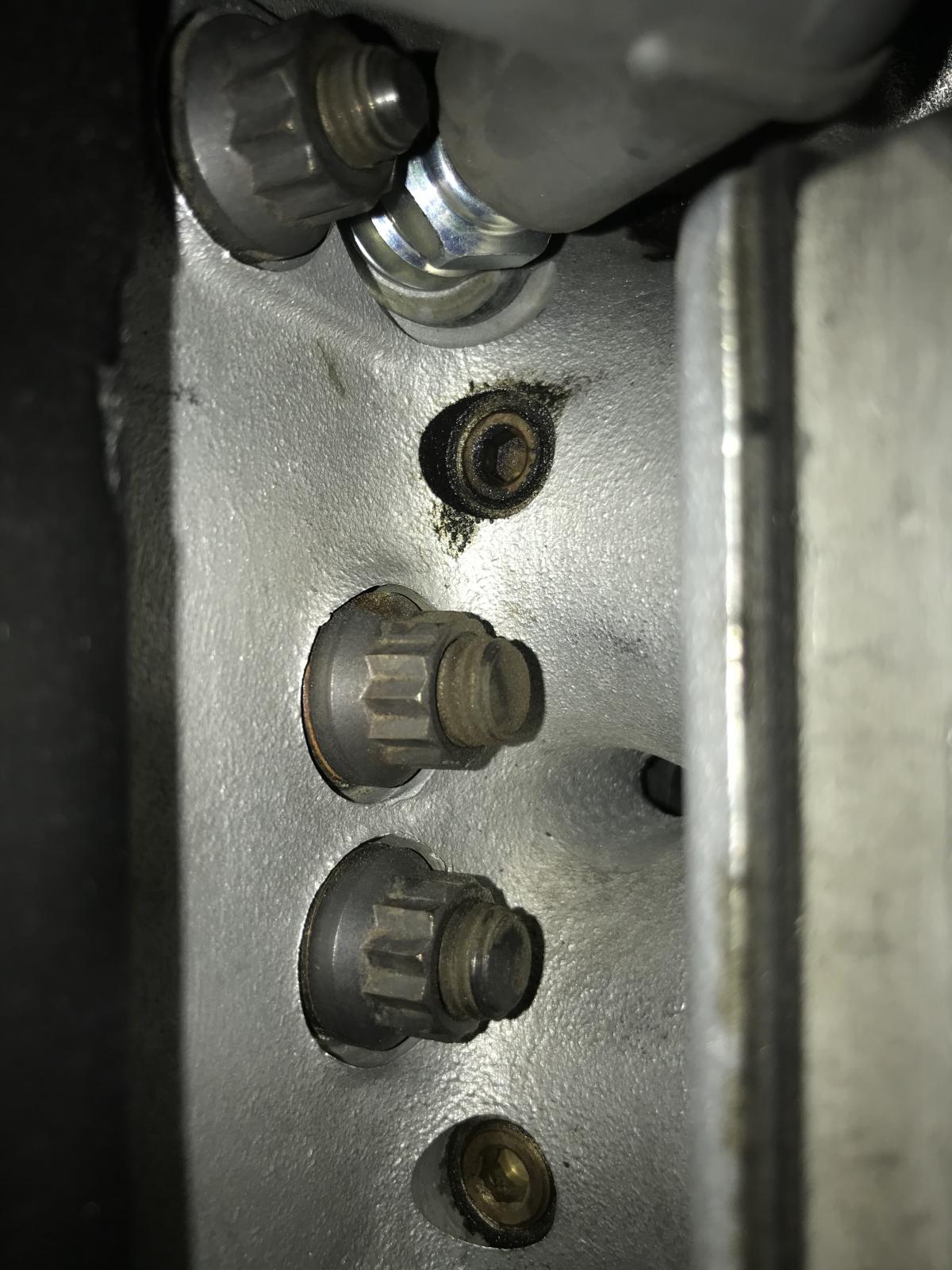
Tom Schuh had 2 sets of injectors on their old motor, one in the manifolds and the second Just above the valve.(see picture, you can see the 1/8" pipe plugs) They were mechanical but it shows how close they were trying to get to the valve.
Their new engine has 3 sets.
|
|
| Back to top |
|
|
HotStreetVw
Samba Member
Joined: October 03, 2004
Posts: 871
Location: Wild West
|
| Posted: Tue Jul 02, 2019 2:38 pm Post subject: Re: Sequential Injection |
|
|
Thanks Steve. Its not a question of running sequential. The car is already running it. But its a different thought process beside running the injectors at 80-90% IDC at peak power. At that point there are no benefits to timing the injection when your spraying fuel for 650 degrees of the cycle, but only moving air for ~280. The goal here is to increase injector size to the point where fuel delivery is over a similar time period as the air flow.
| Steve Arndt wrote: |
| I've ran sequential injection on my 2275 for close to 10 years now. I adjust the injection to coincide with maximum port velocity as best as possible. I also control the timing advance of the fuel event just like an ignition timing table. I advance it as engine speed increases. |
_________________
4inBhore
50 Split - 2724cc NA. Haltech injected
62 Notchback - 2542cc Turbo WIP |
|
| Back to top |
|
|
raygreenwood
Samba Member
Joined: November 24, 2008
Posts: 23509
Location: Oklahoma City
|
| Posted: Tue Jul 02, 2019 6:19 pm Post subject: Re: Sequential Injection |
|
|
| HotStreetVw wrote: |
Thanks Steve. Its not a question of running sequential. The car is already running it. But its a different thought process beside running the injectors at 80-90% IDC at peak power. At that point there are no benefits to timing the injection when your spraying fuel for 650 degrees of the cycle, but only moving air for ~280. The goal here is to increase injector size to the point where fuel delivery is over a similar time period as the air flow.
| Steve Arndt wrote: |
| I've ran sequential injection on my 2275 for close to 10 years now. I adjust the injection to coincide with maximum port velocity as best as possible. I also control the timing advance of the fuel event just like an ignition timing table. I advance it as engine speed increases. |
|
True....to an extent. Yes....if the injector is large enough to accomplish spraying a complete dose....must during the "air moving" part of the cycle.....thats great.....and works.....IF you are racing and at WOT.
But the risk os getting an injector too big....that can only inject so "small" and is uncontrollable for low rpm and part throttle.
So if you were road racing......having two different injectors running different volumes.....load and rpm indexed.....it can be a benefit. Ray |
|
| Back to top |
|
|
Chip 
Samba Member
Joined: July 19, 2008
Posts: 1011
Location: Utah
|
| Posted: Tue Jul 02, 2019 6:37 pm Post subject: Re: Sequential Injection |
|
|
| raygreenwood wrote: |
| HotStreetVw wrote: |
Thanks Steve. Its not a question of running sequential. The car is already running it. But its a different thought process beside running the injectors at 80-90% IDC at peak power. At that point there are no benefits to timing the injection when your spraying fuel for 650 degrees of the cycle, but only moving air for ~280. The goal here is to increase injector size to the point where fuel delivery is over a similar time period as the air flow.
| Steve Arndt wrote: |
| I've ran sequential injection on my 2275 for close to 10 years now. I adjust the injection to coincide with maximum port velocity as best as possible. I also control the timing advance of the fuel event just like an ignition timing table. I advance it as engine speed increases. |
|
True....to an extent. Yes....if the injector is large enough to accomplish spraying a complete dose....must during the "air moving" part of the cycle.....thats great.....and works.....IF you are racing and at WOT.
But the risk os getting an injector too big....that can only inject so "small" and is uncontrollable for low rpm and part throttle.
So if you were road racing......having two different injectors running different volumes.....load and rpm indexed.....it can be a benefit. Ray |
Injectors of today are leaps and bounds better than they were even 10 years ago though. I have a 1000cc set that easily and cleanly idles at a nice very street friendly rpm, but will also support plenty of get up and go when needed. I tried out a set of 2200s recently. Those were a bit much for my setup, even on e85. Granted, I don't think my engine has any compression right now, so it's definitely not at the top of its game. Also, I don't have my injector timing dialed in, and could probably control things even better if I messed with that. That said, 160s would probably be about perfect for me, should be manageable down low, and give me headroom for years. Having to run 2 sets of injectors in order to hit that perfect sweet spot is outdated in my opinion. Buy some big ones and move on. |
|
| Back to top |
|
|
HotStreetVw
Samba Member
Joined: October 03, 2004
Posts: 871
Location: Wild West
|
| Posted: Sun Oct 13, 2019 9:22 am Post subject: Re: Sequential Injection |
|
|
UPDATE
My car has been apart for the last 4 months waiting on 32mm torsion bars from SAW that still haven’t arrived. Quoted 5 weeks, it’s been 15 so far...
So instead of letting the car sit in parts any longer, it’s back together with the 30mm bars, and new injectors. Honestly I missed the hottest part of year here in Texas so it wasn’t a total loss.
Previously it was running Holley 66lb/hr (Bosch EV1 form). I looked at most of the available injectors and mainly due to Made in the USA, and being if EV1 form, I went with Billet Atomizer 160lb/hr, which flow ~168lb/hr, or 1750cc/min for you metric types. They have extended tips that stick into the port slightly (throttle body), with a wide spray pattern. I like this because it’s injecting into the widest cross section (62mm diameter) directly below the throttle plate.
I’ve got idle tuned with no issues. It’s down to a 1.7ms injection time at 950 rpm. I used a lean best idle approach. Reading about .95-.98 lambda. The engine is large cc, and it’s running e85, so it could be really pushing it with less CCs or pump gas.
Haltech allows the user to select start or end of injection time. In this case we will be using end and mapping it in the table as a function of RPM and fuel load. The value is measured in degrees from TDC of compression, so +110 is somewhere around when the intake valve is closing at .050. And +325 is around when the overlap period is over.
Still lots of tuning to do, but I won’t be running out of injector soon.
_________________
4inBhore
50 Split - 2724cc NA. Haltech injected
62 Notchback - 2542cc Turbo WIP |
|
| Back to top |
|
|
|