| Author |
Message |
BreenMachine
Samba Member
Joined: September 14, 2005
Posts: 6
Location: Corvallis Oregon

|
 Posted: Tue Mar 25, 2025 10:51 am Post subject: 6 to 12 Volt Clutch problem Posted: Tue Mar 25, 2025 10:51 am Post subject: 6 to 12 Volt Clutch problem |
 |
|
I know this topic has been covered thousands of times and I've read all the info I can find, I've done this conversion several times in the past, (like 20 years ago so my memory is foggy of the details), but I have an issue with the clutch I can't seem to resolve.
The transmission and engine are original 1200 40hp, I'm installing a later 1600 and have machined the bellhousing, replaced the starter bushing and starter, and installed a new Sachs clutch kit with the center-ring on the pressure plate and corresponding throw-out bearing. The engine was fully installed and running fine however I couldn't adjust the clutch enough to get proper clutch dis-engagement, (meaning excessive pedal free-play and grinding gears).
Measuring the distance from the face of the pressure plate to the engine cases shows a significant difference from the original 6V 180mm plate to the new 12V 200mm plate, I do understand that the later flywheel is recessed where the pressure plate mounts but even that amount isn't enough to explain the difference.
Original 6V shows almost 70mm clutch depth, (The distance into the bell-housing the clutch will sit when installed).
New 12V shows 63mm depth, a significant amount that means I run out cable adjusment
I know that 7mm doesn't seem like much but the clutch release arm magnifies this subtle difference meaning it takes a large amount of adjustment at the cable end. Any insights are very much appreciated.
Last edited by BreenMachine on Wed Mar 26, 2025 6:33 am; edited 1 time in total |
|
| Back to top |
|
 |
MrGoodtunes
Samba Member

Joined: May 14, 2012
Posts: 1055
Location: South Florida
|
| Posted: Tue Mar 25, 2025 1:56 pm Post subject: Re: 6 to 12 Volt Clutch problem |
|
|
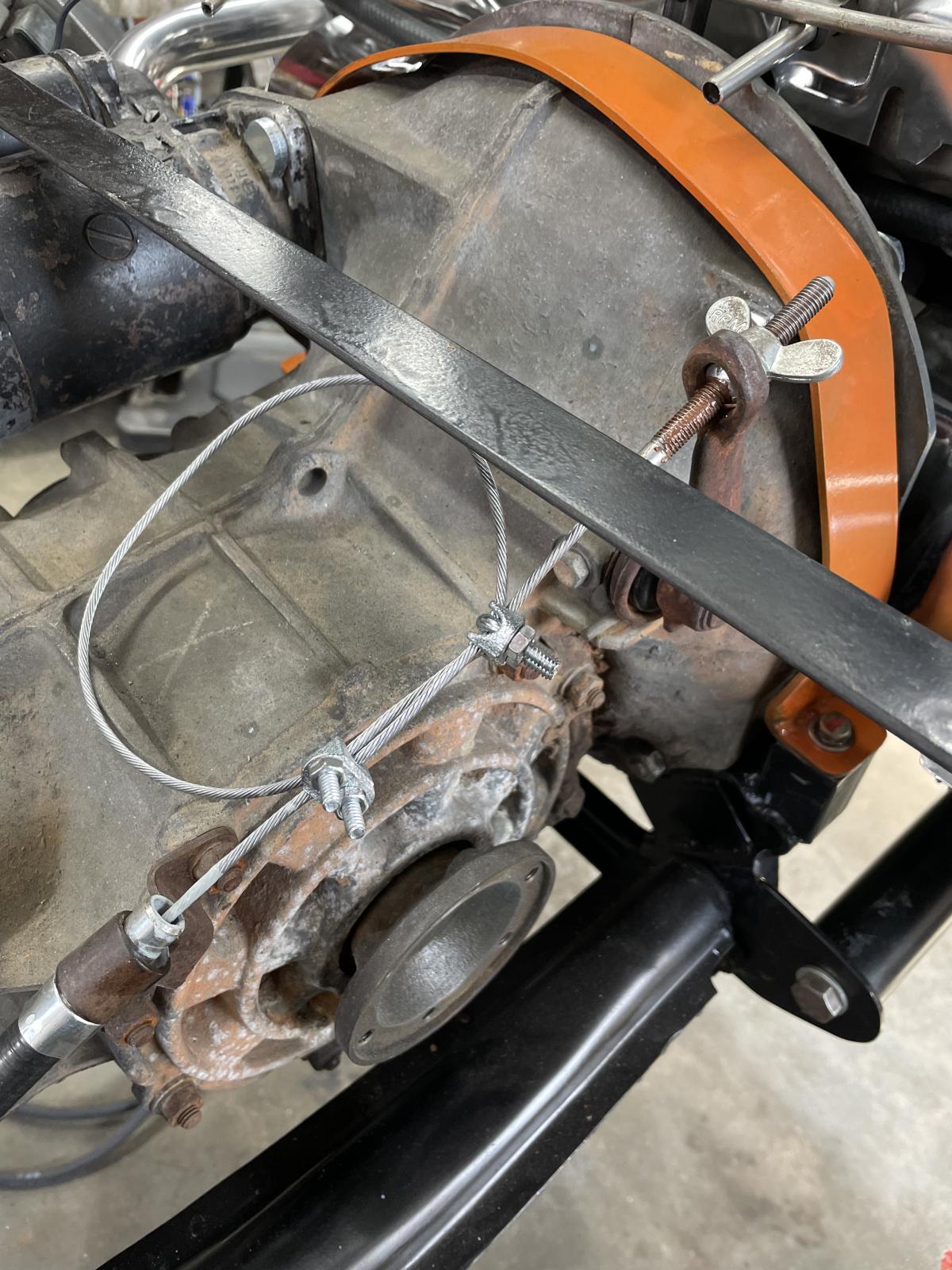
You could try putting a loop in clutch cable; like this, but not nearly as big a loop:
Something tells me this will not solve the problem, 'cuz you already may be pulling the throw-out shaft arm as far as it will go? |
|
| Back to top |
|
|
rcooled
Samba Member

Joined: September 20, 2008
Posts: 2845
Location: Santa Cruz, CA
|
| Posted: Tue Mar 25, 2025 4:02 pm Post subject: Re: 6 to 12 Volt Clutch problem |
|
|
Do you have the proper slack in the Bowden tube?
Clutch cables are available in several different lengths depending on application...try using a shorter one.
_________________
'63 Ragtop (current)
'65 Ghia coupe (totaled)
'67 Ghia convertible (current)
'69.5 Ghia convertible and
'62, '63, '65, '69 Bugs (all long gone) |
|
| Back to top |
|
|
BreenMachine
Samba Member
Joined: September 14, 2005
Posts: 6
Location: Corvallis Oregon
|
| Posted: Wed Mar 26, 2025 6:31 am Post subject: Re: 6 to 12 Volt Clutch problem |
|
|
Thanks for the replies, unfortunately as MrGoodtunes mentioned I'm near the end of the throw-out arm's usable travel. In the picture below the blue line represents where the arm is when I adjust it so that the throw out bearing is almost in contact with the pressure-plate, the red line represents 90-degrees between the arm and clutch cable, this being the shortest distance from the bowden tube outlet and the arm, the maximum amount that can be pulled.
I'm stumped because the only solution I can think of is some kind of additional spacer between the throw-out bearing and the pressure plate, like another 8mm of center-ring is needed. I compared another 12V engine I had lying around and it too measures 63mm from pressure-plate to case.
|
|
| Back to top |
|
|
MrGoodtunes
Samba Member
Joined: May 14, 2012
Posts: 1055
Location: South Florida
|
| Posted: Wed Mar 26, 2025 5:19 pm Post subject: Re: 6 to 12 Volt Clutch problem |
|
|
A couple thoughts: (1) Could your new clutch disk be overly thick? And (2) Might your new 12v pressure plate, with it's late multiple finger'd flange style springs, be that different from the early 3-spoke 12v pressure plate? This pic compares 6v (left) to early 12v (right).
|
|
| Back to top |
|
|
VW_Jimbo 
Samba Member

Joined: May 22, 2016
Posts: 11437
Location: Huntington Beach, CA
|
| Posted: Wed Mar 26, 2025 5:33 pm Post subject: Re: 6 to 12 Volt Clutch problem |
|
|
If I am reading this right, you need a longer clutch cable. What length cable do you have now?
_________________
Jimbo
There is never enough time to do it right the first time, but all the time necessary the second time!
| TDCTDI wrote: |
| Basically, a whole bunch of fuckery to achieve a look. |
| 67rustavenger wrote: |
GFY's Xevin and VW_Jimbo!  |
|
|
| Back to top |
|
|
MrGoodtunes
Samba Member
Joined: May 14, 2012
Posts: 1055
Location: South Florida
|
| Posted: Wed Mar 26, 2025 6:49 pm Post subject: Re: 6 to 12 Volt Clutch problem |
|
|
And, a 3rd thought:
| BreenMachine wrote: |
| ... I do understand that the later flywheel is recessed where the pressure plate mounts but even that amount isn't enough to explain the difference ... |
Might your flywheel be lighten'd or otherwise machined, and is there any issue between flywheel & crankshaft? |
|
| Back to top |
|
|
ashman40
Samba Member

Joined: February 16, 2007
Posts: 16756
Location: North Florida, USA
|
| Posted: Wed Mar 26, 2025 10:48 pm Post subject: Re: 6 to 12 Volt Clutch problem |
|
|
Two dimensional reasons I can think of...
1) Clutch disc itself is too thick. This causes the pressure plate springs to compress too much bringing the TO bearing surface (ring) closer to the flywheel. There was a problem from years back where clutch discs coming from overseas were too thick out of the box.
2) The PP mounting surface to clutch surface on the flywheel are not within spec. Unlike many other cars where the pressure plate mounts to the same flat surface the clutch disc is pressed against and resurfacing the face of the flywheel automatically adjusts the PP mounting surface too... ACVW flywheels have two separate surfaces. The clutch friction surface of the flywheel wears over time. When you take it to a machine shop to resurface the face of the flywheel the shop must also remember to cut the PP mounting lip to maintain the proper height above the friction surface. When these are allowed to slide out of spec the result is the TO bearing contact/ring point changes.
Normally this is a problem the other way... the two surfaces are too far apart because the friction surface was cut but the PP mounting lip was not and the TO bearing ring sits too close to the TO bearing and they never separate.
But in your case, it sounds like the two surfaces are too close together. That could only really happen if the flywheel PP mounting surface was cut too much.
Give this thread a read for the spec:
https://www.thesamba.com/vw/forum/viewtopic.php?p=7451260
_________________
AshMan40
---------------------------
'67 Beetle #1 {project car that never made it to the road  } }
'75 Beetle 1200LS (RHD Japan model) {junked due to frame rot}
'67 Beetle #2 {2019 project car - Wish me luck!} |
|
| Back to top |
|
|
|